

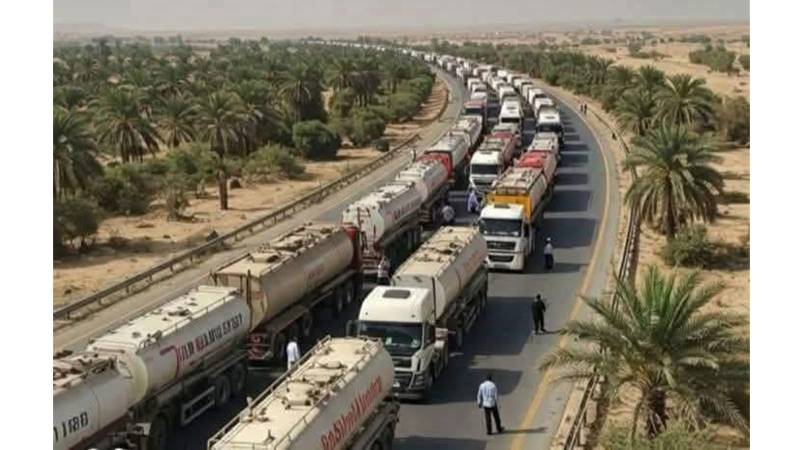
Last week, a friend from London asked me a simple question that lingered in my mind: “What is so remarkable about the Sindhis’ struggle?” After a pause, she suggested that the Babarloi Dharna might help me answer.
Her question is worthy of reflection. But before I attempt an answer, I must first pay tribute to GM Syed, whom many Sindhis regard as their foremost modern political thinker. Much of what Sindhis behold in Sindh today echoes the ideas he set forth decades ago. He gave voice to the belief that Sindhis are a nation. That Sindh is their motherland. That its resources belong to its people. That Sindh entered the federation of its own will. And that its people have the right to determine their own destiny.
The recent debate in the Sindh Assembly may be read in the light of Syed’s Sindhu Ji Sanjah (The Wisdom of the Indus), written in the late 1970s. Syed beheld Sindh as a civilisation. Through the ages, many faiths passed through its gates. Even so, Sindh lost not itself. It received these influences and made them part of its inheritance. The Geeta, the Ramayana, the Bible, the Old Testament, the Qur’an, and other traditions entered its intellectual life. They enriched its culture without erasing its character.
Thus, the banners raised in the Sindh Assembly bearing the words “Dharti Maa Ahe,” Earth/Sindh is mother, proclaim more than a political message. They speak of an ancient bond between Sindh and her people. The words reach beyond the coming of Bin Qasim. They evoke older civilisations, faiths, and traditions in which the earth was held sacred.
GM Syed gave this inherited consciousness a modern political language. He taught generations to behold Sindh as mother, beloved, and sacred inheritance. For him, Sindh was ishq.
Here, then, I may begin to answer my friend’s question.
The Babarloi Dharna, held at the Babarloi Bypass near Sukkur in Khairpur Mirs’ Districts, began on the 18th of April 2025. It arose in response to the federal government’s plan to construct six new canals from the Indus River. Sindh’s political parties, lawyers, civil society groups, and citizens viewed the plan as a threat to the province’s share of Indus waters and to the future of its agriculture and people.
The All-Sindh Lawyers Action Committee took the lead in organising the protest. The Sindh United Party (SUP) also played an important role in mobilising political workers, bringing its organisational network into the movement and helping sustain the momentum.
Thus, Babarloi was not merely a protest at a roadside. It became a collective stand over the river upon which Sindh’s life, agriculture, and civilisation have long depended. The protest soon moved beyond the Dharna and entered the daily life of Sindh.
At Babarloi, the struggle did not arise from the wadero, the sardar, or the great political parties. None came forth to lead it. It rose from the middle class and the lower-middle class.
Lawyers, teachers, doctors, writers, activists, students, traders, and other professionals left their workplaces and homes and gathered by the roadside. They brought neither wealth nor political power. They brought their education, their convictions, and their concern for Sindh and the Indus.
For twelve days, the highway became their place of assembly. They spoke, organised, endured, and held their ground. Thus did Babarloi reveal a new force in Sindh’s political life: ordinary professionals who came forth not under the command of the powerful, but by the strength of their own conviction.
When Culture Became a Language of Resistance
Around the world, political parties and ordinary people have turned to culture to resist injustice. In India and South Africa, as in many other lands, songs, symbols, art, and everyday objects have become instruments of protest. Where the voice is constrained, culture often finds another way to speak.
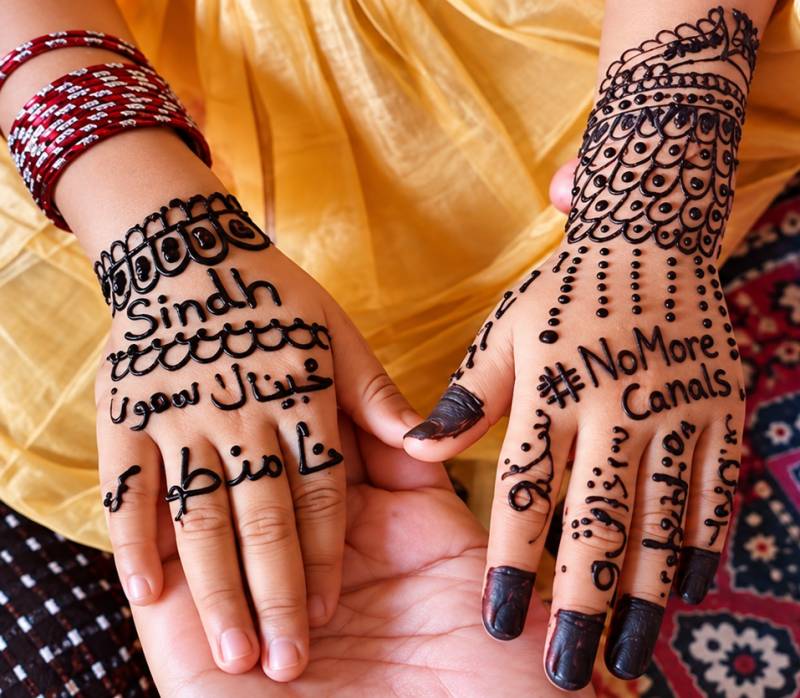
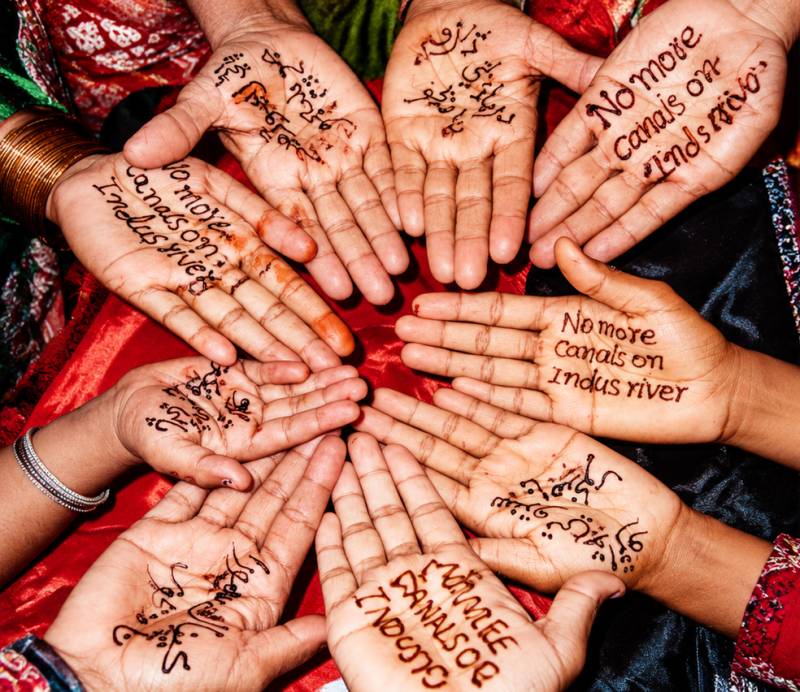
So it was at Babarloi. Soon after the Dharna began, Eid came upon the land. Young women adorned their hands with henna. Yet among the flowers and patterns appeared the words “No More Canals on the Indus.” Their arms and palms became banners.
Resistance had entered ordinary life. What began at the roadside had found expression in the daily life of the people.
At Babarloi, people came from different political parties, professions, and walks of life. Lawyers stood alongside activists. Professionals stood alongside members of civil society. The middle class formed a significant part of the gathering.
They did not come because they shared every political belief. They came because they believed that the waters of the Indus concerned the future of Sindh.
One issue stood before them, and around it they gathered. The road became a meeting ground where differences could be set aside without being denied. Babarloi showed that people need not share every political belief to stand together for a common cause.
Young women adorned their hands with henna – but among the flowers and patterns appeared the words 'No More Canals on the Indus’
The language of Babarloi carried the message of resistance. Many contemporary slogans condemn injustice without naming the power against which they are raised. The slogans heard at Babarloi were more direct. Two rang through the Dharna: “Punjab, Tusan Jhero Aa”—Punjab, we will fight you—and “Wafaq, Tusan Jhero Aa”—Federation, we will fight you.
The words did more than express anger. They named the adversary and drew a line of political confrontation. The people were no longer speaking into the air. They were addressing power itself. The slogan became an address, and the address became a declaration: we know whom we challenge, and we shall not be silent.
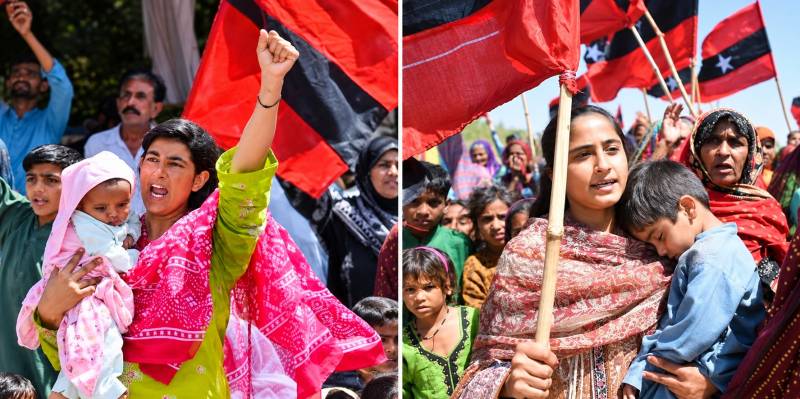
Within days, Babarloi became a movement of the whole people. Men and women, young and old, stood together with one purpose: “No more canals.”
The old footage of the Dharna bears witness to their presence. Men, women, youth, and children gathered there in great numbers. Many came from the neighbouring villages of Sukkur and Khairpur Mirs districts. Others travelled from far beyond. People came from Jacobabad, Shikarpur, Karachi, Badin, and Tharparkar. Some arrived in hired buses. Others came in their own cars.
At Babarloi, differences of place, class, and political background receded. What remained was a common purpose and one political cry: “No more canals.”
Sindhyani Tehreek, Salt of Sindh
The Sindhyani Tehreek, the women’s front of the Awami Tehreek, holds a distinctive place in the political history of Sindh. Rasool Bux Palijo organised it with a vision that was far ahead of its time. He understood that no movement could become a movement of the people while women remained at its margins. He called them “Wadhan Waran Wari Foj”—an army with long hair.
At Babarloi, the continued presence of the Sindhyani Tehreek breathed new spirit into the struggle. Their courage encouraged other women to come forth. Soon, women from social organisations and literary circles began to join the Dharna. Many were teachers. Others were low-paid employees of the health department. They came knowing that their participation might carry a price.
The following day, many were penalised and had their salaries deducted. Yet they did not retreat. Their numbers grew.
The women of the Sindhyani Tehreek changed the character of the Dharna. They showed that the struggle for Sindh’s water belonged to women and men alike. They endured the consequences and returned. Thus, did they become the salt of Sindh, preserving the spirit of resistance and giving new life to the struggle.
Those who understand the geography of Sindh know that the land is largely a great plain. Across this plain run its chief arteries of communication. The national highway and the railway bind Karachi and its port with Lahore and Peshawar, and with routes leading towards Kabul, Kandahar, and Central Asia. Towns and villages stand along these arteries.
The people who dwell along these routes may cast their votes for different political parties. Yet, when the interests of Sindh are at stake, they can stand upon common ground. They understand that strength lies in its geography.
The Dharna at Babarloi junction revealed this geographical consciousness. Its closure turned the junction into a strategic point of peaceful political action. Some trucks and buses sought other routes to the national highway. But people from surrounding villages and towns gathered and closed the link roads. The wider geography of the protest thus came into play.
Babarloi became more than a place upon the road. It became a junction where geography and political purpose met. The All-Sindh Lawyers Action Committee understood the significance of the site and gave that geography political force.
Babarloi revealed a simple truth: when geographical consciousness joins political purpose, a place on the map can become a powerful centre of peaceful resistance.
The Road Became a Table for All
The Babarloi Dharna revealed another strength of the Sindhi struggle: its spirit of hospitality. Political movements often depend upon their organisers for transport, food, and shelter. At Babarloi, the people themselves took up this burden.
The people of the surrounding villages opened their homes and brought food, water, and whatever else was needed. Breakfast was served in the morning. Lunch followed. Dinner came at night. The food was offered to all who came.
Even people from distant towns joined this act of hospitality. From Sanghar and Tando Adam came quilts, tents, and pillows. Others brought drinking water. Mineral water was supplied in large quantities beneath the April sun of northern Sindh.
Local vendors also became part of the scene. One brought gulab-water and sprinkled it among the people to ease the heat and refresh those who had gathered.
Thus, the roadside became a place of sharing. Food passed from hand to hand. Water was given to the thirsty. Shelter was offered to the stranger. For a time, the road itself became a grand bazaar of food and fellowship.
Song and Dance Became Resistance
Within days, Babarloi was no longer merely a place of protest. It had become a living gathering. At the central stage, speakers rose one after another. Their voices carried across the Dharna. They spoke against what they saw as the injustice of the federation, the unequal treatment of the smaller provinces, and the failures of the state.
Around the Dharna, smaller circles came alive. Here a poet recited verses. There a singer raised his voice. Nearby, people danced to the beat of the dhol. Poetry, song, and dance filled the gathering.
The poets gave the struggle its words. The singers gave it a voice. The dancers gave it movement. For a while, protest and celebration stood together. The people expressed their anger without surrendering their joy.
Political groups also brought their literature and placed it in the hands of the people. A passer-by could stop, listen to a speech, hear a song, watch a dance, and leave with a pamphlet in his hand.
Babarloi became a living theatre of resistance. The people came to protest, but they also came to speak, sing, dance, read, and gather strength together.
The Books Went Among the People
Sindh’s political struggle has never been a stranger to books. Reading has travelled wherever people have gathered to resist. In prison, study circles have risen behind walls. In the streets, books have travelled with protesters. At celebrations, birthdays, and death anniversaries, people have gathered not only to remember but also to read. Even at the Dharna, books have found their place. Babarloi was no exception.
Alongside the banners, tents, and gathering crowds, bookstalls appeared. Professional publishers and lovers of books brought their collections and set up makeshift stalls beside the Dharna. Though simple, the stalls remained open day and night.
The stalls carried literature, history, poetry, and other writings. Political literature held a prominent place. Books on Sindh’s history, politics, national question, and long struggle stood among the collections. The written word thus became another voice of Babarloi.
The Sindhi political tradition has not been sustained by speeches and slogans alone. It has also lived through reading, discussion, and the circulation of ideas. A slogan may stir a crowd for a moment. A book can remain with a person for years.
At Babarloi, the road became a place of protest and learning. The people gathered around the written word as they gathered around the cause.
Holding the Road, Harming None, a New Culture of Protest
Every roadblock brings traffic to a standstill. So it was at Babarloi. For twelve days, the national highway was closed, and a great multitude of trucks, trailers, and loaders stood in long rows beneath the April sun.
Ambulances and vehicles carrying essential services were given passage. The others remained where they were, for the road had become the ground of protest.
One journalist estimated that between 35,000 and 40,000 heavy vehicles were held up during those twelve days. Another independent estimate placed the value of the goods carried by each vehicle at around Rs. 10 million. By that measure, goods worth nearly Rs. 500 billion remained upon the highway.
And behold, though the vehicles stood within reach, no one laid hands upon their cargo. No goods were taken. No driver was harassed. No cleaner was threatened. The property of strangers remained safe.
In some places, the people did more. They gave food and water to the drivers and their helpers. Those stranded upon the road were treated not as enemies, but as fellow human beings.
Thus did Babarloi reveal the discipline of peaceful resistance. The people held the road, yet guarded what was not theirs. They resisted power without forsaking restraint. Their protest was firm, but their conduct remained humane.
And herein lies the lesson of Babarloi: to resist injustice without becoming unjust.
Ishq for Sindh, the Heart of the Sindhis’ Struggle
The above is my response to my friend’s question. The story of the Babarloi Dharna shows how the Sindhis’ peaceful struggle has acquired a character of its own. I am grateful to her for allowing me to use Babarloi as an example.
At the beginning of this essay, I spoke of Sindh as ishq, a love rooted in the hearts of its people and carried from one generation to another. A story shared by my friend Muban Mangrio brings this idea to life.
In the 1990s, the agencies picked up Abdul Wahid Arisar, then chairman of Jeay Sindh Mahaz, a political organisation inspired by the ideas of GM Syed and committed to an independent Sindh. When Arisar later met Syed, the ageing leader looked at him and said, “Thank God, you are still alive.”
Nisar Hakro, a leader of Mahaz, who was present, replied, “Not only is he alive. He has kept his iman alive.”
Syed fell silent. Then he recited a verse by Sultan Bahu, the great Punjabi Sufi poet:
“ایمان سلامت ہر کوئی منگے، عشق سلامت کوئی ہو” Imaan salamat har koi mange, ishq salamat koi ho, Everyone seeks the preservation of faith. But who seeks the preservation of love?”
In these few words lies a wisdom of endurance. Ishq gives the heart strength to remain steadfast. Perhaps this was what Sindh meant to Syed. It was a beloved entrusted to the heart. He made Sindh part of his ishq, and thus part of his very self. For what the heart holds as a sacred trust is not easily forgotten.