

Over the past few days, social media has been flooded with one question: "Why don't Pakistani students protest?" The question has gained momentum as many Pakistanis watched students in India occupy streets and university campuses. The underlying assumption is that Pakistani students have somehow become politically indifferent, unwilling to challenge authority or organise collectively.
History tells a different story. For decades, students were not merely participants in Pakistani politics - they were among its principal architects. Whether it was the Democratic Students Federation (DSF), the National Students Federation (NSF), Islami Jamiat-e-Talaba (IJT), Peoples Students Federation (PSF), APMSO or countless smaller organisations, university campuses were once among the country's most vibrant political spaces. Students represented every ideological persuasion. They disagreed fiercely, organised campaigns, debated ideas, mobilised supporters and, in the process, learnt politics.
The student movements of the late 1960s became central to the agitation against Field Marshal Ayub Khan. During General Zia-ul-Haq's dictatorship, when censorship was severe, political parties were restricted and dissent invited imprisonment, students continued organising and resisting. They did so without social media, without independent television channels and without the digital tools that many today consider indispensable for mobilisation.
Student politics did not produce ideological uniformity. It produced political leadership. Which brings us to a more important question. What happened to student politics? The answer lies not in the attitudes of today's students but in the dismantling of the institutions that once nurtured them. The ban on student unions is often remembered as a measure to curb campus violence. Its consequences were far deeper.
Student unions were never merely about campus elections. They were schools of politics. They taught negotiation, organisation, coalition-building, public speaking, campaigning, accountability and leadership. They exposed young people to competing ideas long before they entered provincial assemblies or parliament.
When those institutions disappeared, Pakistan did not simply lose student elections. It lost one of its most important training grounds for democratic politics. Today another argument dominates social media. That the Pakistani state has become so powerful that no meaningful movement can survive. Activists, we are told, risk being picked up in the now infamous Kaala Daala or Vigo merely for speaking out. The fear is real. But political movements have rarely emerged under comfortable conditions.
Pakistan has lived through periods of far harsher authoritarianism. Ayub Khan's military government and particularly General Zia-ul-Haq's dictatorship exercised far greater control over political life than many young Pakistanis have experienced. Yet those periods still produced some of Pakistan's strongest student movements. It would be great injustice to not name the Legends of 1960s such as Ameer Haider Kazmi, Mairaj Muhammad Khan, Ali Mukhtar Rizvi who looked straight in the eyes of then dictators forgetting the consequences.
The state was not weaker. Society was stronger. Students had unions. Campuses had politics. People had institutions through which they could organise. Even the protests we are currently comparing ourselves with have unfolded under heavy state scrutiny. Reports from India have documented surveillance measures, including the use of facial-recognition technology to identify protesters. State pressure is not unique to Pakistan. It is a challenge - movements across the world have historically confronted. What I find more revealing is the selective nature of this argument.
Many of those who today present state repression as the sole explanation for the absence of student movements were, until only a few years ago, among the strongest defenders of the very establishment they now criticise. During Imran Khan's government, journalists complained of pressure, dissent was curtailed, and student marches demanding the restoration of student unions received little sympathy from many of the same political spaces that today lament the absence of student activism. The Lahore Student March in 2019, remembered by many for activist Arooj Aurangzeb's recitation of Sarfaroshi Ki Tamanna Ab Hamare Dil Mein Hai, was mocked by sections of social media rather than embraced.
Support for student politics cannot depend on who occupies the Prime Minister's House. If it does, then the commitment is not to student politics. It is to political convenience.
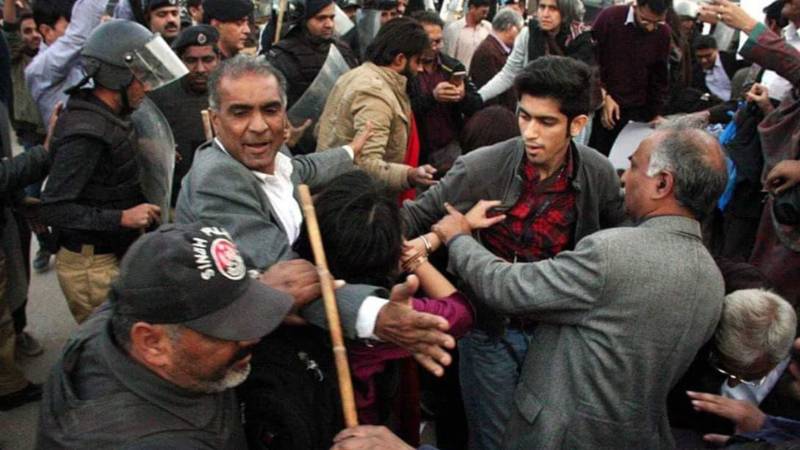
I was reminded of this while revisiting photographs in my phone from January 2017. They were taken during protests demanding the safe recovery of the disappeared bloggers and activists Salman Haider, Waqas Goraya and Asim Saeed. By then, religious groups had accused the missing bloggers of blasphemy. Those demanding their recovery were themselves branded sympathisers. I was there as a journalist covering the demonstration.
The protest quickly descended into violence. Police baton-charged demonstrators. On the other side, supporters of Tehreek-e-Labbaik Pakistan (TLP) and other religious groups, mobilised around the blasphemy allegations, charged towards the protesters. For many of us, there was nowhere to retreat. Those events were covered internationally, including by Al Jazeera. I do not share those photographs to romanticise the past or suggest that previous generations possessed greater courage. I share them because archives often remember what public debate forgets. Another aspect of this conversation deserves equal attention. It is remarkable how little Pakistan's mainstream political parties speak about reviving student unions.
Bilawal Bhutto Zardari leads a party whose history is inseparable from student mobilisation. His mother, Benazir Bhutto, became the first Asian woman to serve as President of the Oxford Union, one of the world's most prestigious student debating institutions. Yet in recent years, the Pakistan Peoples Party has rarely made the restoration of student unions a meaningful political priority, nor has it taken any substantial steps towards their revival. To its credit, however, the party has continued to bring leaders shaped by student politics into Parliament. Among the most notable examples are the late Jehangir Badar and Senator Masroor Ahsan, both of whom carried the experience of campus politics into national politics.
MQM traces its own origins to the All Pakistan Muhajir Students Organisation (APMSO), perhaps Pakistan's most successful example of a student movement evolving into a major political party. Yet even it no longer speaks of restoring the culture that gave it birth. Many of its senior leaders, including Haider Rizvi and Faisal Sabzwari, demonstrated a level of parliamentary debate and political articulation that reflected years of training within student politics. Such political maturity is rarely cultivated overnight; it is nurtured through the ecosystem of organised campus politics.
Imran Khan built perhaps the largest youth following any Pakistani politician has enjoyed in decades. Yet despite repeatedly speaking of political reform, the restoration of student unions never became part of that vision. Ironically, many of those who have stood by him during his most difficult political moments are themselves products of student politics, including the current Chief Minister of Khyber Pakhtunkhwa, Suhail Afridi. It is a reminder that organised student politics has long served as a training ground for political leadership, even for those who later rise to the highest offices.
As for PML-N, it has shown little sustained interest in strengthening student unions, or, for that matter, local governments, the institutions closest to ordinary citizens. Yet even within its ranks are Senator Pervaiz Rasheed, Khawaja Saad Rafique and Javed Hashmi - the most prominent student leaders of their generation. Throughout their political career, they repeatedly demonstrated resilience in the face of state repression. Despite that legacy, their party has never meaningfully championed the restoration of student unions.
The silence is bipartisan. And perhaps deliberate. Because political parties today no longer seem interested in politically educated students. They are interested in politically loyal youth. There is an important difference. Student politics produces debaters. Today's political culture often produces digital warriors. Young people are increasingly valued not for their ability to question their own leadership but for their willingness to defend it online, trend hashtags, attack opponents and amplify party narratives. Student unions encouraged disagreement. Social media armies often reward conformity. A student activist questioned ideas. A digital foot soldier is often expected to defend personalities. We have reached a point where sections of our political youth spend as much time celebrating the private lives of political leaders as they do discussing public policy.
That is not political education. It is personality cult. Student unions are only one part of a much larger democratic ecosystem. Alongside labour unions, bar associations, local governments and other representative institutions, they form the foundations from which democratic politics grows. They produce politicians before parliament ever does. They expose future legislators to ordinary citizens before they become ministers. When these institutions weaken, the pathways into politics narrow. Leadership increasingly comes through inheritance, wealth, patronage or existing power structures rather than grassroots political organisation. Parliament then begins to reflect those pathways.
One is left wondering: when was the last time our legislature passed a law that fundamentally transformed the everyday lives of ordinary Pakistanis? The question is not meant to dismiss every piece of legislation enacted over the years, but to ask why our parliamentary debates so often appear detached from the lived realities of the people they represent. Even today, I occasionally watch legislators such as PPP's Masroor Ahsan and Waqar Mehdi, or MQM's Farooq Sattar, challenge the Chair simply to secure a few minutes to raise issues such as prolonged loadshedding, inflation, unemployment, housing and human rights. The fact that representatives must struggle merely to draw attention to these everyday concerns says much about the priorities that increasingly dominate our legislatures.
Perhaps that distance begins long before anyone enters parliament. Perhaps it begins when the institutions that once connected politics to society are allowed to disappear. So the next time someone asks why Pakistani students no longer protest, I think they are asking the wrong question. The better question is: How can we expect organised student movements after spending decades dismantling organised student politics? Pakistan did not merely ban student unions. It dismantled one of its most important schools of democracy.