

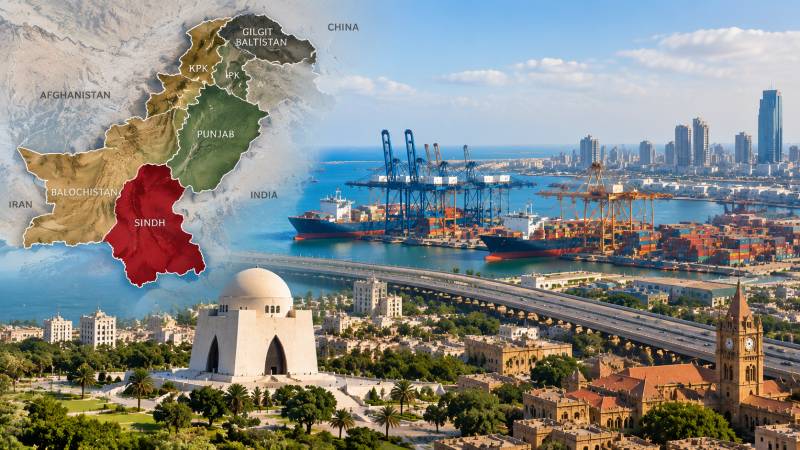
The question of creating new provinces in Pakistan is becoming increasingly controversial. In Sindh, in particular, there is strong political resistance to the creation of new provinces, especially to any administrative or political division of Sindh. The question is: why is the resistance to this issue so strong in Sindh? Is it based merely on linguistic sentiments, or is it rooted in a complex combination of Sindh’s history, national consciousness, concerns about the federal structure, and the historical promises associated with the creation of Pakistan? To understand Sindh’s resistance, it is necessary to examine all these dimensions together and in a critical manner.
One strong political perception in Sindh is that the question of dividing the province is not merely related to administrative requirements; rather, there may also be maritime and geostrategic interests behind it. Karachi’s geographical position, its access to the Arabian Sea, its port, maritime trade, and its proximity to the Persian Gulf give it exceptional strategic importance. Some Sindhi political circles have expressed concern that separating Karachi from Sindh could create new possibilities for international and regional powers in relation to maritime interests. Although such concerns should be treated as political assumptions rather than established facts, the maritime and geopolitical significance of Sindh cannot be ignored. Therefore, any proposal concerning the division of Sindh should be examined not merely in terms of administrative necessity, but also within its broader regional and global context.
Another important reason for resistance to new provinces in Sindh is the major transformation that took place in the province’s demographic structure after 1947. Following Partition, a large number of Muslims who migrated from India settled in the major cities of Sindh, particularly Karachi and Hyderabad. This migration brought fundamental changes to the linguistic, economic, and political structure of Sindh’s urban society. Over time, conflicts emerged between Sindhi- and Urdu-speaking populations over political representation, employment, urban resources, language, and political power. The politics of the Muttahida Qaumi Movement (MQM) remained an important political expression of this conflict. The demand for a separate administrative or provincial status for Karachi has therefore remained an extremely sensitive issue in Sindhi nationalist politics. Consequently, the debate over new provinces in Sindh is not viewed merely as a question of administrative reform; it has become closely associated with the future of Karachi and the territorial unity of Sindh.
The stronger argument from Sindh should not be that ‘Sindh can never be divided,’ but rather that ‘Sindh cannot be divided without the clear consent of its people.
Another important reason for opposition to new provinces in Sindh is Sindh’s historical and national consciousness. For many Sindhis, Sindh is not merely an administrative unit of Pakistan but a land possessing a long historical, cultural, and geographical continuity. From Mohenjo-daro and the Indus Valley Civilization to the Sindhi language, literature, culture, Sufi traditions, and historical experiences, numerous elements have played an important role in the formation of modern Sindhi identity. Consequently, many people perceive the division of Sindh not simply as a change in administrative boundaries, but as a process that could affect collective memory, cultural unity, and political identity. An important basis of resistance in Sindh is the perception that the idea of division is being advanced as a political project imposed from above rather than one emerging from local consent. Therefore, the stronger democratic argument from Sindh should be that the division of Sindh cannot take place without the clear consent of its people.
Sindh’s organised political consciousness and national awareness should also be regarded as important causes of this resistance. From the British period onward, questions concerning Sindh’s separation from the Bombay Presidency, the Sindhi language, land, rivers, resources, and political autonomy remained part of Sindh’s political discourse. Even after Sindh attained separate provincial status from the Bombay Presidency in 1936, the question of Sindh’s political identity did not disappear. After the creation of Pakistan, it became more closely connected with federalism, provincial autonomy, and the distribution of resources. Although different political groups in Sindh have held different positions, there has been considerable agreement among many of them on the question of the territorial unity of Sindh.
An important political and constitutional argument against the creation of new provinces in Sindh is also associated with the Lahore Resolution of 1940. A significant section of Sindhi political circles associates the creation of Pakistan with a federal conception under which the constituent units joining Pakistan were expected to enjoy autonomy. Here, however, an important historical clarification is necessary: the word “Pakistan” itself did not appear in the Lahore Resolution of 23 March 1940. The resolution spoke of grouping the Muslim-majority areas into “independent states” and granting their “constituent units” autonomous status. Therefore, interpreting the resolution as a direct and complete constitutional agreement concerning the present structure of Pakistan represents a particular political interpretation. Nevertheless, it is also true that the questions of provincial autonomy and the federal structure were extremely important during the Pakistan Movement. Therefore, the stronger argument from Sindh should not be that “Sindh can never be divided,” but rather that “Sindh cannot be divided without the clear consent of its people.”
An important dimension of the debate over the division of Sindh is also the province’s internal class contradictions. Landlords, feudal elites, capitalists, urban business classes, the middle class, peasants, and workers in Sindh do not share identical economic interests. The economic interests of a Sindhi worker and those of a Sindhi feudal landlord are not necessarily the same in every matter. From a Marxist perspective, the fundamental question is: who controls Sindh’s land, water, industries, ports, cities, and natural resources, and how is the wealth generated from these resources distributed? The defence of Sindh’s territorial unity and the struggle against class exploitation are not necessarily contradictory questions. If the national question is reduced merely to the question of linguistic or national unity, the class relations of power existing within society remain concealed. From a Marxist perspective, the national question can become an instrument serving the interests of the ruling classes if it is separated from the class question. Conversely, by linking national rights with economic justice, the interests of ordinary people, peasants, and workers can be placed at the centre of the political struggle.
The question of creating new provinces in Pakistan is therefore not merely a question of administrative efficiency. It contains multiple layers involving history, nationalism, linguistic identity, the distribution of resources, urban political power, class interests, and trust in the federal structure. To describe Sindh’s resistance to new provinces merely as emotional nationalism would be to overlook its historical and material foundations. At the same time, treating the defence of Sindh’s territorial unity as something above and beyond class contradictions would also fail to present the complete picture. It is therefore necessary to understand Sindh’s national identity and class interests not as mutually opposed forces, but as interconnected processes that must be examined together.