

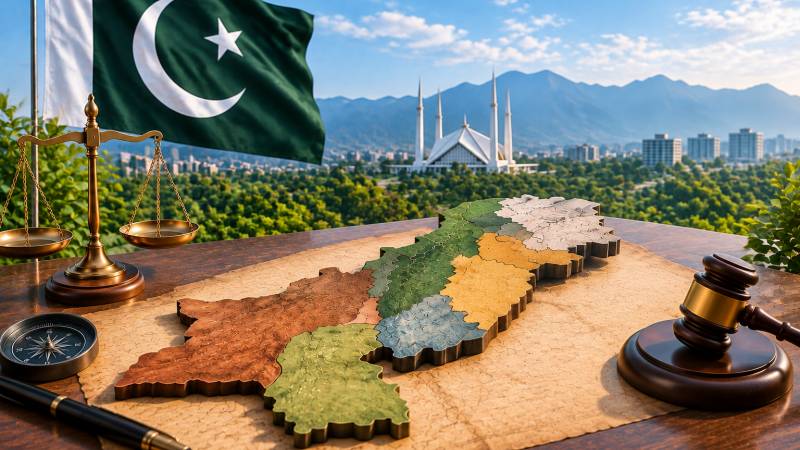
Pakistan’s history reflects a persistent tension between its ethno-geographic diversity and institutional centralization. From the integration of princely states after independence to today’s debate over territorial restructuring, the state has repeatedly recalibrated the relationship between the centre and its constituent units. The debate over subdividing provinces should therefore be viewed not as an isolated administrative proposal but as part of Pakistan’s continuing struggle to make federalism work.
At independence in 1947, Pakistan inherited a heterogeneous territorial landscape. Alongside British-administered provinces, a dozen princely states, including Bahawalpur, Khairpur, Kalat, Swat, Dir, and Chitral, acceded to Pakistan between 1947 and 1948. This early phase involved negotiated and, in some cases, asymmetrical arrangements rather than uniform integration. Instead of institutionalizing this diversity within a coherent federal framework, however, the state gradually moved towards centralization.
The turning point came in 1955 with the imposition of the One Unit scheme. By amalgamating the western provinces and princely states into a single political entity, the scheme sought administrative parity with East Pakistan while effectively neutralizing its demographic majority. It also suppressed the distinct constitutional identities of Sindh, Punjab, the North-West Frontier Province (NWFP, now Khyber Pakhtunkhwa), and Balochistan. Rather than resolving the federation’s structural imbalance, One Unit deepened regional grievances and contributed to the political crisis that culminated in the separation of East Pakistan in 1971.
The 1973 Constitution established a new federal compact, restoring the western provinces and creating a bicameral legislature with equal provincial representation in the Senate. Yet structural asymmetries persisted. Punjab’s demographic dominance, with more than half of Pakistan’s population, continued to shape representation in the National Assembly, making it the country’s principal demographic and political centre of gravity. The resulting imbalance complicated federal governance and reinforced perceptions of peripheral political marginalization.
A major structural realignment came with the 18th Constitutional Amendment and the 7th National Finance Commission (NFC) Award in 2010. The 18th Amendment abolished the Concurrent Legislative List, expanded provincial autonomy, and strengthened parliamentary government. The 7th NFC Award, meanwhile, moved fiscal federalism beyond a population-only formula by incorporating poverty and backwardness, revenue generation, and inverse population density. Together, these reforms represented significant steps towards a more balanced federation.
New provinces cannot automatically guarantee better governance, accountability, or service delivery. Without fiscal and political decentralization, Pakistan could simply reproduce provincial centralization through a larger number of administrative capitals.
Yet devolution largely stopped at the provincial capitals. While more powers and fiscal resources shifted from Islamabad to provincial governments, provincial political executives frequently resisted meaningful devolution under Article 140-A. Centralization was therefore not dismantled; it was relocated one tier downward. Local governments remained constitutionally recognized but politically and financially vulnerable.
It is against this history that the contemporary debate over new provinces has resurfaced. Earlier demands, including movements for South Punjab and Hazara, as well as territorial and identity-based debates in Balochistan and Sindh, were largely rooted in regional political mobilization. The current discourse, by contrast, has acquired a more institutional and top-down character. Federal Interior Minister Mohsin Naqvi’s call for an administrative reset frames territorial restructuring primarily in terms of governance and administrative efficiency.
Administrative rationalization may offer benefits for a population exceeding 240 million, but redrawing boundaries is not synonymous with reform. New provinces cannot automatically guarantee better governance, accountability, or service delivery. Without fiscal and political decentralization, Pakistan could simply reproduce provincial centralization through a larger number of administrative capitals. The establishment-led nature of the proposal therefore also warrants scrutiny: is it genuine administrative reform, or could it become another instrument for reshaping regional political power?
The constitutional framework provides an essential safeguard. Altering provincial boundaries is subject to the procedure prescribed by Article 239(4), requiring a two-thirds majority in Parliament and a two-thirds majority in the affected Provincial Assembly. No executive directive, administrative convenience, or security rationale can substitute for this constitutional process.
Pakistan therefore needs an objective framework for considering territorial reform. A statutory national commission on territorial and administrative reform could be established to assess proposed units against transparent criteria, including population and demographic density, geographical coherence and accessibility, fiscal viability, economic potential, administrative capacity, human development, infrastructure, and demonstrable public support. Language and identity should be considered, but neither should become the sole basis for drawing constitutional boundaries.
Equally, national-security considerations must not be used to bypass democratic consent. Any proposal to create, merge, or alter a province must follow the constitutional process and secure the approval of Parliament and the affected Provincial Assembly, as prescribed by the Constitution. Executive governments may initiate reform, but only democratic institutions can confer lasting constitutional legitimacy on such changes.
The real opportunity is to rethink Pakistan’s federal architecture holistically. The question is not simply whether Pakistan needs four, eight, or more provinces. The deeper question is whether it can build a federation in which power is genuinely shared among the centre, provinces, and empowered local governments, with each tier of government exercising authority in a manner accountable to the citizens it serves. The ultimate measure of federalism is not the number of provinces on the map, but how effectively power is brought closer to citizens and made accountable to them.