

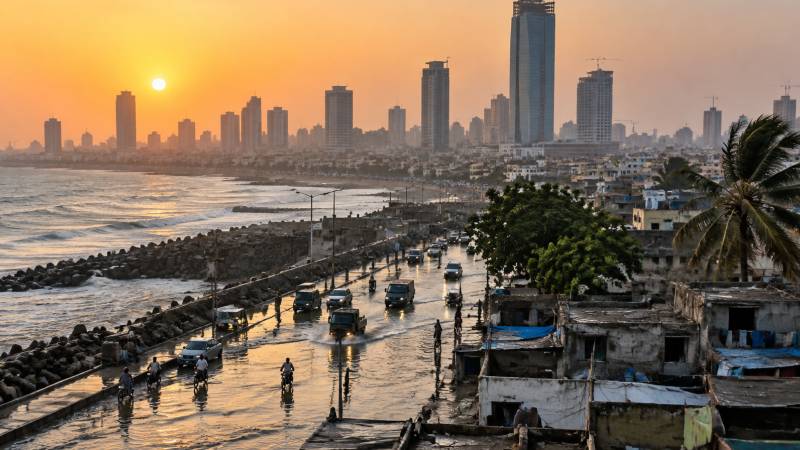
Every time the issue of the future of Karachi comes up, the discussion inevitably starts with control. Who will oversee the city? Would it be advisable to establish new administrative units? How far can the autonomy of Karachi and how far does the authority go from elected local governments? These are great questions. These, however, are not the first ones, So, before we start debating who should rule Karachi, let's discuss what kind of Karachi do we want in 2050? The city is no longer just a rapidly expanding metropolis. It's a city that lives with high temperatures, flood, water scarcity, pollution, reduction of green spaces, coastal risk and pressure on land and infrastructure. These are not distinct problems. They are the creations of the planning, construction and governance of Karachi. That's why it's time for the city to shift from traditional urban governance to climate governance.
Climate dimensions exist in land use, housing, roads, drainage, buildings, transport, water and parks, coastal development. Climate change is intrinsic to the Karachi urban experience, and the work of the Karachi Urban Lab (KUL) again demonstrated the need to do so. However, heat is no longer a weather phenomenon and can be considered a seasonal event. It is an urban design, governance and inequality issue. In Karachi, it's not only about the rising temperature. It also has to do with how the city has been constructed. Concrete absorbs heat. Tree cover is thin. There is limited air circulation due to high density of construction. When the power goes out, one of the few ways households have to cope is taken away, and when water is scarce extreme temperatures are more difficult to endure.
This is not all the same for everyone. People working in construction, traffic police, rickshaw and motorcyclists, children, the elderly and those living in informal settlements are the hardest hit. Better quality healthcare, alternative electricity and air conditioning are available for purchase by wealthier households. All others just suffer. How important it is that every major urban project has to answer a fundamental question: Does this make Karachi hotter or cooler? Pedestrian and tree placement should be taken into account for each new road. All new structures must consider water consumption, water-borne waste and how they will affect their surroundings. These cannot be mere ancillary matters. They must be a part of the approval process.
The city of Karachi is a paradox. During the extreme heat, it is difficult for people to obtain water. The same city finds itself hard pressed to rid itself of it during torrential rain. Urban Flooding is not just a function of Rainfalls. All these contribute, including the protection of natural drainage channels, closed drains, solid waste, lack of stormwater infrastructure and the gradual loss of open land due to settlement in low lying areas. A drain is not just a piece of engineering! The City's environmental infrastructure includes natural waterways, drainage corridors, parks and open spaces. The amount of rain has become more of a question of how much, but also, have the city maintained the natural and built systems necessary to handle it?
This same principle also holds true about the coast. Mangroves and coastal ecosystems are not 'wild' space that can be 'tamed'. They are part of the natural defence line of Karachi and in the age of climate change, they must be considered as climate infrastructure instead of real estate. The question, therefore, needs to change from "What can this land be used for?" to "What is this land already doing for the city?" However, if a piece of land absorbs rainwater, offers ecological protection, cools and drains the city and supports biodiversity, the value of this land cannot solely be judged by its commercial value.
Air pollution should be on this agenda as well. Public health is impacted by traffic, industrial emissions, construction dust, waste burning and diesel generators. But there are still limited, intermittent and publicly available air quality measurements at the neighborhood level. How will they know where it is occurring, what is causing it and if their policies are working without it? That's where GIS and local data are essential. A modern local government should be aware of not only where roads, buildings and utilities are located, but where heat is concentrated, flood water accumulates, trees are vanishing, the air is polluted, and which communities are most vulnerable. Climate governance should be data governance.
The impact of climate risks is not uneven. During a heat wave, a wealthy household can afford to purchase drinking water, maintain an air-conditioner and reach a good hospital. These may be unavailable to a low-income household. Heat is dangerous to health and livelihood for any worker in the construction industry or on the street selling. Water is scarce when it becomes an economic burden to a family relying on costly tanker water. Heavy rain may pose a potential threat to life and property for residents next to sensitive drainage systems. Resilience goes hand-in-hand with justice. Community resilience is shade, trees, water availability, pedestrian safety, early-warning systems, improved buildings, health facilities and safe spaces during disasters. Climate policy must not be a product of public awareness or community preparedness; there must be a place for it. So to local government we come. When a councilor is supposed to represent the community, but has no direct power over drainage, parks, local roads, waste, trees, the use of public space or climate information, who can citizens hold responsible?
Article 140-A of the Constitution clearly states that each province should be given a system of local government and the political, administrative and fiscal powers and authorities should be delegated to local elected representatives. It is not possible for local government to be a layer without any power. However, devolution should be extended to Karachi. Local governments should have a clear climate mandate that has the authority to build a cohesive, integrated approach to land use, drainage, parks and trees, public spaces, mobility and resilience, and water management, rather than going at them separately. The provincial government would also have key roles to play in the areas of legislation, standards, regional infrastructure and oversight. But planning that is sensitive to climate should be carried out where people feel its consequences. An empowered councilor needs more than a budget. GIS maps, population data, land-use records, water and sewerage information, and infrastructure databases and climate-risk maps should be accessible to the job. A "data-driven" local government of the future is required.
Local governments should have a clear climate mandate that gives them the authority to build a cohesive, and integrated approach to land use, drainage, public spaces, mobility, and water management, rather than addressing them separately.
The example of New York City is helpful. It has embedded climate mitigation and adaptation in local laws, planning and municipal responsibilities. Local Law 97, for example, establishes greenhouse-gas emission limits for many large buildings, directly linking the climate goals to the building regulation. The lesson is not about copying New York, Karachi can. That climate change can be the business of city government, instead of the business of national or provincial environment agencies. A similar transition is required in Karachi, where considerations related to climate become a part of planning, building codes, land use, infrastructure investments, disaster preparedness and the city budget.
Major development projects in Karachi should have a Climate and Public Interest Test of 2050. Authorities should ask themselves if a scheme will add to the urban heat, impact a natural drainage route, increase water demand or sewage, remove trees or green space, exacerbate air pollution and traffic, expose low-income areas to additional risk, or damage coastal and ecological systems prior to approval. Above all they should ask the views of the people who live there. No EIA can be merely a bureaucratic step towards a no-objection letter. It should be an integral component of decision-making.
A resilient city also requires a new type of city budget. Karachi's local government should publicly disclose each year the number of trees that have been protected, rehabilitated or planted; the number of drainage corridors that have been rehabilitated; the number of natural waterways that have been protected; the amount of water lost to leakage; the number of neighbourhoods with air quality monitoring; and the percentage of the development budget for climate resilience. Citizens need to see the results of the allocation, rather than just the amount allocated. No power without information, resources and accountability is decentralization.
We are accustomed to development being measured in real terms: roads, bridges, new high rises, new commercial centres. However, the tree is infrastructure. So is a park, a functioning drainage corridor, a safe footpath, clean air and a protected coastline. These are not limitations to growth. They enable development to be lived. So, today's school-going children will grow up into workers, parents, entrepreneurs, teachers, journalists, decision makers in Karachi of 2050. They will inherit the water systems that we construct, the roads that we design, the coastline that we defend or take down, the neighborhoods that we make resilient or leave vulnerable, and the air that we pollute or clean up.
They will not enquire about the number of flyovers we constructed. They might inquire if they had access to clean water, if they could breathe, if there were trees and public spaces in their neighborhoods, if their houses would be safe in a flood, if they would be protected from extreme heat, and if their voice was heard when their city was being planned. The administration of Karachi can be changed. The structure of institutions can be changed and authority could be transferred from one level of government to another. All of this alone will not address the city's climate challenges. The question is not just who has the power but what is it used for and how is it subject to control.
Karachi requires a new social contract for the city, one where citizens are not only voters and taxpayers, but are also planners; councilors are not only political representatives, but decisions makers; local governments are not only responsible for sanitation, but for planning for the city and climate; universities are not only producing knowledge and data, but usable knowledge and data; experts are not only producing knowledge, but they are producing knowledge that is connected to public policy; and civil society are not only engaging in monitoring, but they are engaging in holding power to account.
The city must have empowered local governments, but it must have informed ones as well. It requires better institutions, and institutions that are science-led, participatory and long-term focused. It requires development without its trade-off of environmental systems that it relies upon. A city isn't merely something that can be plotted out on a map. It is the actual experience of the people. At its core, people-centred planning is creating a city that is safe, heard and designed for citizens to shape their future. In the case of Karachi, it is now a necessity to plan for that future, with the climate at its Centre.