

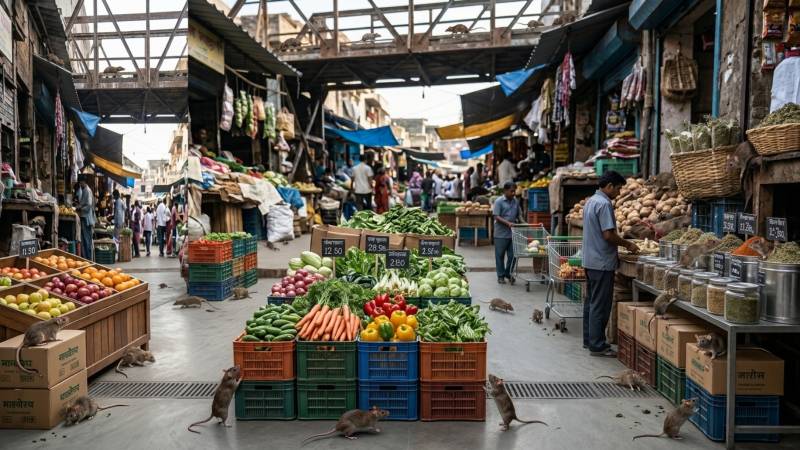
The other day, while buying vegetables in Mingora, the main city of Pakistan's Swat Valley, I noticed a large rat roaming freely behind a vegetable cart. It darted between an open drain and a wall without hesitation, despite the thick crowd and bright afternoon sunlight. When I pointed it out to the cart owner and suggested him to do something about it, he merely smiled and replied that the rodents had become his neighbours.
His remark was humorous, but the reality behind it was deeply troubling. When rodents roam openly around vegetable stalls, meat shops, and restaurants, the problem is no longer confined to basic municipal cleanliness. It becomes an urgent issue of public health, food safety, and basic urban governance.
Mingora and Saidu Sharif together form the commercial, administrative, and social heart of the Swat Valley. They serve a vast region, drawing people from Shangla, Buner, Upper and Lower Kohistan, Mardan, and across the country for trade, education, healthcare, employment, and tourism. This concentration of activity is a natural engine of economic growth, yet the infrastructure needed to accommodate it has failed to keep pace. The problem is not the influx of people, as migration brings enterprise, skills, and vitality. The real failure lies in allowing urban growth to proceed without proper planning, transport, sanitation, or public space management. The Mingora and Saidu Sharif Master Plan 2024–2042 offers a much-needed structural framework, but a plan on paper cannot improve daily life unless its recommendations are actively implemented and responsible institutions are held accountable. A non-political administration now has a rare opportunity to reverse this decline through a coordinated urban recovery program uniting district authorities, municipal bodies, traffic police, trade unions, food safety authorities, educational institutions, environmental specialists, and civil society.
Sanitation deserves immediate priority. Rodents have become alarmingly visible in commercial hubs, where exposed food waste provides abundant nourishment while open drains, basements, and neglected corners offer shelter. Killing individual rats provides only temporary relief; the underlying environment must be systematically cleaned.
Municipal authorities must begin with a sustained sanitation drive focused on markets, slaughterhouse drains, and waste collection points. Heavy cleaning, road sweeping, and drain desilting should be scheduled during night hours between ten in the evening and six in the morning when streets are clear, while routine trash collection continues through the day. Covered waste containers must be installed at key market points and emptied on a fixed schedule. Meat waste, bones, and offal must be removed daily through an organized collection system rather than left exposed overnight.
To build public confidence, the first ninety days of this urban recovery initiative must deliver visible, measurable results. The administration should immediately map major traffic bottlenecks, waste accumulation points, rodent hotspots, and obstructed pedestrian routes.
Food handlers and traders share this responsibility. Meat displayed on exposed wooden or cement platforms must be replaced with cleanable, food-grade surfaces, and all produce must be stored under protective covers. Food safety teams should inspect shops regularly for hygiene, pest access, and proper waste disposal, offering practical guidance alongside enforcement so safe handling becomes standard practice.
Effective rodent control requires combining sanitation, physical trapping, and professionally managed pest control. Indiscriminate poisoning is unsafe as it puts children, domestic animals, and non-target wildlife at risk. Instead, an ecological opportunity should be explored. Barn owls, known locally as ullu, are natural predators of rodents. Scientific research in Pakistan highlights their effectiveness in controlling small mammal populations. The Khyber Pakhtunkhwa Wildlife Department, working with conservation bodies like WWF-Pakistan, could assess selected sites near grain stores or city outskirts for a monitored nest-box pilot program. While owls complement sound sanitation, they cannot replace it. Additionally, stray dog populations around meat markets should be humanely managed by municipal and veterinary authorities through vaccination and birth control programs.
Traffic congestion is the most visible symbol of urban paralysis. Rickshaws, motorcycles, private cars, pushcarts, and roadside vendors constantly compete for limited road space, while illegal parking narrows already choked avenues. Commuters waste hours, shopkeepers lose business, and idling engines create severe noise and air pollution that harms residents, school children, traffic personnel, and roadside workers. Traffic flow requires a combination of firm enforcement and practical planning. School, college, and office timings should be staggered across major choke points, organizing primary, high school, and higher education institutions into separate opening and closing windows to prevent simultaneous morning and afternoon gridlocks.
The massive volume of transport also demands structured regulation. Introducing a three-color rotational scheme for rickshaws, hand carts, push carts, and animal carts (rerhi/gadi) using green, blue, and white front badges across morning, afternoon, and night shifts will instantly reduce active vehicle volume on main arteries while ensuring equal earning opportunities for operators. To keep shop fronts clear, strict accountability must be enforced: no motorcycles, cars, or carts will be allowed to park directly in front of shops, with fines levied on shopkeepers who permit frontage obstructions. Traffic police must establish designated rickshaw stands, organized loading and unloading zones, marked motorcycle parking on side streets, and strictly enforced no-parking zones along main thoroughfares. High-definition camera surveillance at key bottlenecks like Nishat Chowk, Green Chowk, and Saidu Road will support this effort by issuing electronic fines and monitoring traffic compliance.
Physical public space must be recovered through clear and consistently applied rules. Footpaths, road junctions, and emergency access corridors must remain completely unobstructed so pedestrians are not forced into vehicle lanes. Authorities should distinguish between permanent illegal structures on public land, temporary vending, and legitimate commercial loading. A week voluntary grace period should be announced through loud speakers, giving encroachers the opportunity to remove illegal structures themselves without facing heavy penalties. Once the grace period expires, municipal teams must carry out uncompromising clearance drives, using camera surveillance to ensure cleared areas do not revert to illegal use.
Public health extends beyond roads and markets to the natural ecosystem. The Swat River and its tributaries must be protected as irreplaceable ecological assets rather than treated as municipal dumping grounds for solid waste and sewage. Urban tree canopies and green spaces also require urgent protection. A dedicated pedestrian and cycling corridor connecting Saidu Sharif directly to Mingora should be lined with native trees to encourage walking and reduce short vehicle trips. Local banks, private schools, and commercial establishments can be engaged through public-private partnerships to adopt and maintain hundred meter stretches of green belts and walkways. Furthermore, tree planting campaigns led by the Forest Department must move beyond simple numbers; every initiative must focus on native species, regular watering, physical protection, and survival monitoring. This groundwork will culminate in a massive, community led plantation drive in the upcoming spring, bringing together students, youth volunteers, and civic groups to green the avenues and public spaces of Saidu Sharif, Mingora, and Fizagat.
A clear public action plan should then be published, detailing responsible departmental leads, specific tasks, deadlines, and measurable performance targets. To maintain institutional performance, a transparent reward system should grant monthly cash awards and formal commendation letters to traffic personnel who keep their beats clear. Regular progress reports will allow citizens to verify whether commitments are being met.
The rat behind the vegetable cart was a small incident, but it exposed a much larger failure of past public representatives and municipal administration. When rodents become familiar visitors to food markets, when pedestrians surrender footpaths to vehicles, and when public space is treated as nobody's responsibility, the issue is no longer just a lack of cleanliness. It is a fundamental failure of urban governance. Reclaiming Mingora requires more than sweeping its streets. It requires restoring public health, safeguarding the natural environment, and making the institutions responsible for the city truly answerable to the people who live and work here.