

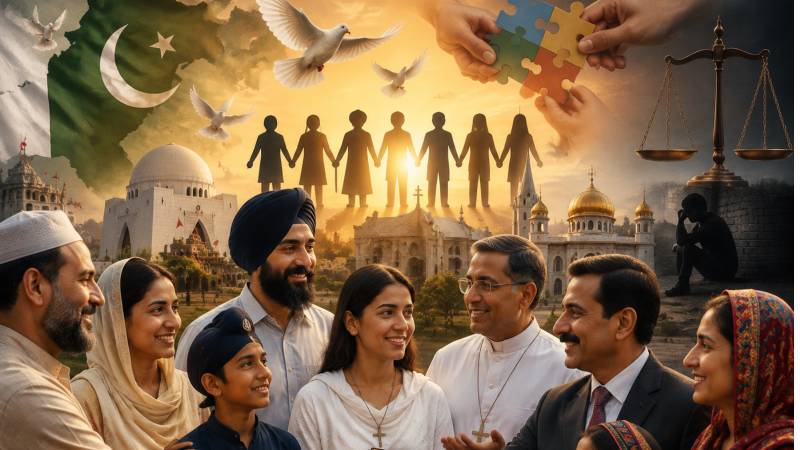
Every year on 11 August, Pakistan observes National Minorities’ Day to recognise the contributions of its religious minority communities and reaffirm the principles of equality, religious freedom, and social harmony. The date commemorates Quaid-e-Azam Muhammad Ali Jinnah’s historic address to Pakistan’s Constituent Assembly on 11 August 1947, in which he presented a vision of a state where all citizens, regardless of religion, would enjoy equal rights and responsibilities.
In his landmark speech, delivered shortly before Pakistan’s independence, Jinnah stated that citizens should be free to follow their own faiths and that religion should not determine their relationship with the state. He said, “You are free; you are free to go to your temples, you are free to go to your mosques or to any other places of worship in this State of Pakistan. You may belong to any religion or caste or creed that has nothing to do with the business of the State.”
For many, this address remains a significant reference point in discussions about citizenship, religious freedom, and minority rights in Pakistan. Recognising the importance of this vision, the Government of Pakistan People’s Party officially declared 11 August as National Minorities’ Day in 2009. Pakistan is home to diverse religious groups, including Christians, Hindus, Sikhs, Parsis, Kalash, and others, alongside the Muslim majority. Members of these communities have made important contributions in education, healthcare, public service, business, the armed forces, sports, science, arts, and culture. Minorities’ Day provides an opportunity to recognise these contributions and encourage greater understanding among all citizens.
Over time, the significance of Minorities’ Day has expanded beyond a symbolic celebration. While early observances focused mainly on recognising the services and achievements of minority communities, the day has increasingly become a platform for discussing constitutional rights, equal opportunities, political participation, religious freedom, and social inclusion. Since Pakistan’s independence, minorities still face violence and discrimination on many levels. Often minorities worship places and properties are under attack and attackers are not punished. Minority girls feel unsafe due to kidnapping, forced conversion and forced marriages. Often, non-Muslims are presented negatively in the syllabus and the textbooks.
The Constitution of Pakistan still treat minorities as inferior as no non-Muslim can be president or the prime minister of the country under Articles 41 and 91.
Apart from other sectors, the media and educational institutions can play a significant role in bringing Pakistani minorities into the mainstream. Educational institutions can play an important role by using Minorities’ Day as an opportunity to promote inclusion, celebrate diversity, and challenge prejudice. Interfaith sessions can be organised by inviting representatives from different faith communities to share their traditions, values, festivals, and personal experiences. Schools and colleges can also include special sessions highlighting the histories, cultures, and achievements of minority communities, recognising their diverse contributions across different subjects and areas of society.
The media has an important responsibility in recognising and highlighting the contributions of minority communities throughout the year, rather than focusing attention only on a single awareness day. If Pakistan wants to be a pluralistic society, then it should appreciate Pakistan’s different languages, cultures, traditions, and histories as part of the country’s identity. The state should encourage schools and universities to promote respect for diverse beliefs and backgrounds. This can be achieved by developing youth initiatives that use sports and creative activities to foster cooperation, conflict resolution skills, and a sense of civic responsibility.
National Minorities’ Day is not only a day to celebrate the contributions of religious minority communities but also an opportunity to reflect on the values of equality, inclusion, and mutual respect. Its significance lies in encouraging Pakistan to recognise the diversity of its citizens and to continue working towards a society where every person enjoys dignity, security, and equal opportunities. By promoting understanding and respecting diversity, communities can work together to strengthen social harmony and shared national progress.