

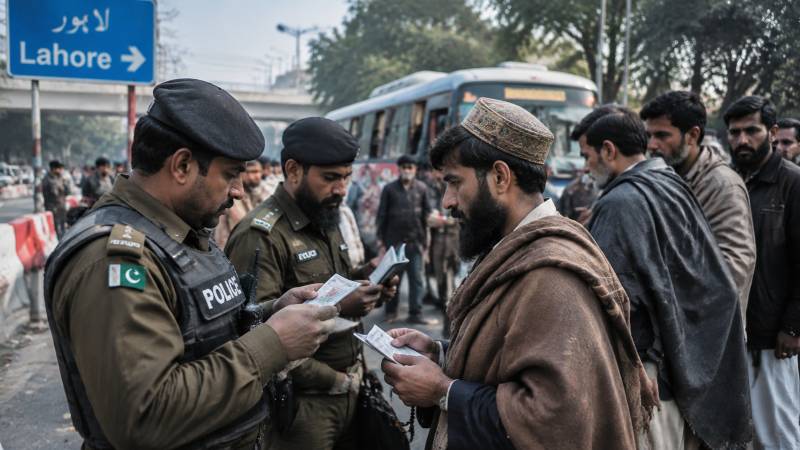
On 27 April 2026, Muhammad Yousuf, a Lahore-born Afghan, was arrested by the police outside Khyber Restaurant, near Saggian Bridge by the Ravi. His brother, Saifullah Suleman Khel, says that Yousuf was not working that day due to high blood pressure and had come to the area to meet a friend. This area had already experienced document checks, frequent raids, and mass evictions as part of Pakistan’s latest refugee deportation drive. Yousuf’s visa had expired, according to Saifullah, and he was soon incarcerated in Kot Lakhpat jail.
Ravi Road still bustles with the noise of the city—motorcycles, rickshaws, trucks, and dust swirling through traffic. However, inside the Afghan settlement near Saggian Pull, the broken dirt roads are eerily quiet. The settlement feels like a ghost town. A few people remain outside, but most doors are closed, and the rooms behind them appear abandoned, bereft of the families that once inhabited those makeshift walls. Saifullah gestures to his own lane. ‘Not one family remains,’ he says. ‘All the families have gone.’ Saifullah returned to Pakistan after his family was forced to leave for Afghanistan in 2025 because he still had outstanding payments to recover from their work in scrap and recycling trade.
In 2023, the Pakistan government announced its intention to expel undocumented Afghan residents from the country. Approximately six months later, this process expanded to include Afghan Citizen Card holders. By June 2025, it encompassed anyone holding a Proof of Registration card. It became starkly clear that documents which once allowed Afghan residents to remain in Pakistan no longer offered protection. In October 2025, the Punjab government reported the repatriation of approximately 42,913 Afghan nationals since 1 April 2025, under the third phase of Pakistan's Illegal Foreigners Repatriation Plan. By April 2026, the Punjab Police continued to describe it as an ongoing province-wide evacuation drive. The Punjab Police claimed that 34,576 illegal foreign nationals, including Afghan citizens, had been deported from Lahore and other districts, while 203 more remained at holding points awaiting deportation.
The successive government directives also raised questions about the arbitrary withdrawal of protections previously extended to Afghan residents, including those who had lived in Pakistan for decades. Although the state retains the authority to regulate immigration, Article 4 of Pakistan’s Constitution guarantees the protection of law to every person within its territory, irrespective of citizenship. Pakistan is not a signatory to the 1951 Refugee Convention, but remains bound by the customary international law principle of non-refoulement, which prohibits returning individuals to places where they face persecution or other serious threats to their life or freedom. In August 2025, the United Nations High Commissioner for Refugees warned that the forced return of registered Afghan refugees holding Proof of Registration cards would violate this principle. The successive expulsions therefore raise questions not simply about the legality of residence, but about the absence of meaningful consideration of individual circumstances and protection needs.
Saifullah stated that Afghan families had lived around Saggian for 35 to 45 years. Many residents whose families had migrated were born there, and their elders were buried there. His own family first arrived at Shingan camp in Kohat, where they stayed for about a year before moving to Lahore to find work. He came with his father and brothers before Yousuf was born. Although the family lived around Saggian for decades, questions regarding their citizenship and proper documentation to remain in Pakistan eventually arose. Before their repatriation by road, Afghan residents were gathered in holding centres set up in panagahs (shelter homes) and musafir khanas (travellers’ lodges) in Thokar, Sabzi Mandi, near Data Sahib’s shrine, and at the railway station. Saifullah recounted that when a relative, accompanied by children or family members, went to a holding centre to check on loved ones, they too would be apprehended and deported. Families witnessed this repeatedly. Saifullah believes this practice is more common in Punjab.
Most families in the settlement survived by dealing in paper, cardboard, bottles, and scrap. Afghan workers would collect waste material from the streets throughout the day and then sell it to factory owners. When families left, they abandoned not only houses, but also rented rooms, tools, outstanding payments, customers, shopkeepers, and debts owed to them. Some men returned on visas because their money was still tied up in Pakistan. Saifullah claims he was owed Rs 2,000,000 in Lahore. Others were owed Rs 1,000,000, 2,000,000, 3,000,000. If Afghan workers returned to collect these payments, similar police action could be taken against them. Someone who owed money might call the police instead of paying.
Yousuf had returned with a visa, but the border closed shortly thereafter. During this time, Afghan residents heading towards the Torkham border by road were unable to get their passports stamped due to the closure. They were advised to travel by air, but tickets cost Rs 70,000 or 77,000. Even if a visa holder had entered legally, the visa could expire because the process for maintaining passport validity had ceased. The same issue, Saifullah explained, had confronted Yousuf. He had arrived with a visa when the border was open, but after its closure, the necessary stamp to keep his visa current could not be obtained. By the time the police arrested him near Khyber Restaurant, his visa issue had become grounds for detention.
Saifullah says police sometimes abused them, saying, ‘You have lived off Pakistan your whole life.’ They call residents ‘Afghani,’ and these words, he notes, are mostly directed at Pashtuns. Anyone with an Afghan or Pashtun identity attached to them is treated as a terrorist. He referred to the many years the families had spent in Lahore, lamenting that Afghan residents who had lived there for decades were now being picked up, questioned, insulted, and forced to prove a life they had already lived.
The distinction between an Afghan national and a Pakistani citizen becomes increasingly difficult to sustain when ethnic identity, traditional dress, language and place of origin are treated as evidence of foreignness.
The Afghan Label
Quetta-born Hammad Kakar, a recent graduate living in Muslim Town, says police in Punjab treat every Pakhtun as an Afghan migrant. ‘As soon as you enter Punjab, you are treated with suspicion,’ he said. Buses from Balochistan and Khyber Pakhtunkhwa are routinely stopped at check-posts upon entering Punjab. Passengers are made to disembark, stand in line, and present their identity cards. Police question them about their origin, destination, and purpose of travel.
Kakar recently experienced this firsthand during a winter return to Punjab from Balochistan via D G Khan. ‘It was as if there was a border of a different country there,’ he recounted. ‘They make you get off the bus, stand in a line, and then you cross the border.’ The accusations he hears are direct: ‘Either they say these people are involved in smuggling, or they say Afghan refugees are travelling with them.’ By the time the bus reaches Lahore, passengers have often answered the same questions multiple times.
In Lahore, Kakar explains, newcomers from Khyber Pakhtunkhwa or Balochistan are required to report to a police station before securing accommodation in a hostel, renting a room, or settling in the city. ‘The biggest issue that has come up is in the name of registration,’ he said. ‘First, you have to go to the police station and get yourself registered. Only then can you live here.’ Many students, workers, businessmen, and those seeking medical treatment are unaware of this requirement. If stopped by police and found unregistered, they can be taken directly to the thana (police station). There, Kakar says, individuals can spend one or two days while police complete verification. Even with a computerised national identity card, they must wait for signatures and clearance from the police station.
Amir Bahadur Khan Hoti, the Awami National Party (ANP)’s provincial general secretary in Punjab, notes that Pakistani Pakhtuns are being caught in the Afghan deportation process. ‘Generally, in Punjab, it becomes difficult for authorities to distinguish between Afghans and Pakistanis,’ he says. ‘But in this process, Pakistani Pakhtuns are also arrested.’ While the ANP accepts the government’s decision on undocumented Afghans, Hoti criticises the way Pakistani Pakhtuns are being swept into these operations, particularly during raids on homes, rented properties, shops, and hostels.
In Muslim Town, Barkat Market, and the surrounding hotel and café strip, police now arrive asking, ‘Where are the Afghan refugees?’ Kakar says hotel owners confirm that all their guests possess Pakistani identity cards. However, police retort that the card doesn’t definitively identify Afghans. Officers demand that owners identify Afghan migrants in their vicinity, threatening action if names are not provided and offering rewards for cooperation.
Hoti described a case where a Pakistani Pakhtun family visiting neighbours was arrested during a raid, along with two women who were guests. ‘It took us four to five hours to prove that they were Pakistani,’ he said. Their documents required verification through the deputy commissioner, a level of access an ordinary family typically lacks. Hoti also notes that local enmities in districts like Chakwal, Mandi Bahauddin, and Khushab sometimes lead to false reports of Afghan presence to authorities. Police teams arrive, search the premises, only to find the suspected individual is Pakistani.
Kakar observed that police checks intensify before protests and rallies. Prior to one announced protest, police swept through the area and arrested twenty-three men. Twenty-one were Pashtun, including teenage students and waiters with no political affiliations. Kakar said the later explanation was not that the men had committed specific offenses, but that each station house officer (SHO) had been instructed to apprehend a certain number of people before a Pakistan Tehreek-e-Insaf (PTI) rally or any anti-government political activity. Hoti rejects the idea of formal targets against Pakhtuns for police stations. He attributes police harassment more to faulty verification, abuse by lower-level police, informants, and the inherent difficulty in distinguishing Afghan and Pakistani Pakhtuns during search operations.
Abdul Samad from Pishin, who runs a café in Muslim Town, has been picked up about four times in the last year. Most recently, in late April, he refused to serve tea to police without payment. The next day, police returned, questioning why he had gathered a crowd, placed chairs outside, and not installed cameras. There was no lockdown at the time, and cameras were already installed. ‘The whole record is there,’ he stated, but the CCTV footage did not prevent his arrest. He was detained for almost two days. Inside the jail, he says, most inmates were Pashtun, except for one Punjabi man held on a drug charge. ‘When we came here, we had already gotten ourselves registered,’ he said. ‘Even after that, they kept troubling us again and again.’ At night, he says, two men patrol while the sub-inspector sits nearby. They pick people up, and whoever pays money is released. Abdul Samad says he paid Rs 7,000. Following repeated complaints, Hoti says the ANP raised the matter with the Punjab Home Secretary, provincial minister Khawaja Salman Rafique, the AIG, and other officials. They demanded the formation of committees to help verify individuals' nationalities (Afghan or Pakistani) before arrest. Hoti reports that officials responded seriously, and the situation has improved in some areas.
For families forced to leave Lahore, deportation has meant more than abandoning their homes. It has meant losing businesses, unpaid wages, customers, outstanding debts and livelihoods built over decades.
Markets, Checkpoints, and Police Pressure
At his electronics showroom, Moin Wazir explained that the police didn’t need a major case to repeatedly target him. One day, they arrived, claiming his security cameras weren’t working properly and that it was his responsibility. Moin pointed out that the entire market had the same setup, but only he was singled out. Then came notices about security guards. Three times, he said, he received papers demanding to know why there wasn’t a guard outside his showroom. He repeatedly told them that if there was a rule, and if any shop from his showroom to Multan Chungi had a guard, he would also arrange one. However, his shop was barely covering its rent and expenses.
The notices, he observed, appeared to be pre-prepared. ‘They just insert your name in the middle,’ he said. For Moin, this was the daily harassment of running a Pakhtun-owned business in the area. The police could show up over cameras, guards, paperwork, or any other minor pretext, and each visit forced the shopkeeper to stop working, answer another question, deal with another notice, or await another demand. Around the same time, he said, Pakhtun-run shops and hotels faced repeated raids during business hours, often with customers still present. ‘Three raids on the shop were conducted in a single day,’ he added.
In Shah Alam, Gulraiz Khan, a worker from Buner, stated that the main issue was that police checks had begun extending to the quarters where daily-wage labourers slept after the market closed. Many workers stayed close to Shah Alam because they could earn a living through loading and carrying. However, work itself had become uncertain amid the economic crisis and repeated market closures during periods of political unrest. Gulraiz had been working in the area for almost 25 years. Another worker had been in Lahore for 12 years and lived in the quarters instead of returning home regularly.
Even after many Afghans had left or been removed, workers reported that men in the quarters were still being asked to show their ‘entry’ or registration papers. When they presented them, officers sometimes questioned what was written on them. ‘Then we have to explain, 'this is the name, this is the entry, this is the card,’ one worker said. A man could possess an iqama (a Gulf residency or work permit), an identity card, registration, and other papers, he said, and still be stopped. ‘In Pakistan, the identity card has no value left,’ he lamented.
In Ichhra market, Shabaz Khan, a cloth trader, recounted a recent incident. He was walking back to his shop with his older brother after dinner, wearing a Pashtun dress with traditional embroidery. Shortly after, two police officers on a motorcycle approached them. ‘The moment they saw me, they jumped toward me like they had caught a big terrorist,’ he said. They searched him on the road while people in the market watched. Bystanders could only see a man being searched and wonder what had been found on him.
Shabaz believed the search was tied to the fact that he was a Pakhtun and wearing traditional Pashtun clothes. After searching him, the police checked his identity card. When one officer saw the name of his hometown on it, he remarked, ‘You're from the home of terrorism.’ Shabaz said he told the officer that people often complain about Pashtuns having anti-Punjabi sentiments and then pointed out the discriminatory treatment they receive.
The same suspicion followed Sohail Afnan near Niazi Adda. A law student, he was going home during the holidays around December when police approached him on a bike and shouted for him to get off the bus. They told him to place his bag on the ground. When he did, they claimed there was a gun inside. Sohail denied it. They kept repeating the charge, asking about the weapon ‘you kill with’. He felt they had already decided what he was before they checked anything. His appearance and his being Pakhtun had made him a suspect before the bag was even opened. He told them he was a law student studying at university. ‘If you wanted to ask me about books, that would have been better,’ he told them. ‘What do I have to do with a gun?’ When he tried to speak, one officer told him to shut up and called him a ‘Pathan’s child’.
Such encounters also raise questions about the constitutional rights of Pakistani Pashtuns. Article 25 of Pakistan’s Constitution guarantees equality before the law and equal protection of the law, while Article 15 protects citizens’ freedom of movement and residence, subject to reasonable restrictions imposed by law. Articles 9 and 10 further provide protections against unlawful deprivation of liberty and establish safeguards against arbitrary arrest and detention. Pakistan is also a signatory to, and has ratified, the International Convention on the Elimination of All Forms of Racial Discrimination, which obliges the state to prohibit discrimination based on national or ethnic origin. These accounts collected across Lahore suggest that Pashtun identity, traditional dress, language and place of origin have become grounds for suspicion, irrespective of citizenship or possession of valid identity documents. The distinction between an Afghan national and a Pakistani citizen consequently becomes increasingly difficult to sustain in police practices that treat ethnic identity itself as evidence of foreignness.
These forms of discrimination did not stop at insults, searches, notices, or raids. In several accounts, Pashtun workers and students were picked up without clear paperwork, held for days, and located only after families, friends, or community members began searching for them. Moin recalled the case of Ashiq, a friend from his home area in former FATA, who had come to Lahore for studies and was seeking admission to an MPhil program. After gaining admission at Government College, one of Pakistan’s most respected universities, Ashiq disappeared for two days. On the third day, Moin said, a call came saying the police had picked him up in an ‘Afghan case.’ When Moin went there, he found around 20 men had been picked up. They were being asked whether they were Afghan or not, and according to Moin, each was told to pay Rs 30,000 or face deportation. Moin said they refused and told the police to deport them if that was what they wanted. After that, he said, ten men were released on the spot, while the remaining ten were told they would be released by morning.
Abid’s case in Baghbanpura followed the same pattern. He had been in the hosiery business in Baghbanpura Bazaar for five years, and according to him, Pashtuns in the bazaar faced discriminatory treatment from various individuals, especially from the police and LDA staff. One day, men in plain clothes picked him up from the bazaar. ‘They picked me up from Baghbanpura Bazaar in civilian clothes,’ he said. Their behaviour, he said, was harsh from the beginning. He kept asking what he had done and why he was being taken, but no answer came that could explain why a man doing hosiery business in the bazaar had been picked up. Abid said he was kept for four days without an FIR. ‘They demanded money. But I categorically refused.’ Throughout those four days, he kept wondering why he was picked up. ‘First tell me what I have done,’ he said. ‘Prove the crime, then do whatever you want.’
This article was originally commissioned by the Human Rights Commission of Pakistan and is being printed with permission for the first time.