

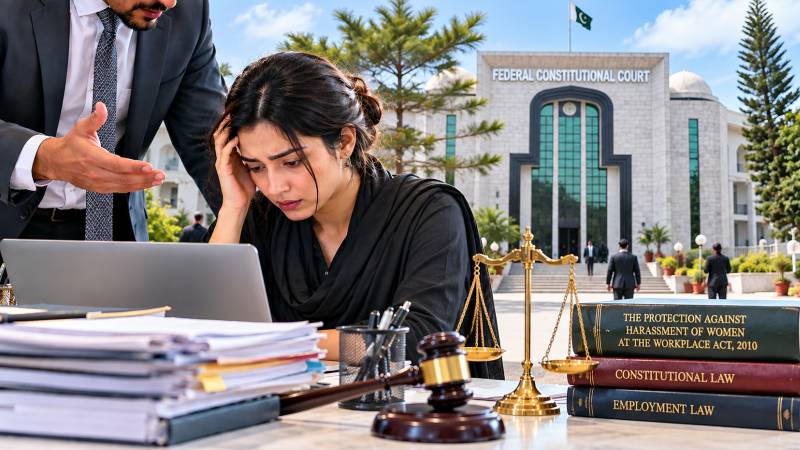
As Pakistan's workplaces slowly open up to greater female participation, the law governing harassment at the workplace has once again come under judicial scrutiny. The Federal Constitutional Court, in its recent judgment in Usman Shahid v. Nadia Sarwar (CPLA Nos. 1011 and 1113 of 2025, decided on 16 September 2026), has held that under the law as it stood before 2022, not every form of undesirable, hostile or harmful conduct at the workplace amounted to actionable harassment under the Protection against Harassment of Women at the Workplace Act, 2010. The conduct had to carry the sexual character contemplated by the statutory definition before the specialized jurisdiction under the Act could be invoked.
A three-member bench comprising Chief Justice Amin-ud-Din Khan, Justice Ali Baqar Najafi and Justice Syed Arshad Hussain Shah allowed the petitions and set aside the Islamabad High Court's judgment dated 31 December 2024. The judgment, authored by Justice Najafi, deserves careful reading, for it is likely to be misunderstood in both directions: by those who will read it as a license for non-sexual misconduct, and by those who will read it as a rollback of protections for working women. It is neither.
The dispute arose from complaints made by an employee of the National Bank of Pakistan. The matter traveled through several institutional stages: an internal inquiry at the Bank, a complaint before the Federal Ombudsman under the 2010 Act who imposed a major penalty, a representation before the President who reduced the penalty to censure, and finally the Islamabad High Court, which set aside the President's order and restored the decision of the Ombudsman. When the matter reached the FCC, the real question was not whether the complained-of conduct was objectionable. It was whether that conduct fell within the statutory definition of harassment applicable at the relevant time, and whether the High Court, in its constitutional jurisdiction, could substitute its own appraisal of the evidence for that of the competent statutory authorities.
The Court answered both questions by emphasizing statutory boundaries and judicial restraint. Under the pre-2022 version of section 2(h), harassment was defined around an unwelcome sexual advance, a request for sexual favors, verbal or physical conduct of a sexual nature, or sexually demeaning attitudes causing interference with work or creating an intimidating, hostile or offensive work environment. The Court held that this definition was not an open invitation to bring every workplace grievance before the Federal Ombudsman. The specialized forum exists for conduct falling within the statutory concept of harassment; everything else belongs to the ordinary disciplinary and service law framework.
This matters because the events in question occurred in 2012 and 2013, long before Parliament amended the Act in 2022. The amended definition now expressly covers discrimination on the basis of gender which may or may not be sexual in nature. The FCC judgment therefore cannot be casually described as holding that, under today's law, non-sexual gender-based discrimination can never constitute harassment. It interpreted the law as it stood when the alleged conduct took place, and nothing more.
A workplace complaint should not be decided by the label placed upon it, but by the facts, the applicable law, the jurisdiction of the forum and the evidence placed before it.
The judgment acquires particular significance when read alongside the Supreme Court's earlier jurisprudence. In Nadia Naz v. President of Pakistan (PLD 2021 SC 784), the Supreme Court had adopted a restrictive interpretation of section 2(h), confining the definition largely to conduct of a sexual nature. That interpretation was revisited in review, and in Nadia Naz v. President of Pakistan (PLD 2023 SC 588) the Court adopted a broader, purposive reading, recognizing that workplace harassment could arise from gender-based power dynamics rather than merely from sexual desire or physical sexual conduct. More recently, in Muhammad Din v. Province of Punjab (PLD 2025 SC 354), the Supreme Court considered the amended law and acknowledged its expanded scope.
The FCC did not simply revive the restrictive approach of 2021. It applied the statutory text in force when the conduct occurred and declined to treat the sexual component of the pre-2022 definition as dispensable. A quiet tension now exists between the purposive, dignity-centered reading of the Supreme Court's 2023 judgment and the FCC's insistence on the statutory language in force during the relevant period. Neither proposition should be overstated. The former does not mean that every workplace dispute is harassment; the latter does not mean that non-sexual misconduct is legally irrelevant.
For lawyers and inquiry committees handling current matters, the practical question is therefore temporal: which version of the law applies to the conduct under examination? For pre-2022 conduct, the FCC's reading governs. For conduct after the amendment, the expanded definition covering gender-based discrimination applies, and the same factual episode may, in an appropriate case, attract consequences under more than one legal regime, as the Supreme Court recognized in Raja Tanveer Safdar v. Tehmina Yasmeen (PLD 2024 SC 795).
Having appeared in workplace harassment inquiries and employment litigation for over a decade, I believe the judgment's real lesson lies in a distinction organizations routinely blur: harassment and misconduct are not interchangeable terms. A supervisor who bullies a subordinate, a manager who unfairly denies leave, a colleague who spreads malicious allegations, a superior who misuses administrative authority, all of these may warrant serious institutional action. But the legal question is never merely whether the conduct was objectionable. It is which law, rule or forum provides the appropriate remedy. A complaint alleging humiliation, shouting or denial of leave should not be automatically labeled sexual harassment merely because the complainant is a woman and the respondent a man. Equally, an allegation that fails the test of the harassment statute does not become acceptable conduct; it may simply belong before a different forum under the applicable service rules or code of conduct.
The judgment also carries a lesson on process. The Court emphasized the supervisory nature of certiorari and held that a High Court should not substitute its own assessment of the evidence merely because another view is possible. Interference is warranted only where there is a recognized legal or jurisdictional defect, such as absence of evidence or violation of natural justice. Inside organizations, this translates into a simple discipline: an inquiry report should not merely declare that conduct was harassing. It should explain why the conduct satisfies the applicable legal definition, on the basis of evidence, after a fair hearing.
Does the judgment then create a safe harbour for non-sexual misconduct? It should not. Not every misconduct is sexual harassment, but not every misconduct that falls short of that definition is therefore permissible. An employee should not escape disciplinary accountability merely because his conduct does not satisfy the statutory definition of harassment, and an employee should not be dragged before a specialized harassment forum merely because his conduct was unpleasant or rude. Both extremes create legal risk.
For employers, the message is not to lower their guard against workplace misconduct but to become more legally disciplined in classifying it. For inquiry committees, the lesson is to distinguish facts from labels and evidence from conclusions. For complainants, identifying the correct legal character of the conduct remains critical to securing an effective remedy. A workplace complaint should not be decided by the label placed upon it. It should be decided by the facts, the applicable law, the jurisdiction of the forum and the evidence placed before it.