

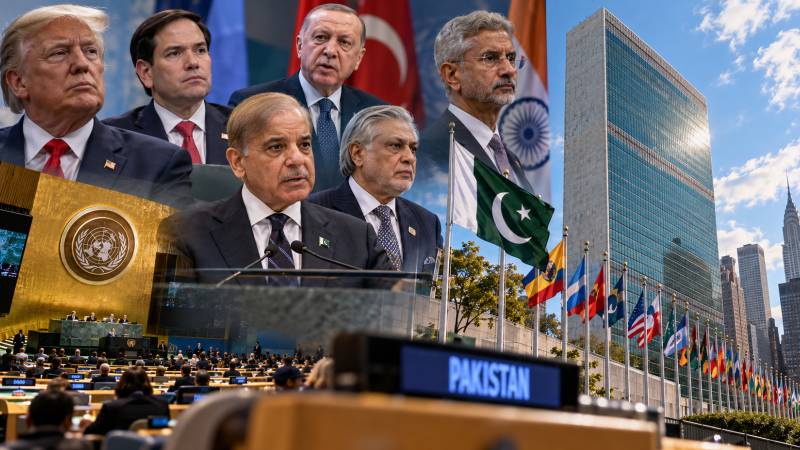
If there was one unmistakable message emerging from the corridors of the United Nations in New York this week, it was this: Pakistan is no longer a country the international community can conveniently overlook. The contrast with only a few years ago is striking. Prime Minister Shehbaz Sharif and Foreign Minister Ishaq Dar arrived for the 81st session of the UN General Assembly with Pakistan occupying a noticeably more prominent place in international diplomacy. Their schedules reflected it: meetings, consultations and engagements with world leaders at a time when the Middle East is in crisis and the international system is struggling to contain multiple conflicts. Reporting from New York described Pakistan as standing out amid the flurry of UN diplomacy.
The transformation did not begin in New York. A major turning point was the four-day India-Pakistan military confrontation in May 2025 following India's launch of Operation Sindoor. Whatever competing claims New Delhi and Islamabad continue to make about the military outcome, the diplomatic consequences have become increasingly difficult to ignore. Consider what US Secretary of State Marco Rubio said in New York. Discussing what he described as the failure of the existing international system to resolve conflicts, Rubio specifically cited India and Pakistan as an example of the sort of dangerous confrontation a functioning global order should be capable of addressing. That matters. For decades, India's position has been that Kashmir is essentially a bilateral matter between India and Pakistan and that there is no role for outside mediation. Pakistan, conversely, has consistently sought international involvement and highlighted UN resolutions on the dispute.
Rubio did not explicitly propose mediation over Kashmir in those remarks, and it would be inaccurate to claim that he did. But the significance is still considerable: at the world's foremost multilateral gathering, America's top diplomat publicly used India-Pakistan tensions as an example of a conflict that an effective international system should be able to address. That sits awkwardly with the idea that outsiders should simply keep out. Then came Turkish President Recep Tayyip Erdogan.
Speaking before the General Assembly, Erdogan again raised Kashmir, saying the issue should be addressed through dialogue and expressing hope for peace and stability in South Asia. New Delhi may dislike international references to Kashmir. But disliking them does not make them disappear. And there was another striking contrast in New York. Shehbaz Sharif was there. Narendra Modi was not.
That does not mean Pakistan has suddenly become a great power. Its economic weaknesses remain severe, its internal political challenges are substantial, and diplomatic relevance can disappear quickly if it is not converted into lasting economic and strategic gains.
India was represented at the high-level week by External Affairs Minister S. Jaishankar, who led the Indian delegation, just as he did the previous year. An absence from a UN General Assembly is not by itself evidence of diplomatic retreat — several major leaders skipped this year's gathering but in the context of an unusually active Pakistani diplomatic presence, the optics were nevertheless notable. One episode involving Jaishankar was particularly revealing of the poisonous atmosphere surrounding India-Pakistan relations.
A Pakistani journalist asked him when India would stop allegedly sponsoring terrorism in Pakistan. Jaishankar did not engage with the substance of the allegation. Instead, he replied: “A terrorist country is asking me that question. Come on.” India's UN representative then told the journalist that he had received his answer.
Indian audiences may regard that as a forceful retort. Others may see a senior diplomat substituting an insult for an answer. Either way, it illustrated how far apart the two countries remain. But perhaps the most extraordinary development came from Washington. In his UN address, Shehbaz Sharif publicly thanked President Donald Trump for what he called his “timely intervention” during the May 2025 India-Pakistan confrontation. Then Trump amplified it himself.
The US president shared an 87-second clip of Sharif's remarks on Truth Social, without additional comment. Trump has repeatedly claimed that his intervention helped end the fighting between the two nuclear-armed neighbours. India rejects that account and maintains that the cessation of hostilities resulted from direct military-to-military contact between the two countries. This is where the diplomatic problem for New Delhi becomes particularly obvious. India is perfectly entitled to maintain that no American mediation occurred. But it cannot prevent the president of the United States from publicly advancing a different version of events. Nor can it prevent Pakistan from embracing that version.
And when the White House occupant repeatedly says he helped stop the India-Pakistan conflict, then personally circulates a video of Pakistan's prime minister thanking him for doing precisely that, India's preferred narrative is no longer the only one circulating internationally. That does not prove Pakistan's account of every event surrounding Operation Sindoor. Nor does it erase the serious accusations India continues to level against Pakistan over terrorism. Those remain central to New Delhi's case and cannot simply be wished away. But foreign policy is ultimately measured not by television shouting matches or social-media triumphalism, but by access, relevance and the ability to place one's arguments before those who matter.
On those measures, Pakistan's position has clearly changed. A country that not long ago was frequently described as diplomatically isolated is today being engaged by Washington while simultaneously maintaining strategic ties with China, close relations with Saudi Arabia and Turkiye, and a potentially useful diplomatic role in the Middle East. That does not mean Pakistan has suddenly become a great power. It has not. Its economic weaknesses remain severe, its internal political challenges are substantial, and diplomatic relevance can disappear quickly if it is not converted into lasting economic and strategic gains. But pretending nothing has changed would be equally foolish.
Operation Sindoor was supposed to demonstrate India's ability to impose a new strategic reality on Pakistan. Instead, the period that followed has coincided with Pakistan acquiring greater international visibility and renewed diplomatic access. New York provided the latest evidence. Pakistan's prime minister was meeting leaders. Its foreign minister was deeply engaged in diplomacy. Kashmir was being mentioned by foreign leaders. America's secretary of state was publicly discussing India-Pakistan tensions as an example of a conflict the international system ought to be capable of addressing. And the president of the United States was broadcasting Pakistan's prime minister crediting him with helping end the 2025 confrontation.
One can debate what each of those developments means individually. Taken together, however, they demonstrate something much harder to dismiss. Pakistan has returned to the diplomatic table — and at this year's United Nations General Assembly, the world was paying attention.