

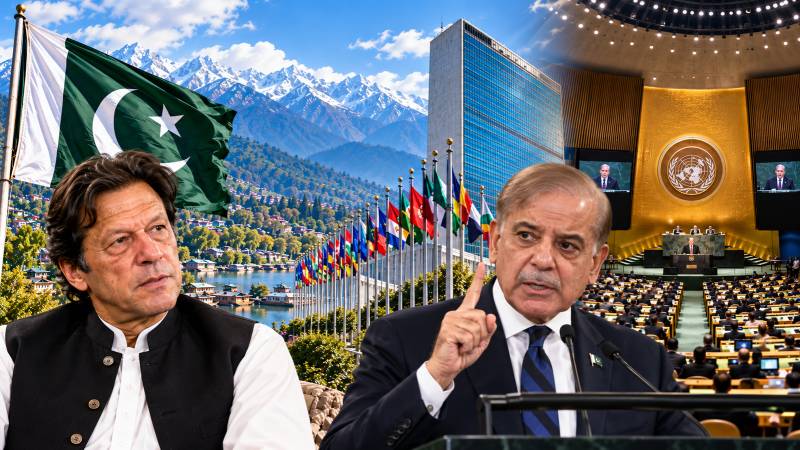
Prime Minister Shehbaz Sharif has once again placed Kashmir at the centre of Pakistan's diplomatic discourse. At the UN General Assembly, he forcefully reaffirmed Pakistan's principled position on this unfinished agenda of Partition: the Kashmiri people's right to self-determination in accordance with the relevant UN Security Council resolutions.
He coupled Kashmir with another existential national interest: the Indus waters. India cannot unilaterally suspend a binding international treaty, nor can it stop, impede or divert Pakistan's rightful share of water. Sharif's warning was categorical: any such attempt would constitute an "act of war." This resoluteness contrasts sharply with Pakistan's Kashmir policy during Imran Khan's government. The PTI government had opportunities both before and after India's illegal actions of August 5, 2019, but failed to convert Pakistan's longstanding position into an effective diplomatic and legal campaign.
The failure was particularly serious because India had hardly concealed what it intended to do. The BJP's 2019 election manifesto explicitly promised to revoke Articles 370 and 35A. After Modi's re-election, the intensification of India's security campaign in Kashmir provided further warning that a fundamental change was approaching.
An even greater opportunity came from the United Nations itself. In July 2019, barely a month before India's action, the UN human rights office issued another damning report on abuses in Kashmir and reiterated the call for an independent international inquiry. Pakistan could have used that moment to mobilise friendly states and seek stronger action at the UN Human Rights Council before India acted. It did not. By the time Khan addressed the UN General Assembly in September, India had already revoked Articles 370 and 35A, divided the disputed territory and fundamentally altered its constitutional status.
Pakistan had faced such moments before. When the BJP promised before the 1998 elections to make India an overt nuclear power, Nawaz Sharif's government understood the implications. When India eventually conducted nuclear tests, Pakistan was prepared to respond despite enormous international pressure. Opportunities remained after August 2019 as well. Imran Khan told the National Assembly that Pakistan would consider challenging India's action before the International Court of Justice. Yet no sustained legal initiative followed. Pakistan's response increasingly became what may be called solidarity diplomacy: speeches, commemorative events, expressions of support and periodic condemnation. These had symbolic value, but they could not prevent India from steadily creating new facts on the ground.
Worse still, Pakistan needed its friends most at precisely this moment. Kashmir cannot be effectively internationalised without a conducive diplomatic environment and sustained engagement with major powers, the Muslim world and Pakistan's strategic partners. Yet relations with Saudi Arabia deteriorated after Foreign Minister Shah Mahmood Qureshi publicly criticised the OIC over Kashmir in 2020. This was particularly damaging because Saudi Arabia remained central to the OIC, whose Kashmir Contact Group provided Pakistan with an established diplomatic platform.
Relations with Washington were hardly better. Pakistan's engagement with the Biden administration remained limited at the highest political level. At a time when Pakistan needed maximum international support for Kashmir, its diplomatic space among some of its most consequential partners had narrowed.
China was particularly important. Unlike almost any other major power, Beijing's strategic interests intersect directly with Pakistan's on Kashmir, especially because India's August 2019 actions also affected Chinese interests and claims in Ladakh. China opposed unilateral changes and continued to support consideration of the dispute in accordance with the UN Charter and relevant Security Council resolutions. Yet the PTI government's early criticism and uncertainty surrounding CPEC created avoidable friction in Pakistan's most consequential strategic relationship. This was particularly unfortunate because China remained the major power most willing to support Pakistan diplomatically on Kashmir, including by helping bring the dispute back before the Security Council after India's August 2019 action.
Kashmir cannot survive on solidarity diplomacy, just as Pakistan's water rights cannot be protected by warnings alone. Both require international law, diplomatic persistence and the systematic mobilisation of Pakistan's partnerships abroad.
India used the diplomatic space available to it. What happened after August 2019 was therefore not simply a constitutional change. It opened the way for a systematic transformation of the legal, demographic and political character of Indian-administered Jammu and Kashmir. The consequences are now before us. Article 35A had protected permanent residency, land ownership and employment rights. Its removal was followed by new domicile and land regulations that have progressively weakened the protections previously available to the indigenous population.
Millions of domicile certificates have subsequently been issued. Political constituencies have been redrawn, administrative control strengthened and the space available for Kashmiri political resistance drastically reduced. Seven lost years have allowed India to create realities that will become increasingly difficult to reverse. This is the inheritance Shehbaz Sharif confronts today. His achievement so far is not that Kashmir has been resolved, but that Pakistan is again projecting the dispute from a considerably stronger diplomatic position.
There is also consistency in Sharif's UN record. In successive General Assembly addresses, he has returned to Kashmir, the relevant UN resolutions and the right to self-determination. His latest address hardened this position further by linking Kashmir with India's coercive conduct towards Pakistan and its weaponisation of water.
The Indus Waters Treaty provides an instructive parallel. After the 2025 crisis, India announced that it was holding the treaty in abeyance. Pakistan refused to accept that unilateral position and persisted with the international legal process available under the treaty. The outcome has strengthened Pakistan's legal position. The Court of Arbitration has maintained that the treaty remains in force and rejected the proposition that one party can simply extinguish its treaty obligations through a unilateral political decision.
India has refused to accept the decision and disputes the tribunal's jurisdiction. This makes Sharif's warning at the UN especially significant. For Pakistan, access to the Indus waters is not an ordinary bilateral bargaining issue but an existential national interest. Kashmir and water consequently converge around one fundamental principle. India cannot be allowed to create unilateral realities and then demand that Pakistan accept them as irreversible. International obligations cannot simply disappear because New Delhi declares them inconvenient.
Sharif's tougher language also comes after the military confrontation of May 2025. The lesson Pakistan drew from that crisis was clear: an incident such as Pahalgam cannot become a licence for military escalation against Pakistan without consequences. The danger of another crisis cannot be dismissed. Pakistan already confronts terrorism from the TTP and Baloch militant groups while simultaneously assuming greater diplomatic and security responsibilities in West Asia. Another confrontation on its eastern border would therefore carry consequences well beyond South Asia.
This makes strategic vigilance essential. Pakistan has every reason to prevent another India-Pakistan confrontation without weakening its deterrence. New Delhi should have no illusion that another attempt to use a terrorist incident as justification for military escalation would go unanswered. This brings us to perhaps the most important difference between 2019 and 2026. Pakistan today possesses something it badly lacked when India transformed Kashmir: considerably greater diplomatic space.
Relations with China are strong. Relations with Saudi Arabia and the Gulf have deepened considerably, while engagement with Washington has revived dramatically under President Trump. Pakistan's growing role in West Asia has further enhanced its diplomatic relevance. That international environment matters enormously for Kashmir. Pakistan cannot compel India to reverse its actions alone, but it can mobilise the partnerships it has rebuilt to ensure that India's post-2019 actions do not acquire international legitimacy merely through the passage of time. This opportunity should not be wasted on speeches alone. Sharif has restored Kashmir to Pakistan's highest diplomatic discourse. The next stage must translate that discourse into policy.
Pakistan should begin with a sustained international campaign rather than occasional Kashmir diplomacy. The objective should be to remind the world that August 2019 did not settle the dispute and that India's subsequent demographic and political measures cannot supersede the Kashmiri right to self-determination.
The UN Security Council should remain part of this effort. Pakistan should work with China, the United States, Muslim countries and other partners to restore sustained international attention to the dispute, even if an immediate Security Council outcome remains difficult.
The legal route deserves even greater attention. Pakistan should establish a first-rate international legal team to examine how India's August 2019 actions and subsequent transformation of the disputed territory can be challenged through international judicial mechanisms, including the International Court of Justice where a viable jurisdictional basis can be established.
The Indus arbitration experience strengthens this argument. Pakistan persisted with an international legal mechanism and obtained a decision reinforcing its treaty rights. Kashmir is legally more complicated, but complexity is an argument for better legal preparation rather than diplomatic resignation. This is precisely where the contrast with the post-2019 period becomes important. Pakistan then possessed a strong moral and legal case but insufficient diplomatic momentum and no sustained international legal strategy. Today it enjoys substantially greater diplomatic capital and stronger relationships with several consequential international actors.
Sharif should use that capital now. Pakistan has helped address conflicts beyond its borders, strengthened partnerships across the Gulf and West Asia, rebuilt engagement with Washington and maintained its strategic relationship with China. It can reasonably expect its partners to take its own fundamental security concerns seriously.
Yet diplomatic goodwill never automatically becomes political support. It has to be mobilised patiently, professionally and consistently. Kashmir therefore requires a permanent diplomatic, legal and intellectual campaign rather than episodic attention around UN speeches or commemorative days. Time is crucial. Every year that passes allows India's post-2019 political, legal and demographic changes to become more deeply embedded. Eventually, facts created on the ground may become harder to undo regardless of how strong Pakistan's legal and moral case remains.
Shehbaz Sharif has restored clarity to Pakistan's discourse on both Kashmir and the Indus waters. His successive UN addresses have rejected an Indian-imposed status quo, while his latest speech has made clear that Pakistan seeks peace with India but will not compromise its vital national interests. But reclaiming Kashmir as a diplomatic cause cannot end with reclaiming the narrative. Pakistan today has greater diplomatic space, stronger partnerships and renewed international relevance. These advantages must now be converted into sustained diplomatic and legal action. That is the real opportunity before Sharif. Kashmir cannot survive on solidarity diplomacy, just as Pakistan's water rights cannot be protected by warnings alone. Both require international law, diplomatic persistence and the systematic mobilisation of Pakistan's partnerships abroad. The opportunity that was squandered in 2019 must not be lost again.