

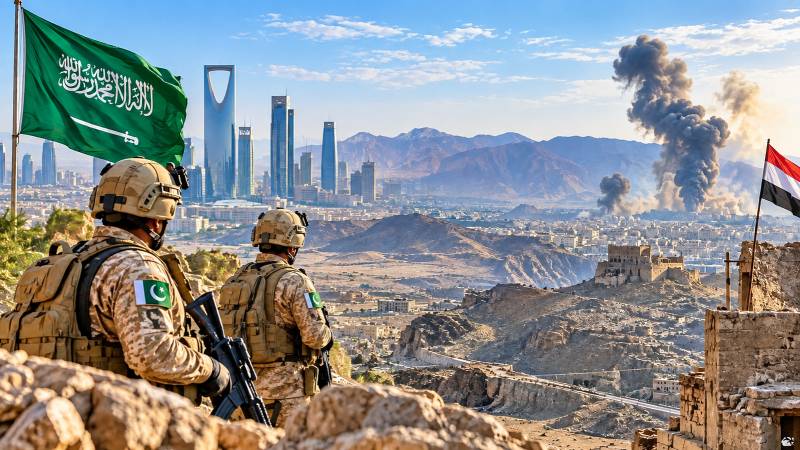
No matter which way one slices or dices it, the only way out for Riyadh is to talk to Ansar Allah and also leash the government it backs in Yemen. Pakistan, instead of being sucked into an ill-conceived Saudi war, should help in diplomatically resolving the issue.
Reports in various news outlets, including Reuters, suggest that Pakistan has sent four planeloads of military equipment to Saudi Arabia. About 7/8000 Pakistani military personnel are already based in the Saudi kingdom. Some are advising and training the Saudi military. The equipment includes drones, ground air defence systems and light artillery.
Pakistan’s troops presence in KSA is not new and in and of itself is not a matter of concern. However, we are told that the current deployment and military supplies are necessitated by the Makkah Joint Defence Agreement (MJDA), specifically the collective defence clause, and renewed hostilities between KSA and Ansar Allah in Yemen.
I have already criticised that clause in this space so I won’t go into why we should have avoided that millstone around our neck. What I intend to do here is to (a) give the reader a comparison of KSA’s and Pakistan’s defence expenditures and (b) analyse four possibilities that exist for any military undertaking if one is actually undertaken and why none is likely to deter Ansar Allah.
Riyadh made it to the list of Stockholm International Peace Research Institute’s (SIPRI) top fifteen global defence spenders in 2013 when a massive 14% surge in spending pushed its military budget to $67 billion. In that year it surpassed the United Kingdom and France to rank as the 4th largest military spender globally. This upward trajectory peaked in 2015 at an all-time high of $87.2 billion, briefly making the Kingdom the 3rd largest military spender in the world, trailing only behind the United States and China and a notch above Russia.
For 2025, Riyadh’s defence spending is $83.2 billion and it occupies 8th position on the SIPRI list as a global defence spender. This budget consumes 6.5% of Riyadh’s GDP, which is one of the heaviest defence burdens in the world, and accounts for approximately 21% of total budget allocations. Let me now give the reader two estimates on Pakistan’s defence spending: one by Janes, the other by SIPRI.
Janes’ puts Pakistan’s official defence at approximately $10.8 billion for FY 2026–27. This represents a nearly 16% increase over previous year’s revised budget. It accounts for roughly 2.08% of the country’s projected GDP and consumes about 16% of the total federal budget outlay.
SIPRI works the figures differently. It factors in military pensions (which cost PKR 822 billion and are handled under a separate government ledger), paramilitary forces and strategic procurement contracts and estimates Pakistan’s overall defence-related spending to reach $11.9 billion. This raises the defence burden to 2.91% of Pakistan’s total GDP. I will go with the SIPRI calculation, round it off to $12 billion and work out the differential between KSA’s and Pakistan’s defence spending. It stands at a staggering $71.2 billion.
Why am I giving these figures? If it’s not clear, let me state it clearly. A country spending $71.2 billion less on defence is sending military equipment to a country that is globally the eighth largest spender on defence. But wait. We are missing out on another fact. Riyadh entered this exclusive club in 2013 (quite another thing that it spent $56.5 billion in 2012). We are in 2026. That’s 13 years of high spending. And it still needs us to fight or help it fight Ansar Allah?! While no decision has been made so far, official statements indicate that we might just be sleepwalking into a quagmire. In any case, it is very different from 2015 when we decided, correctly, to stay out of Riyadh’s decision to launch a war against Ansar Allah. But let’s leave aside the obvious fact that getting dragged into a Saudi war in Yemen would be an egregious folly and look at four military-operational possibilities so that the AI-assisted Sun Tzus on social media can be educated.
The first is ground offensive. What does it mean, what does it require and what can it achieve? It means putting boots on the ground. Easy? Hell, no! For a start, going by the terrain, geographic expense and adversary strength and capabilities, a conventional ground offensive to dislodge Ansar Allah would require an estimated 150,000 to 200,000 troops. This requirement is on the low side and derived from US Army Field Manual, Marine Corps Warfighting Publication, Liddell Hart’s seminal essay, The Ratio of Troops to Space and James Quinlivan’s Force Requirements in Stability Operations.
In highly complex, mountainous terrain, the standard 3:1 attacker-to-defender ratio is insufficient. The literature cited above dictates a 6:1 or 9:1 force-multiplication ratio to execute clearing operations and secure extended, non-linear lines of communication against an entrenched insurgency.
No matter which way one slices or dices it, the only way out for Riyadh is to talk to Ansar Allah and also leash the government it backs in Yemen. Pakistan, instead of being sucked into an ill-conceived Saudi war, should help in diplomatically resolving the issue.
Yemen’s northern geography consists of rugged volcanic peaks and deep ravines that favour defensive operations and allow defenders to attrit the attacking force. Ansar Allah fighters, over many years and by learning from Hezbollah and Iranian trainers, utilise this terrain effectively and rely on subterranean networks and natural caves to offset an attacker’s technological advantages. But what about armour and mechanised infantry? Safer, no? Yeah, right!
Armour and mechanised infantry can be deployed in specific sub-regions of northern Yemen but their operational utility is strictly limited to isolated pockets of flat or undulating terrain. The intermittent flat ground found in the coastal Tihamah plain to the west, specific wide valley floors and the eastern desert fringes bordering Saudi Arabia (such as parts of Jawf and Marib provinces) allow such deployment but the deployment’s effectiveness is restricted because of terrain fragmentation, chokepoints and canalisation (a military tactic or geographic condition that restricts movement into a narrow, predictable corridor and reduces the ability to manoeuvre).
Ask any armour or mech-infantry officer and he will tell you what his biggest nightmare will be in such a fragmented terrain: asymmetric anti-tank/infantry fighting vehicle teams utilising high ground and exploiting canalisation. As for foot infantry, it must engage the defenders in high-altitude, peak-to-peak fighting and clearing operations. That’s no cakewalk.
This is just the beginning of an attacker’s problems. The other is logistics. I can assure the reader that tanks, APCs and IFVs do not operate without fuel or munitions and repairs. Soldiers need rations, water, ammunition. Maintaining and sustaining a force which also has a mechanised component in a fragmented, hostile terrain is a nightmare for the massive tail of fuel trucks, ammunition carriers, and recovery vehicles. And what routes will these soft-skinned supply vehicles will travel? The same vulnerable mountain corridors. What does that mean? The defender, even when he is not directly attacking an armoured column, can isolate the forward elements by destroying a single bridge or blocking a route by triggering a landslide.
Are we done here? Unfortunately, not. The accursed modern battlefield is now heavily saturated with low-cost first-person view drones and buy-off-the-shelf quadcopters (go to Nisbat Road in Lahore and you would know!). What this means is that any discerning reader can google what’s happening on the Donbas front and more generally in the Russia-Ukraine war. Widespread drone surveillance has complicated not just massed armour movements but large infantry movements too. And we already know Ansar Allah’s capabilities with drones. This is a brief overview of the first of the four options. But before I go to the next three, let me take a pause and speak about an historical, pre-eyes-in-the-sky precedent.
Yemen as Egypt’s Vietnam. Egypt deployed forces to Yemen in 1962 to support the military-republican coup against the Zeydi Mutawakkilite Imamate. Cairo supported the officers and viewed its military intervention as a means to project pan-Arab influence and also counter Saudi regional dominance (Riyadh, incidentally, was supporting the Zeydi imam at the time).
From 1962 to ’67, the Egyptian expeditionary force faced a decentralised guerrilla insurgency led by the Zeydi tribes. Predictably, they leveraged the rugged highlands, avoided set-piece battles and engaged the Egyptian military through a series of raids and ambushes.
Result: the Egyptian army suffered significant losses. At the peak of the conflict, Cairo had committed 70,000 troops, nearly a third of its military, but failed to stabilise the interior. Figures differ but the mean seems to suggest that the force lost some 15,000 soldiers to combat, disease, and logistical failures.
There was a bigger problem, though. The intervention degraded Egypt's broader strategic posture. The financial cost and operational strain, combined with the deployment of elite divisions away from the home front, left Egypt's military overextended. When the Zionist entity attacked preemptively in June 1967, Egypt’s elite fighting elements were bogged down in Yemen. The Khartoum Resolution, which among other issues ended the war in northern Yemen came on September 1, 1967. By then the damage had been done to Egypt in Yemen and against the Zionists. Now back to the second military option.
Let’s assume that the top military commander is smart enough to realise that it’s best not to take the ground incursion option and rely instead on precision, stand-off air and missile strikes. Wouldn’t that work? Hmm…, not really. The Saudi-led coalition (from 2015 to 18), and more recently US/UK campaigns, conducted extensive aerial operations with limited strategic results. This is not the space to discuss why Italian air war theorist Giulio Duohet’s optimism about aerial bombing has been proven wrong but briefly here’s why.
Ansar Allah operates a decentralised command structure and utilises mobile, easily concealed launch platforms for drones and ballistic missiles. Because their key assets are concealed and positioned within mountains or in populated urban centres, airpower alone cannot achieve decisive degradation.
The limitations of stand-off strikes are also evident in the Iran-US-Zionist context. Despite advanced intelligence networks and air superiority, stand-off strikes have not permanently dismantled regional resistance networks or prevented coordinated drone and missile salvos. Airpower can be useful but only in a limited way. It cannot win the war.
Damn! How about a combination of passive defence and active non-contact attacks, our third military option? Sure, that could be done. But there’s a problem. Defending vulnerable areas and points through air defence shields, point defence and fortified borders and pairing that with active non-contact attacks (rockets, missiles and targeted drone strikes) generally results in a static conflict. The approach definitely limits expeditionary casualties, but it surrenders the strategic initiative to the adversary. In our present case, Ansar Allah is adept at cross-border incursions and using low-cost loitering munitions to bypass expensive air defence systems.
To clarify this point, let me give an example from closer to home. This dynamic mirrors the ongoing Pakistan-Afghan border frictions. Pakistan’s strategy of constructing a border fence (passive defence) alongside targeted cross-border artillery or intelligence-led strikes against TTP sanctuaries has not stopped asymmetric cross-border movement. Instead, it has morphed into a persistent, low-intensity conflict. For an intervening force in Yemen, this approach creates an unsustainable resource drain without yielding any territorial breakthroughs or forcing Ansar Allah to change its behaviour. Sigh. The land option is dangerous. The other two options push us into a stalemate. Maybe, we should get to the sea. Maybe! So, let’s talk a naval blockade. Easy-peasy? Err… no.
Enforcing a naval blockade requires a substantial maritime commitment. Such a force would need frigates, destroyers, perhaps an odd submarine and maritime patrol assets to monitor the Red Sea and Gulf of Aden. It’s very expensive and resource-draining. Also, these Ansar Allah chappies have developed and deployed effective coastal defence capabilities. They use anti-ship cruise missiles, waterborne improvised explosive devices and loitering munitions. Singly and in tandem these capabilities pose a direct threat to naval vessels.
Exhibit: on April 28, 2025, a US F/A-18E Super Hornet fell overboard into the Red Sea after the carrier, USS Harry Truman, made a sudden, hard turn to evade incoming Ansar Allah drone and missile fire.
Exhibit 2: the vulnerability of modern navies to asymmetric coastal defences has been most effectively demonstrated in the Black Sea. Ukraine, which doesn’t have much of a navy, has used sea drones and shore-to-ship missiles to sink or displace elements of Russia's Black Sea Fleet.
Exhibit 3: Iran has effectively blocked the Strait of Hormuz against the world’s most powerful navy with the biggest air arm.
Additionally, as evidenced by US’s and UK’s naval operations in the Red Sea, a blockade cannot prevent localised smuggling or domestic weapons assembly. Without taking and holding ground, maritime interdiction remains a holding action that fails to change the fundamental balance of power.
This is as far as the four military options are concerned. If any Sun Tzu, of which we are fraught in this age, has any other option(s), I would be very happy to learn. Meanwhile, before I sign off, let’s get to that fellow, the Prussian Carl von Clausewitz. The guy insisted that war should have a politico-strategic objective. He wasn’t the only one but he is better known. In any case, other experts agree with him. In which case, the obvious question is, what is Riyadh’s politico-strategic objective in Yemen? If it is to occupy northern Yemen, that’s not happening. But if the strategic goal is to secure Saudi Arabia’s borders and infrastructure, military escalation will only invite (as it has) retaliation rather than deterring Ansar Allah.
We are then left with diplomacy. Fact is, it worked until recently. There was a four-year truce and it demonstrated that political engagement can produce results that military campaigns cannot. The other fact is that the current round of hostilities began when the Saudi-backed government in Yemen disrupted this peace with a strike on the Sana’a airport.
No matter which way one slices or dices it, the only way out for Riyadh is to talk to Ansar Allah and also leash the government it backs in Yemen. Pakistan, instead of being sucked into an ill-conceived Saudi war, should help in diplomatically resolving the issue. It has China in its corner, it speaks regularly with Iran and it has a pact with Riyadh. That fulfils the necessary condition and prepares the ground to work towards the sufficient. That’s the only sensible option. The other offers no clear path and runs the risk of getting trapped in a complex conflict.