

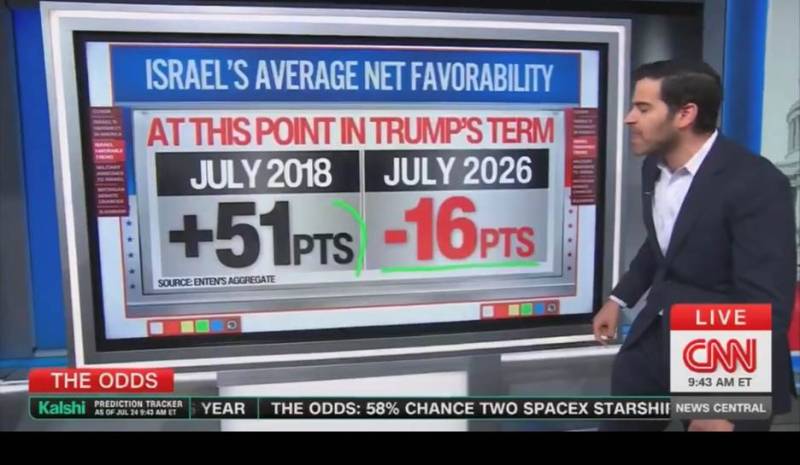
In an interview on Sixty Minutes that was broadcast on the Sunday after Tuesday’s Midterm elections on November 3 elections, the US President mentioned the Iran War as one of the reasons for the overwhelming defeat of the Republican Party but added that “there is a great dislike, incredibly, for Israel.” Coming from a man who had said just weeks earlier that 99% of Israelis liked him, this was a stunning admission. It’s worth noting that Israel’s Prime Minister had called him the best friend that his country ever had in the White House.
According to CNN, Israel’s net favourability rating in the US was +51 points in July 2018 during the President’s first term. In July 2026, during his second term, it dropped precipitously to -16 points.
Before 7 October 2023, Israel enjoyed substantial diplomatic support in Western countries. It was successfully expanding ties with several Arab governments, while maintaining extensive economic and technological connections with the West. Its treatment of Palestinians was controversial, but that controversy had not prevented significant diplomatic advances.
By November 2026, when the US midterm elections were held, Israel faced considerably more unfavourable public opinion, greater diplomatic criticism from traditional allies, international legal proceedings against its leadership, and renewed international recognition of Palestinian statehood. However, its strategic relationships, particularly with the United States, remained substantial.
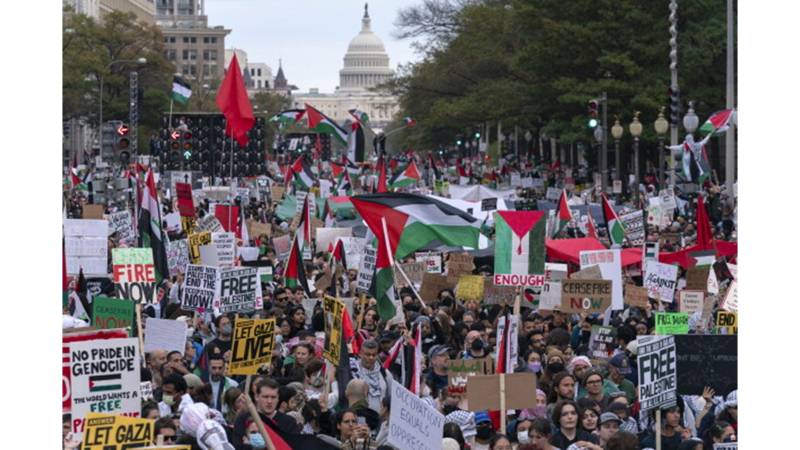
According to the Washington Post, citing a poll conducted by the Chicago Council on Global Affairs, most Americans now want to decrease or stop military aid to Israel. This sea change in American sentiments is correlated directly to the devastation Israel has unleashed on Gaza. The number of Palestinians killed there exceeds the number killed in Israel on October 7 by a factor of 70. Most of those killed are women and children. Just about all apartment buildings, schools and colleges, mosques, hospitals and shopping malls have been flattened.
Robert Pape, a professor at the University of Chicago and an expert on aerial warfare, states that “the word ‘Gaza’ is going to go down in history along with Dresden and other famous cities that have been bombed.” He argues that just as the names Dresden, Hamburg, and Cologne became historical shorthand for the absolute heaviest conventional bombing campaigns of the 20th century, Gaza has joined that infamous list due to the sheer density and speed of its devastation.
When comparing the data, Pape points out that the proportion of physical damage in Gaza rivals or exceeds World War II metrics:
- Dresden: The Allied bombing of Dresden between 1943 and 1945 damaged or destroyed roughly 56% of its non-industrial buildings.
- Gaza: In contrast, analysis of satellite data by remote-sensing experts during the first few months of the conflict showed that upwards of 70% to 80% of buildings in northern Gaza had been damaged or destroyed. Many more have probably been destroyed since then.
Pape says that military planners mistakenly believed that “coercive punishment”—shattering a city and inflicting mass civilian misery—would break the population's morale, causing them to turn against their leaders. The reality is that the carpet-bombing of Dresden and Hamburg completely failed to break German civilian morale or trigger a popular uprising against the Nazi regime. He argues Israel is making the same mistake. Instead of fracturing support for Hamas, the massive devastation and civilian casualties serve to deeply radicalize the population, driving resentment and ultimately increasing popular alignment with the insurgency rather than weakening it.
Israel's deteriorating position in the world seems to evoke the growing diplomatic isolation which faced apartheid-era South Africa
Without question, the massive bombardment of Gaza has tanked Israel’s popularity, not just in the world but also in the US, it’s most staunch backer. Israel’s popularity can be assessed in four dimensions: public opinion, diplomatic recognition, international legal standing, and economic relationships. Each dimension tells a somewhat different story.
Two graphs are worth reviewing, before we do a deep dive into the story behind the graphs.
American public opinion: 2023 versus 2026
Gallup provides one of the clearest comparisons because it has asked Americans the same question for more than two decades.
Net sympathy advantage for Israelis over Palestinians
February 2023
+23 points
February 2026
−5 points
That’s a dramatic, 28-percentage-point change in the balance of American sympathies.
Percentage of US adults sympathizing more with Israelis or Palestinians
Source: Selected annual Gallup surveys
| Israelis | Palestinians | |
| 2016 | 62% | 15% |
| 2018 | 64% | 19% |
| 2020 | 60% | 23% |
| 2022 | 55% | 26% |
| 2023 | 54% | 31% |
| 2024 | 51% | 27% |
| 2025 | 46% | 33% |
| 2026 | 36% | 41% |
Source: Gallup annual World Affairs surveys, February of each year. The 2023 survey preceded October 7. The five-point difference in 2026 is within the survey's margin of error.
The most important findings are:
- Sympathy for Israelis declined by 18 percentage points, from 54% to 36%.
- Sympathy for Palestinians increased by 10 points, from 31% to 41%.
- The balance shifted by 28 points, eliminating Israel’s longstanding advantage in this measure.
The trend had begun before the Gaza war, but it accelerated after the war broke out.
| American adults | 2023: Israelis | 2026: Israelis | Change |
| Republicans | 78% | 70% | −8 points |
| Independents | 49% | 30% | −19 |
| Democrats | 38% | 17% | −21 |
This is particularly significant because the decline is not restricted to Democrats. Independents have also shifted substantially, while Republicans remain considerably more sympathetic to Israelis.
Pew Research Center provides a separate, useful comparison of how Americans perceive the Israeli population and its government.
American favourable views: 2022 versus 2026
Percentage of US adults with favourable opinions
Source: Pew Research Center, July 2026. The 2022 figures are the closest comparable prewar measurements in this series.
| 2022 | 2026 | |
| Israeli people | 67% | 52% |
| Israeli government | 47% | 32% |
| Palestinian people | 53% | 50% |
The results show that favourable attitudes toward both the Israeli government and Israeli people declined by 15 percentage points, while favourable attitudes toward Palestinians changed relatively little.
The distinction matters: disapproval of the Israeli government’s conduct cannot be interpreted as hostility toward Jewish people or toward individual Israelis.
Global opinion: Where Israel stands in 2026
Unlike Gallup's American series, there is no equally comprehensive, consistent worldwide survey covering the same countries immediately before October 7 and in 2026.
We can nevertheless establish the current scale of unfavourable sentiment.
Unfavourable views of Israel, 2026
Percentage of adults in selected countries
Pew Research Center
| Unfavourable | |
| Japan | 83% |
| Australia | 79% |
| Spain | 78% |
| Italy | 75% |
| Germany | 73% |
| United Kingdom | 69% |
| France | 68% |
| Canada | 65% |
| United States | 60% |
| India | 28% |
Pew Research Center, February–May 2026. These are 2026 levels, not changes since 2023.
Across 36 surveyed countries and territories, Pew reported a median of 67% unfavourable toward Israel.
This demonstrates the breadth of current disapproval, but it would be misleading to attribute the entire 67% to the Gaza war. Some countries already had unfavourable views of Israel before 2023, and the 2026 survey was conducted largely after the outbreak of the US-Israeli war with Iran.
Israel’s diplomatic standing
Israel’s diplomatic standing took a big hit after the Gaza war, as shown in the table:
| Indicator | Before 7 October 2023 | By November 2026 |
| Relations with Western Europe | Extensive diplomatic and economic cooperation, alongside disagreements over settlements | Greater public criticism, recognition of Palestine by several major allies, and proposed restrictions |
| United States | Strong bipartisan strategic partnership | Strategic partnership continues, but American public opinion is more divided than ever before |
| Saudi Arabia | US-brokered normalization negotiations underway | Normalization remains unresolved; Saudi Arabia emphasizes Palestinian statehood |
| United Kingdom | Did not recognize Palestinian statehood | Recognized Palestine in September 2025 |
| France | Did not recognize Palestinian statehood | Recognized Palestine in September 2025 |
| Canada | Did not recognize Palestinian statehood | Recognized Palestine in September 2025 |
| Australia | Did not recognize Palestinian statehood | Recognized Palestine in September 2025 |
| European Union | Association Agreement remained a central framework for cooperation | European Commission proposed partially suspending trade provisions, but the proposal remained unadopted |
Sources: UK House of Commons Library and European Commission.
One of the most consequential developments was the recognition of Palestine by Britain, France and Canada in 2025. These were the first G7 countries to take that step.
The decisions did not establish Palestinian sovereignty on the ground, but they represented a significant diplomatic change among governments historically close to Israel.
Israel’s legal standing
Before October 2023, Israel faced long standing international legal disputes over occupation, settlements and Palestinian rights, but its current prime minister was not subject to an ICC arrest warrant. In January 2024, the International Court of Justice (ICJ) reviewed South Africa’s case under the Genocide Convention. The ICJ ordered provisional measures concerning protection of Palestinians in Gaza. It did not issue a final judgment finding genocide.
In November 2024, the International Criminal Court (ICC) issued arrest warrants for Benjamin Netanyahu and former Défense Minister Yoav Gallant over alleged war crimes and crimes against humanity. The allegations remain contested, and the warrants are not convictions.
The distinction between the courts matters. The ICJ adjudicates disputes between states; the ICC addresses alleged individual criminal responsibility.
These proceedings have introduced legal and diplomatic constraints that did not exist in the same form before the war.
Israel’s economic relations
The economic evidence is more complicated. Israel’s Central Bureau of Statistics reported that goods exports declined by 9% in 2025 compared with 2024, including a 14.7% decline in exports to European countries. These figures do not establish how much of the decline resulted from boycotts, political pressure, wartime disruptions or other economic factors.
At the same time, according to the European Commission’s trade statistics for 2025, economic cooperation between the EU and Israel remained substantial. EU–Israel goods trade in 2025 was valued at €43.3B. EU share of Israel’s goods trade was 31.7%.
The EU also remained Israel’s largest goods-trading partner. Consequently, the deterioration in diplomatic relations has not produced a comparable collapse in trade. This is an important counterweight to the public-opinion evidence: international disapproval and economic disengagement are not the same phenomenon.
| Dimension | Measurable change since prewar period | Interpretation |
| American sympathy for Israelis | −18 percentage points | Large decline |
| American sympathy for Palestinians | +10 points | Substantial increase |
| American favourable opinion of Israeli government | −15 points since 2022 | Significant deterioration |
| American favourable opinion of Israeli people | −15 points since 2022 | Decline extends beyond government |
| Western recognition of Palestine | Britain, France, Canada, Australia and others recognized in 2025 | Significant diplomatic change |
| International legal exposure | New ICC warrants and ICJ proceedings | Substantial institutional consequences |
| Economic relations | Trade declines in some categories, but major relationships continue | Mixed evidence |
| US–Israel strategic cooperation | Continues despite growing public divisions | Considerable continuity |
How much of Israel’s unpopularity can be attributed to Gaza? The evidence supports a distinction between three periods. Before October 2023, Israel already faced criticism over settlements, occupation and the Palestinian question. American sympathy for Israelis had been declining for several years. From October 2023 through 2025, the Gaza war unleashed civilian casualties on an unprecedented scale in Gaza, along with destruction of homes, schools, hospitals, offices and shops. These factors, along with displacement of thousands of Palestinians, and the humanitarian crisis caused by shortages of medicines, energy, food and sanitation became central issues in international diplomacy. Recognition of Palestine and international legal proceedings followed.
These changes were directly connected to the conflict. In 2026, public opinion continued to deteriorate in several countries, but the military confrontation with Iran complicated efforts to isolate Gaza's contribution. The strongest evidence of the Gaza war's effect comes from decisions explicitly justified by governments on humanitarian and political grounds, rather than from opinion polls alone.
Conclusion
Israel’s public reputation and diplomatic environment have changed substantially since October 2023, as demonstrated by consistent American polling, the recognition of Palestine by major Western countries, and international legal proceedings.
Its economic and security relationships, however, have proved more durable. Israel remains deeply integrated into Western trade and security networks, and governments have not responded uniformly to public criticism.
The longer-term question is whether the deterioration in public attitudes eventually changes the policies of governments that currently maintain close relations with Israel.
That distinction between public opinion and state policy may be the most important finding of the comparison. It also raises a historical question worth examining. Israel's deteriorating position in the world seems to evoke the growing diplomatic isolation which faced apartheid-era South Africa. No analogies are perfect, but this one is hard to ignore.