

The Iran war is not over; it has entered an even more dangerous phase. The opening of the Houthi front has widened the conflict towards Yemen and the Red Sea, while attacks on Saudi Arabia have activated the Makkah Pact and drawn Pakistan more directly into Gulf security. With both the Strait of Hormuz and Bab el-Mandeb under pressure, what began as a conflict centred on Iran has become a wider struggle over regional security, energy flows and some of the world’s most important maritime routes.
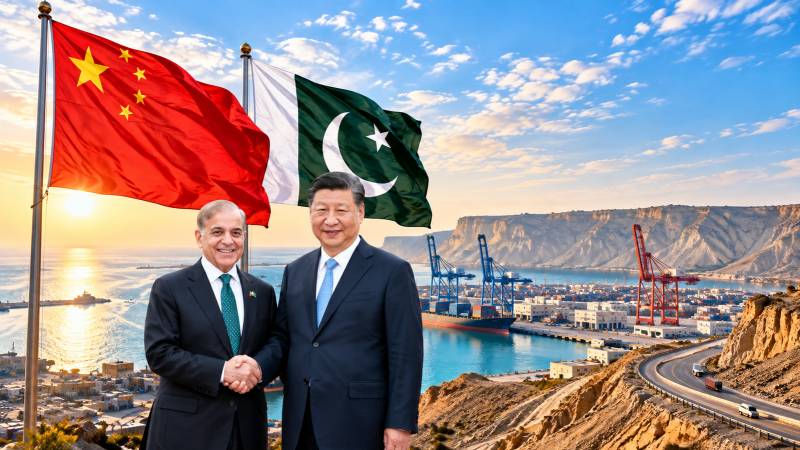
Pakistan’s role has consequently evolved from mediation and crisis diplomacy towards a more consequential security role in the Arab Gulf, even as it continues to favour an eventual negotiated settlement. China has consistently supported Pakistan’s diplomatic efforts while seeking to protect its enormous energy, trade and investment interests across the Middle East. Their roles are different, but their strategic priorities increasingly converge—on regional stability, secure sea lanes and economic connectivity—potentially opening a much wider space for China-Pakistan cooperation after the war.
I had an opportunity to examine this changing relationship closely during a 10-day visit to China in September. On September 3, I presented a paper, “China-Pakistan Collaboration in the Iran Conflict: Assessment and Post-Conflict Scenarios,” at an international conference organised by the Pakistan Study Centre at Peking University to mark 75 years of Pakistan-China relations. The gathering brought together scholars and policy practitioners, including former Pakistani foreign secretaries and ambassadors who had served in Beijing.
A week later, on September 11, I attended another conference at the Pakistan Study Centre of Fudan University in Shanghai, bringing together contributors to a forthcoming volume on 75 years of Pakistan-China relations, in which an expanded version of my paper will appear as a chapter. Spending nearly two weeks in China also provided an opportunity to gauge Chinese perceptions at a particularly consequential moment in the relationship.
What struck me was not simply the familiar Chinese confidence in Pakistan as an enduring strategic partner. There was also an appreciation that Pakistan’s relevance is no longer confined to South Asia. The Iran war has brought into sharper focus a geographical reality that CPEC had already begun to reveal: Pakistan sits at the intersection of South Asia, Central Asia, Iran and the Arab Gulf, while China’s economic and political interests now extend deeply across all these regions.
Wars are perhaps the most severe test of strategic partnerships. China and Pakistan have enjoyed exceptionally close relations for decades, sustained by historical trust and remarkably consistent alignment on their principal strategic interests. The Iran conflict has tested that relationship outside its traditional geographical setting and, in doing so, has revealed possibilities that extend well beyond the immediate crisis.
Pakistan entered the conflict in an extraordinarily difficult position. Iran is an immediate neighbour; Saudi Arabia and the Gulf states are vital economic and strategic partners; the United States remains an important relationship; and China is Pakistan’s principal long-term strategic partner. Islamabad could neither afford a prolonged regional war nor choose one relationship at the expense of the others. Its response combined strategic restraint with active diplomacy. Pakistan maintained its channel with Tehran, coordinated closely with Riyadh and other Gulf capitals, remained engaged with Washington and consulted regularly with Beijing. This unusual access across competing centres of power ultimately gave Islamabad the diplomatic space to mediate.
China stood firmly behind that effort. Beijing’s role differed from Pakistan’s, but their principal objective was substantially the same: contain the conflict, prevent its regionalisation and create conditions for a return to diplomacy. The two countries were therefore not necessarily following identical policies, but they were pursuing compatible strategic outcomes.
On March 31, Foreign Ministers Wang Yi and Ishaq Dar announced a joint Five-Point Initiative in Beijing calling for cessation of hostilities, negotiations, respect for sovereignty and regional stability. Its essential principles subsequently found expression in the diplomatic process pursued through Islamabad. Beijing repeatedly praised Pakistan’s mediation, describing its approach as “fair and balanced,” Pakistan as a “reliable and qualified mediator,” and its role in achieving the first-phase US-Iran understanding as “indispensable.”
Pakistan’s ability to maintain relationships with Iran, Saudi Arabia, the United States and China simultaneously has given Islamabad unusual diplomatic space and increased its relevance to regional security.
There was important historical continuity in this convergence. China has generally preferred diplomacy to military involvement in the Middle East, with its most consequential recent diplomatic achievement in the region coming in 2023, when Beijing facilitated the restoration of relations between Saudi Arabia and Iran after years of hostility. During the present conflict, China again chose diplomatic engagement rather than becoming a military protagonist.
Pakistan’s objective was similarly straightforward. Islamabad did not seek an Iranian or American victory; it sought an end to a war threatening its western neighbourhood, its Gulf partners, its energy security and its economic interests. This alignment of interests, rather than identical policies, explains the close China-Pakistan coordination during the crisis.
The Strait of Hormuz illustrates this convergence most clearly. For Pakistan, disruption of Hormuz means higher energy costs, pressure on foreign exchange, interruption of trade and instability close to its borders. For China, the stakes are even larger because of its enormous dependence on imported Gulf oil and gas and the importance of uninterrupted maritime commerce to its economy.
China’s primary concern in the Gulf is therefore stability: secure energy supplies, freedom of navigation, functioning trade routes and an environment in which commerce and investment can flourish. Beijing has little interest in turning the Middle East into another theatre of great-power confrontation, particularly when geopolitical competition threatens the economic relationships it has painstakingly developed across the region.
This also places the American role in a more nuanced context. China does not necessarily need to replace the United States as the principal external security provider in the Gulf. An American security presence that ensures freedom of navigation through Hormuz and other critical sea lanes can also protect Chinese commercial interests; Beijing’s concern arises when military power becomes an instrument of geopolitical competition that destabilises the region or threatens energy flows.
Pakistan can operate comfortably within this space. Its improving relationship with Washington has not come at the expense of Beijing, while its longstanding relationships with Saudi Arabia and the wider Gulf are increasingly acquiring a security dimension alongside their traditional political and economic foundations. This gives Pakistan room to engage multiple major powers without turning its relationships into mutually exclusive choices.
The Makkah Pact with Saudi Arabia and Türkiye is the most important manifestation of this development. Combined with Pakistan’s longstanding bilateral defence relationship with Saudi Arabia, it potentially gives Islamabad a more institutionalised role in Gulf security than it possessed before the Iran conflict. The significance extends beyond immediate defence commitments, because Pakistan is beginning to move from being primarily a bilateral security partner of individual Gulf states towards participation in a broader regional security framework.
If this process consolidates after the war, Pakistan’s strategic relevance in the Middle East will increase substantially. That matters for China because Beijing has spent the past decade developing an enormous economic presence across precisely the same geographical space in which Pakistan’s diplomatic and security role is now growing.
China is already a principal trading partner of the Gulf states, their largest energy customer in Asia and an increasingly important source of investment, infrastructure and technology. Saudi Arabia and the UAE, in particular, have developed extensive economic relationships with Beijing while retaining their longstanding security relationships with Washington. China’s Belt and Road Initiative has reinforced this expansion through infrastructure, energy, logistics and investment projects across the wider region.
CPEC and Gwadar could evolve from a predominantly bilateral China-Pakistan project into part of a broader transregional network linking western China and Pakistan with Iran, Central Asia and the Gulf.
Pakistan is approaching the same region from another direction. It brings geography, military capability, longstanding relations with Arab states and, after its role in the Iran crisis, greater diplomatic credibility. China brings capital, technology, markets and enormous economic stakes, creating roles that are potentially complementary rather than competitive.
This is also why CPEC should no longer be viewed solely as a bilateral Pakistan-China undertaking. Its future significance increasingly lies in its potential connection with a larger transregional economic space. Gwadar, similarly, is frequently described either as a Pakistani port or as China’s access point to the Arabian Sea, when its greater potential lies in becoming part of a network connecting western China and Pakistan with Iran, Central Asia and the Gulf.
The eventual outcome of the Iran war will be critical to this possibility. Whether Iran’s present political order survives intact, evolves internally or undergoes more fundamental change, the country’s geography will remain unchanged. Iran will continue to occupy the landmass connecting Pakistan with Central Asia, Türkiye and the Gulf, making its eventual stability important to any serious vision of regional economic integration.
A stable post-war Iran seeking reconstruction and economic reintegration could offer substantial opportunities. China possesses capital, technology, infrastructure expertise and a huge market, while Pakistan possesses proximity, access and potentially a developing trade and logistics corridor through CPEC and Gwadar. Pakistan-Iran trade also has considerable room to grow if political, financial and security constraints ease.
Greater stability along Pakistan’s western frontier could allow road, rail, energy and commercial links to develop in ways that decades of sanctions and confrontation have prevented. CPEC could consequently evolve from a predominantly bilateral corridor into part of a wider network linking western China and Pakistan with Iran, Central Asia and the Gulf.
The larger opportunity, however, may ultimately lie across the Arab Gulf. Saudi Arabia and other GCC states are undertaking massive programmes of economic diversification, while China is already deeply engaged through trade, investment, energy, infrastructure and technology. Pakistan, meanwhile, possesses longstanding human, economic, political and security relationships with these countries.
Pakistan’s expanding security role could therefore add another dimension to a region where Chinese economic interests are already substantial. This does not mean Pakistan becomes a Chinese proxy in the Gulf; Islamabad’s relationships with Saudi Arabia, Türkiye, Iran, the UAE and the United States are driven by its own national interests. Rather, if Pakistan becomes a more consequential provider of security and diplomatic stability where China has enormous economic stakes, the strategic space in which Pakistan and China can cooperate inevitably becomes wider.
Turkiye adds another dimension to this emerging landscape. Its participation alongside Pakistan and Saudi Arabia in the Makkah framework links three important regional states across South Asia, the Gulf and the eastern Mediterranean. China already possesses significant economic relationships throughout this geographical arc, giving Beijing a strong interest in the stability of an increasingly interconnected regional space.
The emerging geography is therefore quite different from the traditional map of China-Pakistan relations. For most of their history, the partnership was viewed primarily through South Asia: India, defence cooperation, diplomatic support and, more recently, CPEC. Increasingly, another map can be imagined, extending from western China through Pakistan and the Arabian Sea towards Iran, Saudi Arabia and the wider Gulf, while reaching northwards towards Central Asia.
This is why the Iran war may ultimately prove important to China-Pakistan relations for reasons extending well beyond Iran itself. It has demonstrated Pakistan’s capacity to exercise diplomatic influence outside South Asia while highlighting how closely Islamabad’s interest in regional stability overlaps with Beijing’s growing economic and strategic interests in the Middle East.
It has also demonstrated the continuing importance of history. Seventy-five years of China-Pakistan relations have created accumulated strategic trust, allowing neither country to require the other to replicate its foreign policy. Pakistan can engage Washington and strengthen Gulf security partnerships while maintaining close relations with Beijing; China can maintain its relationship with Iran while simultaneously expanding ties with Saudi Arabia and other Arab states.
That flexibility is an important strategic asset in an increasingly fluid Middle East, but there are serious qualifications. The war remains unresolved, Hormuz is insecure and Iran’s future is uncertain. The Makkah framework must also demonstrate that it can contribute to regional stability without becoming another source of bloc politics, while renewed military escalation could again disrupt energy supplies, trade and investment.
Pakistan faces important limitations of its own. Diplomatic relevance cannot substitute for economic performance, and Chinese investors have become more commercially selective. Security threats, bureaucratic delays, inconsistent policies and implementation failures continue to constrain CPEC, reminding Islamabad that strategic geography can create opportunities but cannot guarantee that they will be exploited.
Nevertheless, the Iran conflict has already demonstrated that the China-Pakistan strategic partnership can operate effectively in a major crisis beyond South Asia. Pakistan has employed diplomacy, strategic relationships and its growing security weight, while China has used political engagement, economic influence and consistent support for de-escalation. Their instruments have differed, but their fundamental interests have largely converged.
The next stage could be considerably more consequential. Pakistan may emerge from the war with greater diplomatic credibility and a more important security role in the Gulf, while China will remain one of the region’s largest trading partners, investors and energy customers. Between them lie CPEC, Gwadar and the possibility of much wider regional connectivity. For 75 years, history has provided the cement for China-Pakistan relations, and the Iran war has tested that foundation under extraordinary pressure while revealing how far their interests now extend beyond their traditional bilateral framework. The war is not yet over and its outcome cannot be predicted, but when it does end, China and Pakistan may discover that the strategic space available to their partnership is considerably wider than the one with which they entered it.