

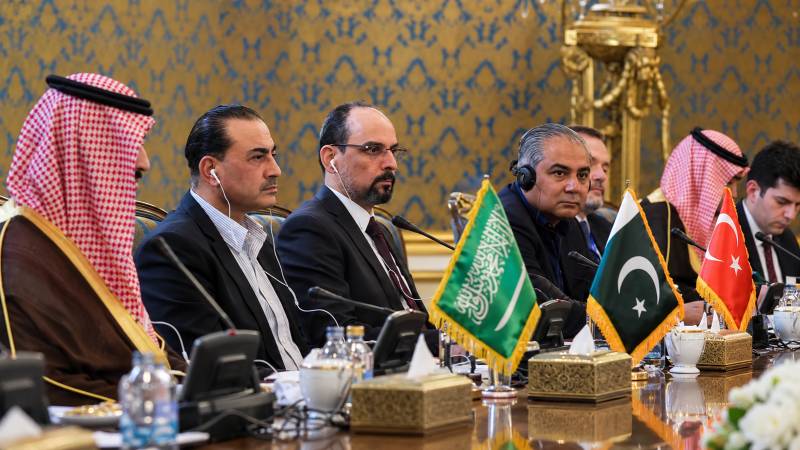
The formation of the Makkah Defence Alliance between Pakistan, Saudi Arabia and Turkiye in August 2026 marked an important development in the security architecture of the Middle East and the wider Muslim world. At a time when regional tensions have intensified, traditional security arrangements are under pressure and the possibility of a wider conflict remains dangerously real, the alliance represents an attempt by three influential Muslim countries to assume greater responsibility for their collective security.
However, the real significance of the alliance may lie not simply in its military capabilities or collective defence commitments, but in its potential to prevent wars through diplomacy, deterrence and dialogue. The October 26 meeting in Tehran between representatives of the three alliance members and Iran's leadership provides an important illustration of this broader role.
The Makkah Joint Defence Agreement, signed on August 7 by Saudi Crown Prince Mohammed bin Salman, Turkish President Recep Tayyip Erdoğan and Pakistani Prime Minister Shehbaz Sharif, establishes the principle that an armed attack against one member will be regarded as an attack against all three. This commitment gives the alliance considerable strategic significance, particularly given the combined military, economic and diplomatic strengths of its members.
Saudi Arabia brings substantial economic resources, energy influence and diplomatic standing. Turkiye contributes an advanced defence industry, extensive military experience and membership of NATO. Pakistan brings significant conventional military capabilities, nuclear deterrence and longstanding defence relationships across the Muslim world. Together, these countries possess considerable capacity to influence regional security developments. Yet military strength alone cannot guarantee peace. Indeed, the history of the Middle East demonstrates that military superiority, without corresponding diplomatic engagement, frequently produces prolonged instability rather than lasting security. This is precisely why the Tehran meeting deserves particular attention.
On October 26, Saudi Defence Minister Prince Khalid bin Salman, Pakistan's Chief of Defence Forces Field Marshal Asim Munir and Turkish intelligence chief Ibrahim Kalın met senior Iranian officials, including President Masoud Pezeshkian. The discussions addressed regional security challenges amid continuing tensions involving Iran, the United States and Israel, as well as escalating hostilities involving Yemen's Houthis. The meeting was significant because it brought together countries with substantial security concerns and, in some cases, competing regional interests, around a common diplomatic table. Rather than allowing the alliance to become an exclusively confrontational military arrangement, its members demonstrated a willingness to engage directly with Tehran. This approach recognises a fundamental reality: lasting regional stability cannot be achieved by excluding Iran from discussions about the region's security.
The participants' agreement to continue dialogue and strengthen cooperation on peace and security was therefore a constructive development, although its ultimate significance will depend on tangible follow-up measures. For Pakistan, the alliance creates both opportunities and responsibilities. Islamabad has traditionally maintained close strategic relations with Saudi Arabia while seeking to preserve a functional relationship with neighbouring Iran. Pakistan also enjoys strong defence and political ties with Türkiye. These relationships provide it with an opportunity to facilitate communication between countries whose interests do not always coincide. Pakistan's recent diplomatic engagement with Tehran and Washington further demonstrates the relevance of this position. Its ability to maintain communication across competing regional blocs could prove valuable in reducing misunderstandings and encouraging negotiated settlements.
The presence of Field Marshal Asim Munir at the Tehran meeting also highlighted the growing importance of military-to-military and security-level diplomacy. In situations where miscalculation can rapidly escalate into armed confrontation, direct communication between senior security officials can be particularly important. The alliance's collective defence provisions are intended to discourage aggression by increasing the potential consequences of attacking any member. However, credible deterrence must be accompanied by clearly defined commitments, effective coordination and mechanisms to prevent accidental escalation. This balance between military preparedness and diplomatic restraint will be central to the alliance's future effectiveness.
The continuing conflict involving Iran and the United States, attacks affecting Saudi Arabia, instability in Yemen and disruptions to regional shipping have demonstrated how interconnected the Middle East's security challenges have become. A confrontation in the Gulf can affect international oil prices, maritime commerce, investment flows and food security far beyond the immediate conflict zone. For developing economies such as Pakistan, the consequences of prolonged regional instability can be particularly severe.
The alliance must avoid assuming that collective military strength automatically translates into diplomatic influence. Its credibility will ultimately depend on whether it can combine deterrence with restraint, maintain unity among its members and encourage practical compromises between competing regional actors.
The Makkah Alliance therefore has an economic as well as a strategic stake in preventing further escalation. Its members could help establish regional communication mechanisms, support ceasefire negotiations, facilitate confidence-building measures and develop procedures for addressing security incidents before they spiral into wider confrontations. The October 26 discussions could provide a foundation for such initiatives, particularly if they lead to regular consultations involving Iran and other regional stakeholders. Nevertheless, significant obstacles remain. The differences between Tehran and Washington over sanctions, nuclear activities and regional military operations cannot be resolved through a single meeting. Similarly, the conflict in Yemen involves political and security grievances that extend well beyond relations between Iran and Saudi Arabia.
The alliance must therefore avoid assuming that collective military strength automatically translates into diplomatic influence. Its credibility will ultimately depend on whether it can combine deterrence with restraint, maintain unity among its members and encourage practical compromises between competing regional actors. There is also a broader lesson in the Tehran engagement. Regional security arrangements need not be defined exclusively by confrontation or rigid divisions between opposing camps. They can provide platforms through which states protect their legitimate security interests while simultaneously pursuing dialogue with potential adversaries.
The Makkah Alliance's emerging diplomatic role suggests the possibility of a more regionally driven approach to conflict prevention, one that complements rather than replaces international diplomacy and existing mediation initiatives. For decades, the Middle East has experienced repeated cycles of confrontation, foreign intervention and fragile ceasefires. Breaking this pattern will require more than new defence agreements. It will demand sustained political engagement, mutual assurances and a recognition that security cannot be achieved at the permanent expense of neighbouring states. The October 26 meeting in Tehran does not, by itself, establish that a new regional security order has emerged. It does, however, demonstrate that the Makkah Alliance can serve as a forum for diplomatic engagement alongside its collective defence responsibilities. If this approach develops into sustained dialogue, effective crisis-management arrangements and meaningful cooperation, the alliance could contribute to a regional environment in which military preparedness supports the prevention of conflict rather than its escalation. That would be a consequential contribution to the future stability of the Middle East and the wider region.