

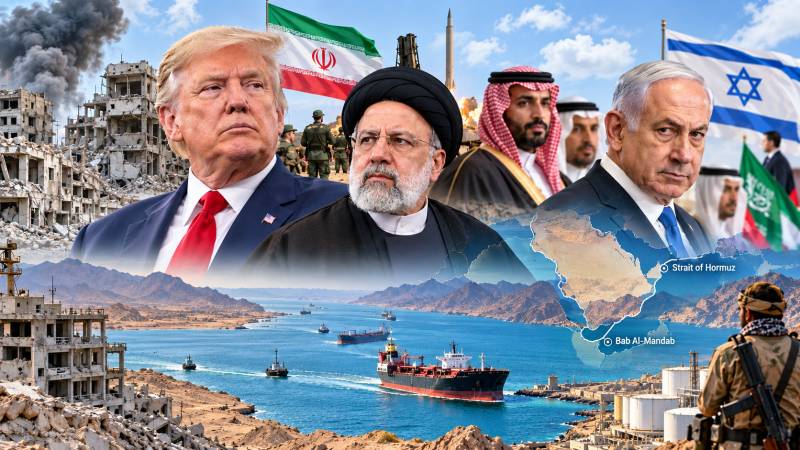
Though the war has stalemated, the indirect talks between Iran and the USA have not collapsed – threatening pasturing, pause in exchange of messages, hot and cold statements, and boasts of annihilation of a civilization notwithstanding. Iran is economically hard pressed, the USA feels the shortage of arms and ammunition, Israel advances its plan to secure its flanks from Hezbollah, and turn the Arab world into a divided and weak bloc of nations. Israel has had no challenge from any Arab country since its last war of 1973.
The USA policy to undermine the nationalist autocrats to secure Israel and the Gulf monarchies was successful. The present Middle East with no strong country on the scene would have gone under the security umbrella of Israel signing the Abraham Accords had the latter not been arrogantly over-ambitious seeking to establish itself as the master of the region. Among all the countries in the Middle East, only Iran stood out as the resisting block.
Two important events exposed the limits of the USA political and strategic prevalence in the Middle East. The overkill in Gaza by Israel devastating indiscriminately entire neighborhoods, schools, hospital, improvised camps of the internally displaced persons. The entire Palestinian population, and the entire well-built city were the target of ruthless bombardment to shock and disgust of the world. The invasion of Iran at the behest of Israel while with it were in progress on a question of utmost importance to the USA and Israel. These two events were bound to have seismic changes in the Middle East much beyond the estimations of invaders.
Maybe, the USA leadership was trapped by the rosy assessment of the direction of the war by Israeli strategic leaders. The Western and Arab world were watching the destruction and killings in Gaza, and the intensive on Iran. The war in the Middle East has left the world wondering about the political, economic and military resilience of Iran, and the limits of the military power of the USA. The military fight with a middle power country, already facing the USA sanctions, pushed the USA to the end of its tether. Amazing.
The ground realities would tell another story which would markedly include: the dashed dream of Israel to control the region as planned; the erosion of the Abraham Accords; the erosion of the trust in the USA security architecture; and Iran regaining its dominant regional position.
Bogged down in the Middle East, President Donald Trump seems at the end of his wits as to how to exit the war. The Islamabad MoU signed by him along with President Masood Pezeshkian of Iran, and Prime Minister Shahbaz Sharif elicited severe criticism in the USA. Even the close followers of President Trump called it a document of surrender than peace. This criticism forced him to look desperately for excuses to wriggle out of it, probably temporarily to pause the technical talks with Iran until the mid-term elections. His advisors chose to leave the outcome of the war ambiguous and elaborate it in ambiguous terms during the campaign for mid-term elections. An impression of defeat in the war would have played havoc with the electoral outcomes.
However, the world economy would not afford the closure of two important chokepoints – Strait of Hormuz, and Bab Al-Mandib - for any longer period. It is at the verge of a collapse. Oil ships scarcely pass through Strait of Hormuz. Bab Al-Mandib is closed for Saudi oil ships. The Saudi East-West oil pipe carrying over 5 million barrels a day was provisionally shut after drone attack on it. Saudi also meet 5% of the global energy requirement or 5-6 million barrels a day through Bab Al –Mandib. The Strait of Hormuz caters to 20% of the global oil needs. The world seems in chaos. The Hoathis have the upper hand in the fight for strategically important positions in the western coast of the Red Sea.
An African adage describes this situation well that two elephants fight, destroy the vegetation and exit the contest. This war has really choked the international trade, and the flow of oil to the world. The USA leadership along with Benjamin Netanyahu did not have the slightest idea that Iran would be able to close these important waterways. The gross miscalculations on their part have changed the direction of the war. Instead of removing the ruling clerics, the hasty, unplanned and haphazard invasion of Iran has fortified their grip on power, showing them as heroic defenders of their land and civilization.
The war will come to an end in one way or the other after the mid-term elections. But the arrogant mindset and the superpower’s ego would be reluctant to concede victory to Iran. No clear defeat to Iran is actually the defeat of the lone superpower. Their exit would be accompanied by ambiguity, arrogant talk, threats and procrastination in discharging their responsibilities towards Iran as pledged in the Islamabad MoU or a fresh understanding. However, the ground realities would tell another story which would markedly include: 1) the dashed dream of Israel to control the region as planned; 2) the erosion of the Abraham Accords which were reining in Arab countries; 3) the erosion of the trust in the USA security architecture with other countries emerging as perceptibly reliable strategic partners in the Gulf Region; 4) Iran regaining its dominant regional position within a short span of time wooing Gulf States to find out a strategic framework for peaceful co-existence with necessary confidence building measures to reassure their security and territorial integrity.
This does not mean that with the end of the war, the USA would wrap up its affairs in the Middle East and leave. It will redouble its efforts to revitalize its strategic relations with the Gulf States by revamping defence systems and offering more sophisticated and technologically advanced weapons. It could possibly strike a deal with Iran to retain an aura of political and strategic influence in the Middle East, and safeguard the political, economic and strategic interests of Israel. Iran has a tougher stand on the interaction with Israel than all the Muslim countries. But the compulsions of statecraft cannot be ignored. Between states, anything in national interest is kosher.
China is very careful, and has been carefully moving to avoid any accidental confrontation with the USA anywhere in the world. Similarly, it will also move carefully to fill in the political, and strategic vacuum in the Middle East. Russia is bogged down in its war with Ukraine. The western world would like Russia to remain embroiled in this war. It should consolidate its position in the Crimea and the surrounding Russian speaking regions, and exit from the war. It has been in this conflict for too long. So, Vladimir Putin will also not be in a position to step in the Middle East.
Pakistan and Turkey are two states at the periphery of the conflict. Pakistan cannot trade away its military strength for the sake of a bag of dollars. Turkey has an advanced defence industry, and would be able to revitalize the defence systems of these countries. For that matter, the global defence markets are open for such lucrative purchases. The Makka Defence Accord is at the embryonic stage, and would need time to take a strategic shape.