

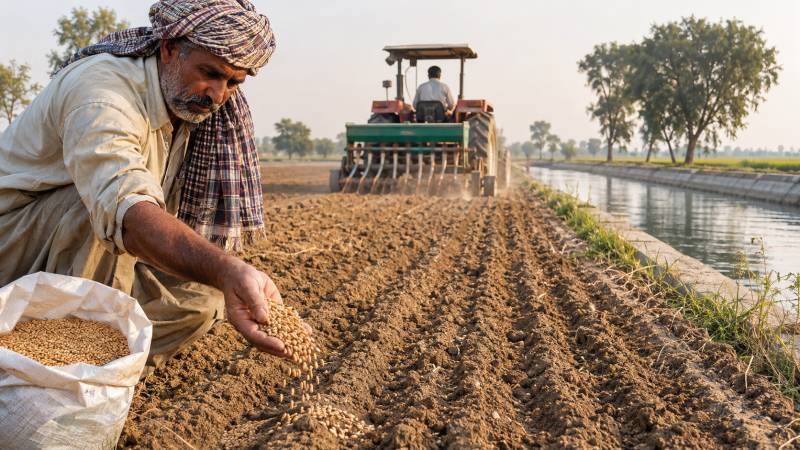
The Wheat sowing is approaching fast in the country. However, farmers are skeptical about the fate of water availability, certified seed’s availability, and the ultimate output price and procurement options. These concerns get aggravated when farmers think of a simple question: Will there be sufficient water in the canals when the crop needs it? As Rabi season runs from 1st October to 31st March, the country is starting with low reservoirs. IRSA recently approved a 22% lower water share for the coming crop season, mainly due to upstream neighbour’s leveraging of water. Under the de facto 3-tier formula for water allocation, this decrease only applies to the Punjab and Sindh provinces, exempting KPK and Balochistan. This situation leaves the nations with a little margin of error – be it policy intervention of any sort or input availability.
Wheat crop has to bear the major brunt, which last year, was able to record a production of 29.31 million tons although falling short to meet domestic consumption requirement of around 3.2 million tons, and ultimately forcing government to order import of nearly one million tons as a last resort. The import figure might cross this number (to around 1.4 million tons as per USDA estimates) till the harvest of next crop. Whichever figure one prefers, the country is planning a hefty target of 33 million tons that it has yet to do quite enough to reach. However, the US Department of Agriculture has forecasted wheat production of about 29.6 million tons for 2026-27, based that on a three percent increase in area, higher availability of irrigation water and more certified seed. The water assumption seems too bleak to hold at least. Why this has weight, is as under: This monsoon filled the Tarbela reservoir, but a weak link still haunts. The combined storage at Tarbela and Mangla reservoirs reached a peak level of 11.6 million acre feet (MAF) on 9th September, and have now fallen below 9.5 MAF, the lowest combined level of Tarbela and Mangla reservoirs' storage since 2021, compared to 13 MAF during the last year. Major issue is Mangla where storage is far below the capacity, i.e., 5.12 MAF against 7.277 MAF capacity due to weak flows of Jhelum. IRSA officials flagged in August below-average monsoon inflows in the last 10 years.
The preceding calculation is sobering. The water available this season, including flows projected in the rivers, is around 21-22 MAF, while the water demand for the rabi season is 37-38 MAF, according to the 1991 Water Apportionment Accord, which indicates a shortage of around 25 percent. The reduced share of 22% by IRSA for the current cropping season needs not be ignored either as we have seen earlier, in March 2025 IRSA had predicted the deficiency of 30 to 35 percent for the rest of the Rabi season with the dams almost empty. Nor is scarcity the whole story. Since April 1, approximately 10.33 MAF has flowed to the sea, with the annual environmental requirement of around 8.2 MAF, the excess water could have been stored and managed.
Not surprisingly, the sharing of this water shortage is as important as is its size. With the current IRSA announcement, the shortage is not imposed on Balochistan or Khyber Pakhtunkhwa, but only on Punjab and Sindh, while Sindh has since long been complaining about of bearing a disproportionate burden, while IRSA's mandate to impose the-2002 three-tier formula. Any sort of interprovincial dispute over water shortage in the ensuing months could worsen the farmers’ plight with no one benefiting. However, the tail farmer of Sindh or southern Punjab cares little about the formula, but he cares if his turn comes with water when crop is in need of it.
Looming over this entire crisis is the unresolved transboundary water contention due to Indus Water Treaty put in abeyance by India since April 2025. However, the unanimous ruling of August 31st by the Court of Arbitration, The Hague, that the abeyance did not terminate or stop the 1960 treaty, received rejection by India on the pretext of jurisdiction being a sovereign decision. It also did not participate in any of the hearings. Since then, the court has made four decisions, inter alia, imposing a construction ban on the Ratle hydroelectric plant until 90 days after the decision by Neutral Experts’ is announced – expected in July 2027. India, however, has argued that treaty would remain in abeyance till Pakistan is able to provide a credible and irrevocable proof of complete withdrawal of its support to cross-border terrorism, the allegation Pakistan vehemently denies. A win in the court is good, but the Court having no enforcement powers, mere ruling would not guarantee a water supply.
Sudden surges and sudden stoppages in river flows are equally dangerous, threatening fields and settlements on one hand and standing crops dependent on timely irrigation on the other.
A clarity is warranted too on what India can do and what it cannot. Stopping Indus system is beyond its control as the storage capacity on the western rivers is small compared with flows, however, the timing matters the most and the trend has become almost clear since the last year. The three Chenab reservoirs – Baglihar, Dulhasti and Salal – have a total capacity of around 1.2 MAF. That's a trivial amount of water over a year, but it can be a very significant amount of water in a lean month, while India seems no longer obliged to inform Pakistan about changes in flow downstream. This pattern was observed in May last year as the flows at Marala dropped in a day from up to 35,000 cusecs to about 3,100 cusecs without warning. Similarly, flows were reduced to roughly 870-1,000 cusecs for four days last winter when Baglihar was reportedly being filled while on 2nd May 2026, flows went down from approximately 20,930 to 9,037 cusecs. This, according to Indian perspective, is part of the routine hydropower operations and sediment flushing, that can be undertaken a monthly exercise. There is still another risk of sudden spillways’ opening, such as done in early August due to repeated releases from Baglihar, leading to flooding prompt at Marala due to an inflow of 93,000 cusecs. Hence, sudden surge and sudden stoppage both are dangerous – the former to fields/settlements and the latter to standing crops needing irrigation.
The water availability timing has a critical emphasis for wheat. With low river flows in winter, the canal water supply runs on tight rotation. Just a few days of reduced water availability in the Chenab at the wrong crop-development stage, either at the crown-root stage (around three weeks after sowing), or at tillering, or during the grain filling stage, can cost yield in the canal commands depending on it. Precarious and unpredictable water supplies would do more harm even if the actual volume withheld is small because irrigation departments can hardly plan effectively around flows they cannot forecast.
The WMO forecasts that El Niño conditions are emerging, and warned that if a super El Niño does occur, 2027 could turn out to be the hottest year ever recorded in Pakistan, noted by Pakistan's Met Office as well. However, an above average rainfall for the winter is expected to begin in December-January, in the northern and central regions of the country including eastern and central Punjab, leading to improved soil moisture in the barani belt and reduced pressure on surface water/canals. Similarly, the below-average monsoon associated with El Niño is expected to further impact wheat planting. Hence, the late sowing would compound the risk of yield losses, as wheat faces rising temperatures during the critical grain-filling stage in March. January rains are good cannot serve as substitute for the pre-sowing and first irrigations generally needed in October and November through the canals and not in the clouds.
The money and prices haunt the farmer too. Prices of fertilizers, diesel, chemicals and labor have increased manifolds with no clear signals for support or indicative price of wheat for the year 2026-27. Although the procurement and support price policies have shifted, but the transition has been rough and the new procurement system could not yield promising outcome as the actual procurement remained well short of the intended target.
What would be a realistic option then? The official target will probably again be close to 30 million tons or beyond, however, if sowing slips to December in parts of Sindh and Punjab and early heat in March takes its toll, an output of 26-28 million tons instead of 30 million tons is more likely. In such a case, 2-3 million tons’ gap would require imports worth million dollars. However, if the rains during December and January turn up timely while Chenab runs smoothly, the outcome may be improved. Nonetheless, the wiser course is to prepare for the worst, not plan around the best.