

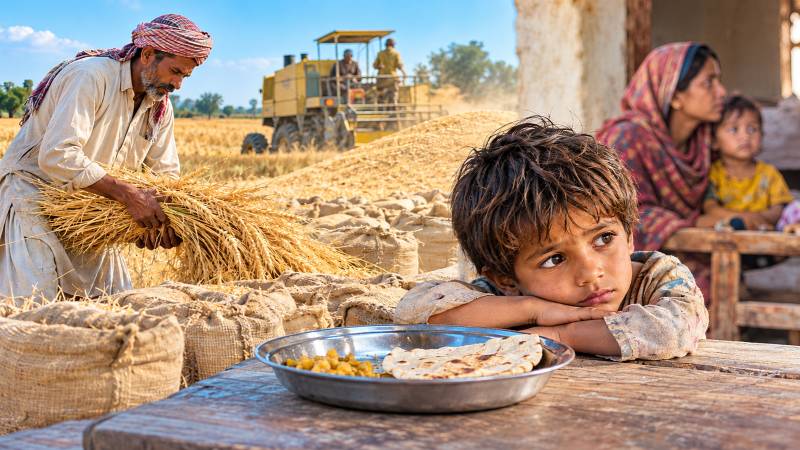
The grain is counted when it leaves the field. Hunger is counted when it reaches the child. Between those two measurements lies much of Pakistan’s failure. The 2026 Global Hunger Index gives Pakistan a score of 25.5, worse than its recalculated 2018 score of 24.0. One in six Pakistanis is undernourished, and one in three children under five is stunted. The index records improvements in child stunting and mortality over that period, but worsening undernourishment and wasting. Progress has not simply slowed. On important measures, it has gone into reverse.
We will respond in the familiar way. Farmers will demand higher crop prices. Consumers will demand cheaper flour. Officials will announce targets, release stocks, change import rules or blame the weather. Each response may address an immediate grievance. None answers the larger question: how can Pakistan make farming profitable enough to sustain rural livelihoods while keeping nutritious food affordable?
We discuss food security as if it were a production target. How many tonnes of wheat? How many bags are stored in government warehouses? But counting bags of wheat and calling it food security is rather like counting bricks and calling it a school. Food security begins with production; it is achieved when families have the means to obtain adequate food and the conditions to benefit nutritionally from it. The missing measure is purchasing power.
The World Bank estimates that national poverty has risen from about 22 per cent in 2018-19 to 29 per cent in 2024-25, affecting some 70 million people. Rural poverty remains more than twice urban poverty. These figures describe something agricultural production statistics do not: the shrinking ability of millions to buy what they need. In a village, the crop pays more than the landowner. It pays the tenant, tractor driver, harvester, transporter, shopkeeper and the family that depends on seasonal work. When farm returns weaken, investment and local spending contract. A landless labourer has no grain to store against hard times. He buys his flour, milk, eggs and pulses like everyone else. When his wages fall behind prices, a varied diet is often the first thing his family abandons. Before the farmer plants, seed, fertiliser, diesel and land preparation demand payment. An arhti may advance the money when a bank will not. If canal water arrives late, a tubewell adds another bill; as groundwater falls, that bill grows. His costs are known before the seed goes into the ground.
The wheat market supplies a recent lesson. The state retreated from procurement and support-price arrangements, and the farmer faced the harvest without the assurances he had known. Wheat acreage fell 6.5 per cent in 2024-25; production declined 8.9 per cent, with weather also playing a part. In October 2025 the government returned to an announced procurement price of Rs 3,500 per 40 kilograms. Whatever one thinks of public procurement, policy that lurches between withdrawal and reinstatement is no basis for decisions farmers must make months in advance.
None of this is hindsight. Section 7.4 of the Punjab Water Policy of 2018, developed when I held the irrigation portfolio, expressly identified a “rational support price structure” among the measures needed to raise crop yields and improve water productivity. It also called for a proper crop-price support structure and equitable distribution between head and tail farmers. We recognised then that farm economics and water delivery could not be separated. Eight years later, the country still improvises where it should have built dependable institutions.
Food security begins with production; it is achieved when families have the means to obtain adequate food and the conditions to benefit nutritionally from it.
Here lies the supposed dilemma: a farmer needs a remunerative price while a consumer needs affordable food. Depress the farm-gate price and production becomes less attractive; let retail food prices outrun wages and families go hungry. Many rural households are both producers and buyers. Asking one to subsidise the other is not a food-security policy. Nor is the conflict immutable. Pakistan’s average wheat yield is far below what well-managed farms and improved varieties can achieve. Better seed, extension, timely irrigation, sound agronomy and appropriate mechanisation can increase output per acre and lower cost per kilogram. The farmer can then earn more without requiring an equivalent rise in the shop price. Productivity cannot abolish every conflict over price, but it can make the conflict smaller. The question is why we have allowed the gap between attainable and actual yields to persist.
There is another gap between field and table. Transport, storage, grading, finance and marketing are real services, not evidence that every intermediary is a villain. But avoidable losses, opaque prices and restricted competition impose costs neither farmer nor consumer should have to bear. Remove those inefficiencies and some of the gain can reach both ends of the chain. Water is central to that effort. A canal shown as running at capacity on a departmental chart may still fail the farmer at its tail. The cost appears as a lower yield, a deeper tubewell or a second crop never planted. Floods then destroy not only crops but livestock, roads, seed and the money needed to recover. Water management is not merely an engineering question. It is rural income security, and therefore food security.
The poor consumer cannot wait for all these improvements. In October, the FAO reported that wheat-flour prices in September remained 19 to 37 per cent above their year-earlier levels in the markets it monitored. A household whose income has not kept pace does not need an empty national warehouse to experience hunger. It needs only a price it cannot pay. That is why consumer protection must be direct. Pakistan already has the Benazir Income Support Programme and its Nashonuma nutrition initiative. The task is to make assistance more adequate, predictable and responsive to sudden food-price shocks and disasters. Targeted transfers can defend purchasing power without repeatedly forcing farmers to carry the cost of cheap-food policy.
But income is only half the answer. A child can eat enough flour and still be malnourished. Protein and dietary diversity matter; so do maternal health, safe water, sanitation, vaccination and care in the first thousand days. That is why a hunger index cannot be reduced to the wheat harvest, and why an agriculture ministry cannot defeat malnutrition alone. Agriculture, irrigation, food, health and social protection are administered in separate compartments. Hunger arrives in a household as one experience. Their common test should be whether a family can afford a nourishing diet after a bad harvest, a flood or another price shock, and whether its children can grow well on it. Our predecessors built canals that brought rivers into dry fields. We must build institutions that carry the benefits of those harvests into people’s lives. The measure of food security is not what stands in the field or fills a silo. It is what reaches the table, and what that meal does for the child who eats it.