

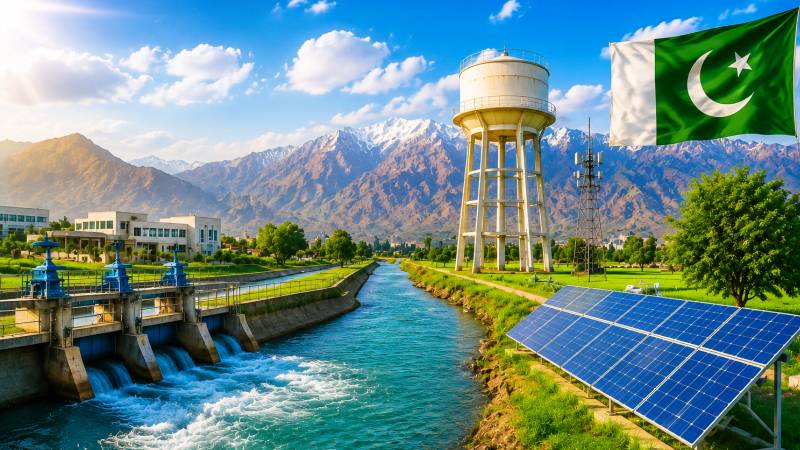
Pakistan’s Prime Minister has announced a USD 1 billion investment in Artificial Intelligence by 2030, aiming to build a national AI ecosystem where youth can acquire technological skills. This ambition is timely, given the global acceleration of AI. Yet AI is not just software or algorithms; it is infrastructure. Data centers, electricity grids, cooling systems, and rare earth minerals form its material foundation, each carrying environmental costs. Among these, the most under-discussed is water. Training advanced AI models consumes shocking volumes of fresh water, while electricity generation itself often depends on water-intensive processes. For a country already facing absolute water scarcity, the digital revolution risks hitting with ecological damaged. Unless Pakistan aligns its AI ambitions with water governance and regional diplomacy, the promise of progress may undermine resilience.
Globally, advanced economies are contending with AI’s environmental footprint. In Europe, sustainability reporting requirements are tightening. In the United States, large data centers face scrutiny over water and energy use. India’s AI-based groundwater monitoring improved transparency but left smallholders behind. China’s AI-driven irrigation scheduling reduced crop water footprints, while Spain modernized irrigation systems by embedding AI into governance reforms. These examples show that technology alone cannot solve water crises. For Pakistan, AI must be embedded in governance reforms, farmer participation, and ecological safeguards. Simultaneously, Pakistan should capitalize on the Permanent Court of Arbitration’s decision under the Indus Waters Treaty by strengthening diplomatic outreach and using AI-powered monitoring to highlight upstream interventions.
Pakistan’s challenges are complicated. More than 23 million people still lack access to safe drinking water. Over three-quarters of renewable water comes from outside its borders, making inflows highly vulnerable. Rainfall variability is increasing, floods and droughts are intensifying, and population growth continues to strain demand. Domestically, hydrological data is scarce, uneven, and inaccessible. Rural communities face a digital divide, while bureaucratic inertia and provincial disputes hinder innovation. Legally, Pakistan’s National AI Policy 2025 supports environmental sustainability but does not set specific rules for the water use or efficiency of AI data centers. The National Water Policy 2018 covers industrial water use and conservation but does not specifically address data centers as a separate industrial water user. This gap could allow growing AI infrastructure to place additional pressure on Pakistan’s already limited water resources. At the same time, Pakistan’s dependence on the transboundary Indus Basin means that changes in upstream water flows can make water security both a domestic and regional concern.
The challenge is not whether Pakistan should invest in AI, it should. The challenge is whether it can align technological ambition with water security. A digital future built on ecological neglect is unsustainable.
Pakistan must embed AI within both domestic governance and regional diplomacy. Domestically, groundwater governance reform is essential, with a national authority to regulate extraction and enforce recharge policies. AI-driven innovations in water resources planning; such as real-time monitoring of river flows, predictive flood models, aquifer mapping, and irrigation scheduling should be prioritized. AI-based Flow Manipulation Advisory System is particularly relevant, enabling continuous assessment of water availability and monitoring of critical river points in light of upstream interventions.
Promising pilots already exist. Under the Catalytic Fund of the Water Resource Accountability in Pakistan programme, an AI-enabled, solar-powered smart irrigation system in Khyber Pakhtunkhwa is showing how soil moisture sensors linked to AI platforms can optimize water delivery to orchards and vegetable plots. With strong government engagement and technical support, the project is advancing through the PC-I approval process, marking a critical step towards public sector financing and scale. This experience highlights that demand-led design, delivery partnerships, and ongoing technical assistance are key to moving beyond pilots towards system-level impact.
At the same time, advanced hydro-economic models are being deployed in the Indus Basin. Tools such as the Indus Pywr Water Allocation Tool and Hydro-Economic Decision Support Systems allow policymakers to simulate trade-offs across water, energy, and food systems before a single rupee is spent. These models have revealed unexpected insights; for example, reducing sugarcane cultivation can sometimes increase water use when replacement crops consume more. They also show that productivity investments in oilseeds are more effective than protectionist trade measures. Such evidence-based tools demonstrate how AI and integrated modelling can guide smarter policy choices, moving beyond speculation to resilience.
Decentralized water management measures; such as managed groundwater recharge, retention ponds, restored wetlands, and small-scale storage facilities can help capture and temporarily store floodwaters in suitable locations across the Indus Basin, particularly where large reservoirs are technically, economically, or environmentally impractical. These measures can reduce flood peaks while also supporting groundwater recharge and improving water availability, provided they are designed according to local hydrological and geological conditions. Integrating AI with GeoAI, GIS, remote sensing, and hydrological modelling would strengthen Pakistan’s capability to detect unusual upstream changes, forecast shortages or sudden releases, and optimize reservoir operations. Internationally, Pakistan should leverage climate finance to retrofit data centers with circular water systems and use AI-generated evidence to highlight treaty violations. Fiscal incentives, such as tax credits for water-positive companies, can further drive sustainable practices.
Pakistan’s USD 1 billion AI investment is ambitious and necessary, but it must not be pursued in isolation from ecological reality. Digital transformation cannot rest on extractive foundations that undermine resilience. By integrating AI-driven innovations in water resources planning; real-time river monitoring, flood forecasting, decentralized water management with strong governance and diplomatic outreach, Pakistan can transform AI from a hidden threat into a tool for resilience. The challenge is not whether Pakistan should invest in AI, it should. The challenge is whether it can align technological ambition with water security. A digital future built on ecological neglect is unsustainable. A water-first AI strategy, embedded in governance and diplomacy, is the only way to ensure that Pakistan’s progress is truly intelligent.