

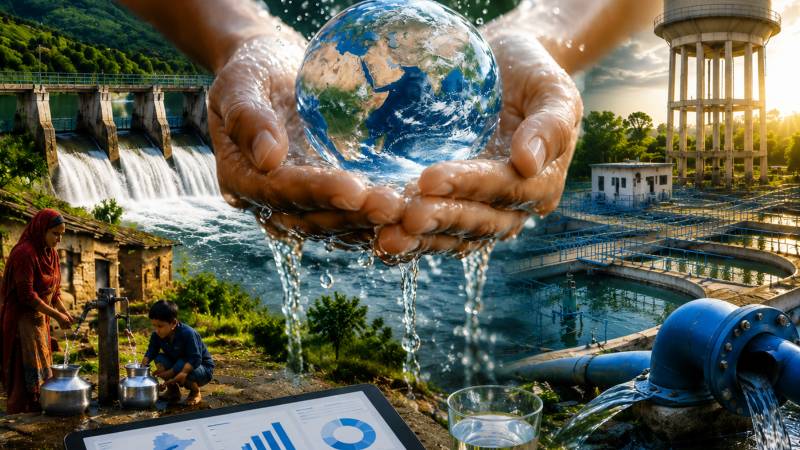
Pakistan’s water debate has resurfaced with Tarbela Dam reaching its maximum storage level of 1,550 feet. On the surface, this looks like a success in conservation. Yet, for Sindh farmers struggling to irrigate cotton and rice nurseries during the early Kharif season, the achievement feels incomplete. The contradiction between full reservoirs and empty canals exposes the weaknesses of Pakistan’s water planning system. This is not just a technical issue; it is a matter of governance, foresight, and fairness.
In a normal year, Tarbela fills in August when monsoon flows are abundant. The concern this year is not the filling itself, but the fact that storage began much earlier, during May, June, and July, when Sindh as the lower riparian urgently needed water for sowing crops in the early Kharif season. Holding back these flows deprived farmers of timely irrigation, and now the arrival of monsoon rains risks creating artificial floods downstream. This pattern not only harms Sindh’s agriculture but also raises questions about the storage calendar itself. River water meant for sowing should not be locked away in reservoirs, as this goes against the spirit of dams, which were designed to regulate flows for both agriculture and energy. In both cases; shortages during sowing and excesses during monsoon; Sindh suffers, while perceptions persist that Punjab gains development advantages.
The motive behind filling reservoirs is understandable: securing water for later use and ensuring hydropower generation. But the timing raises doubts. Why are lower riparian provinces left short of water precisely when their crops need it most? The delay in completing Tarbela’s Tunnel‑5 project until 2027, restricting outflows during peak sowing months, further complicates the picture. These mismatches suggest that planning is not aligned with agricultural calendars, leaving farmers vulnerable.
Comparative experiences show that Pakistan’s reliance on large reservoirs is outdated. India, for instance, has built thousands of small check dams and percolation tanks to capture early flows, stabilizing irrigation at the local level. Its inter‑state water tribunals, though imperfect, provide a legal mechanism to resolve disputes between states like Karnataka and Tamil Nadu over the Cauvery River. China’s integrated basin management ensures upstream hydropower does not compromise downstream agriculture, while Australia’s Murray-Darling Basin reforms introduced basin-wide water accounting and environmental flow guarantees. These examples demonstrate that water planning must be holistic, balancing agriculture, energy, and ecology.
The challenges are several. Infrastructure delays restrict canal releases. Economically, crop losses in Sindh undermine national food security and export earnings. Cotton, a cash crop planted in February and March, requires three timely irrigations in its early stage. Without water, germination fails, reducing yields and threatening Pakistan’s textile industry, which depends on cotton as its backbone. Mango orchards, concentrated along the left bank of Sukkur Barrage, also suffer. Farmers report fruit shedding when irrigation is delayed, jeopardizing an export market worth hundreds of millions of dollars. Sugarcane, bananas, and vegetables like okra and tomatoes face similar risks. When shortages hit, the impact cascades across rural livelihoods, food prices, and export revenues. Sindh produces 67% of Pakistan’s agricultural output, yet persistent shortages amount to what local leaders call “economic massacre.”
Socially, disputes between Punjab and Sindh deepen mistrust, weakening federal cohesion. Legally, the 1991 Water Apportionment Accord specifies how shortages should be shared. System-wise, ten-daily bases should be adjusted pro rata (proportionately) to form the basis for sharing shortages and surpluses on an all-Pakistan basis. However, the controversy surrounding the Three-Tier Formula, along with data misreporting and the lack of telemetry, further erodes confidence. This is where water auditing becomes critical. Without a transparent system of measuring inflows, outflows, and canal withdrawals, accusations of theft and misreporting will persist. Australia’s Murray-Darling Basin reforms placed water auditing at the center of basin management, ensuring every drop was accounted for through independent monitoring. Pakistan must adopt similar practices, with independent audits of provincial withdrawals and telemetry systems installed at all water withdrawal points. Proper auditing would not only build trust but also allow planners to make evidence‑based decisions about allocations and shortages.
International examples must serve as reminders that water management must be adaptive, data-driven, and inclusive of all stakeholders.
A deeper reflection is needed on why Sindh’s economy and agriculture have become so vulnerable. The reasons are not rooted in a single actor but in a combination of choices and gaps over time. Political leadership has often focused on short‑term gains rather than long‑term planning, leaving structural reforms unattended. Policies have sometimes overlooked crop calendars and ecological realities, creating mismatches between water availability and agricultural demand. At the same time, technical expertise has not been given the space it deserves, with decisions too often shaped by favoritism or selective priorities rather than evidence. These overlapping factors have gradually weakened Sindh’s resilience, leading to declining productivity and hardship for rural communities. Moving forward, encouraging technical knowledge, transparent planning, and fair decision‑making can help break this cycle and restore confidence in water governance. Sustainable water management depends on reliability and equity. Pakistan’s system struggles with both: reservoir operations are inconsistent, leaving farmers uncertain, and distribution is uneven, with Sindh often short while upstream regions benefit. Without embedding reliability and equity into planning, reforms will remain superficial.
Solutions must be structural, not temporary. Pakistan needs to invest in small and medium‑sized reservoirs in Sindh to capture early flows and reduce dependence on upstream releases. Modern telemetry systems and independent water audits should be mandatory to monitor inflows and outflows, ensuring transparency. Reservoir operation plans must integrate crop calendars so that sowing seasons are not disrupted. International models offer lessons: India’s watershed management, Australia’s basin‑wide water accounting, and China’s integrated basin planning. Each of these reforms shows that water management must be adaptive, data‑driven, and inclusive of all stakeholders.
Equally important is implementing the 1991 Accord in light of ten-daily basis. Environmental flows downstream of Kotri Barrage must also be guaranteed to sustain the Indus Delta, which supports fisheries, mangroves, and coastal livelihoods. Economic planning must recognize that water shortages are not just a provincial issue but a national one. When Sindh’s cotton fails, Pakistan’s textile exports suffer. When mango orchards shed fruit, foreign exchange earnings decline. When vegetables wither, urban consumers face rising prices. Water planning must therefore be integrated into economic policy, linking irrigation schedules with crop calendars, export targets, and food security strategies. Transparent water audits would make this integration possible, ensuring that economic planning is based on reliable data rather than political bargaining.
In conclusion, the filling of Tarbela Dam this August is not enough to secure Pakistan’s water future. Planning must move beyond storage statistics to balance hydropower, agriculture, and environmental needs. Without reforms, Pakistan will continue to oscillate between floods and droughts, leaving farmers vulnerable and inter‑provincial disputes unresolved. The country must embrace integrated water resource management, where planning anticipates challenges rather than merely reacting to crises. Transparent water auditing, updated accords, and investment in local storage are the pillars of such a system. Only then can water become a source of stability rather than conflict, and agriculture a driver of prosperity rather than vulnerability.