

As I reflect on Claude Monet’s Water Lilies hanging in the Saint Louis Art Museum, I am reminded that water has always inspired more than art. It has shaped civilizations, nourished economies, carried faith and culture, and quietly connected people across landscapes long before political boundaries existed. Just beyond the museum flows the Mississippi River. A river that has carried the stories of Indigenous nations, farmers, traders, cities, and generations of Americans. Like the Indus, the Nile, the Mekong, and the Colorado, the Mississippi reminds us that rivers are not simply resources to be managed; they are living systems that connect communities, economies, and histories.
English poet W.H. Auden observed, “Thousands have lived without love, not one without water.” It is one of those simple truths that somehow becomes more profound with time. For decades, we have been told that oil is the world’s most valuable resource. Wars have been fought over it, alliances have been built around it, and economies have risen and fallen because of it. But I would argue that the most strategic resource of the twenty-first century isn’t oil. It’s water. That may sound dramatic until you look around the world. From the Nile in Africa to the Mekong in Southeast Asia, from the Tigris and Euphrates in the Middle East to the Colorado River in North America, countries are increasingly wrestling with the same questions: who gets the water, who controls it, and what happens when there isn’t enough to go around. South Asia is no exception.
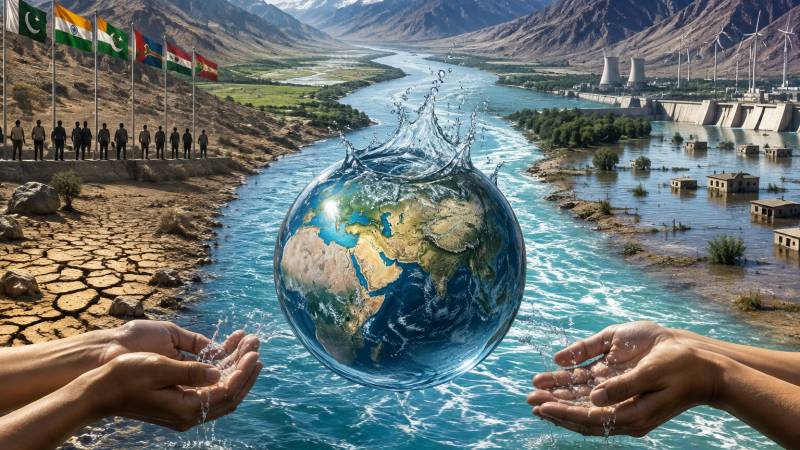
For Pakistan, the Indus River isn’t simply a river. It is memory. It is civilization. Long before borders were drawn, the Indus nourished one of the world’s earliest urban civilizations. It has always been more than geography; it has shaped identity itself. Punjabi poet Bulleh Shah reminded us that “Ranjha Ranjha kardi ni main aape Ranjha hoi”, the beloved and the seeker eventually become one. Rivers have always carried that same lesson and refuse to recognize the borders that human beings insist on drawing.
For decades, we have been told that oil is the world’s most valuable resource... But I would argue that the most strategic resource of the twenty-first century isn't oil. It’s water.
For more than sixty years, the Indus Waters Treaty has been held up as one of the world’s most successful examples of water diplomacy. Remarkably, it survived wars and decades of political hostility between India and Pakistan. But the world that produced that treaty no longer exists. Climate change is changing river flows. Himalayan glaciers are melting. Populations are growing. Demand for food and energy continues to increase. Water is becoming more unpredictable just as countries need it more than ever. The Indus isn’t alone.
Egypt, Ethiopia, and Sudan are struggling over the future of the Nile. Iraq and Syria worry about upstream dams in Turkey. Countries along the Mekong are trying to balance development with cooperation. And in North America, the Colorado River is forcing the United States and Mexico to rethink agreements made a century ago because the river simply does not carry as much water as it once did. Different rivers. Different politics. And the same challenge. We are entering a world where water security is becoming national security. But I worry that we still talk about water as if it is only an engineering problem. Because it isn’t. Water is an economic issue. When there is less water, farmers harvest less. Industries slow down. Investors become cautious. Food prices rise. Rural communities suffer. Jobs disappear. Economic development becomes harder. For Pakistan, this isn’t a future problem. It is already happening.
Water is also about people. Women are often the first to experience the realities of water scarcity in homes and communities, yet they are rarely at the decision-making table. Indigenous communities have managed watersheds for generations, but their knowledge is often overlooked. Scientists produce evidence. Universities generate ideas. Businesses develop new technologies.
Yet we continue to leave many of these voices outside the room. Perhaps that is because we still think water disputes belong only to governments. But they don’t. They belong to everyone whose future depends upon the river. Sufi poet Jalaluddin Rumi wrote, “You are not a drop in the ocean. You are the entire ocean in a drop,” as a reminder that every local water crisis reflects a larger global challenge. What happens along the Indus matters far beyond South Asia. This is why the conversation has to change. Instead of asking how countries can win water disputes, perhaps we should be asking how they can govern shared rivers together in a changing climate. Fortunately, there are encouraging examples.
The Indus River isn’t simply a river. It is memory. It is civilization. Long before borders were drawn, the Indus nourished one of the world’s earliest urban civilizations.
The Senegal River Basin has shown that neighboring countries can jointly manage infrastructure and share benefits. The Danube demonstrates that countries with different political systems can cooperate to protect a shared river. These examples do not eliminate disagreements, but they remind us that institutions built on trust can outlast political crises.
South Asia has an opportunity to think differently about the future of the Indus. The river can continue to be viewed through the narrow lens of rivalry and political leverage. Or it can become the foundation for a broader conversation about climate resilience, food security, economic growth, regional stability, and shared prosperity. Nobel laureate Rabindranath Tagore wrote, “The same stream of life that runs through my veins night and day runs through the world.”
Rivers have always connected civilizations before they connected states. They remind us that nature does not recognize the political boundaries we create. Cooperation is not easy. But neither is living in a world where water becomes another weapon. The next generation of diplomacy will not be shaped solely by foreign ministers or military leaders. It will increasingly involve scientists, economists, engineers, women leaders, Indigenous communities, universities, businesses, and young people working together to solve problems that no country can solve alone. Water has always connected civilizations.
Rivers have always outlived kingdoms, empires, and political borders. From the Mississippi flowing quietly past St. Louis to the Gulf, from the Nile to the Mekong, they continue their journeys regardless of the boundaries we draw. Standing before Claude Monet’s Water Lilies and then looking toward the Mississippi, one is reminded that every great river carries the same lesson: water is never merely local. It connects landscapes, livelihoods, and lives across borders and generations. Long after today’s disputes are forgotten, the Indus will continue its journey to the sea. Just as the Mississippi will continue its journey south. The question is whether history will remember us as the generation that treated water as another instrument of rivalry, or as the one that finally understood that the strongest current flowing through every shared river is not conflict, but our shared future.