

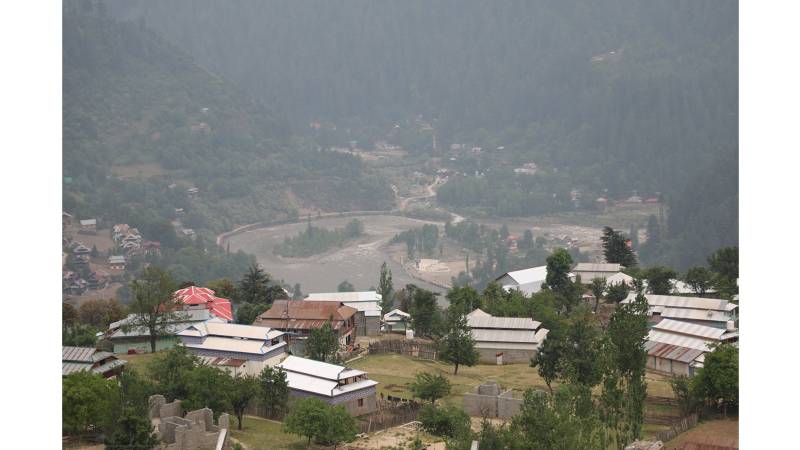
From Keran in the Neelum valley, you can see the other side. That is the particular cruelty of Keran. The Neelum River winds through the valley a few hundred yards wide at this point, and the mountains fold into each other across a geography that does not understand what a Line of Control means. The villages on either side share the same stone, the same cold, the same language, and the same memory of a time before the boundary was drawn—when Keran was one place, not two. Across the river and those mountains lies the place Iqbal once called home, and he has not been able to go back.
"I crossed the Line of Control in 1989 with a hope in my heart that one day Kashmir would be free and I would return home," he says. "I thought I was leaving for a short time. I never imagined that a journey of a few days would become a separation of decades."
He left as an only son, parents waiting on the other side, carrying the certainty that young men carry when they believe political problems resolve themselves before the people who suffer them grow old. Thirty-seven years later, his mother and father are buried across that river. He was not there for either funeral. His children have never met their grandparents.
Letters Tied to Stones
After the 2003 ceasefire between Pakistan and India, divided families in Keran began gathering along the riverbanks, standing on their respective sides of the Neelum, close enough to recognise a sibling's face, yet unable to cross the few hundred yards of cold running water that separated them. They would wave. They would shout names across the current. And when words were not enough, they wrapped letters and small parcels in cloth, tied them to stones, and flung them across the river in the hope they would land on the right bank and be found by the right hands. During Eid, families sent sweets and dried fruits the same way, gifts made heavier by necessity, thrown spinning through the mountain air across a border that had no business being there.
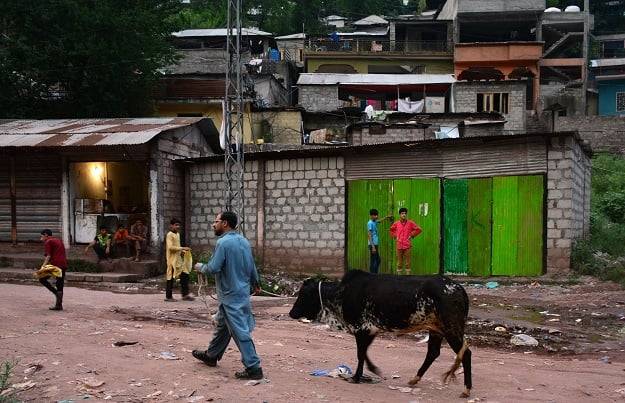
It is an image almost too painful to be believed: a family reduced to throwing stones to communicate across a river. And yet it is also a testament to what families will do when every official channel has been closed—the oldest human instinct of all, the need to let someone know you are still there. For Iqbal, there were no such riverbank gatherings with his parents. They died in 1995 and 2001, years before the ceasefire made even those fragile exchanges briefly possible.
Two Funerals
His mother died in 1995, and he could not attend her funeral. His father died in 2001, and he could not attend that one either. These two dates sit at the centre of Iqbal's story like stones, and everything he says circles back to them.
"I have lived with two regrets for many years: I could not say goodbye to my mother, and I could not say goodbye to my father," he says. "A son should be able to hold his mother's hand in her final days and stand beside his father at his funeral. I could do neither."
What begins as a politically induced displacement becomes, over enough time, a family structure shaped around absence—the missing relatives present only as names, photographs, and memories that have become a form of inheritance passed between generations
There is a particular quality to grief that cannot be witnessed—that cannot be shared in the gathering of relatives, in the rituals of burial, in the physical fact of being present when the person you loved is lowered into the earth. Iqbal's grief had to travel without him. He mourned from a distance, across a river he could see but could not cross, for parents who died before the political circumstances that separated them could change.
"I was the only son of my parents," he says. "When my parents died, I was not there. I could not stand beside my mother. I could not carry my father to his grave. That is a pain I have carried all my life."
The Scale of Separation
Iqbal's story is his own, but it is not singular. The AJK Statistical Year Book 2023, citing the Rehabilitation Department, recorded 43,630 post-1989 refugees living in AJK in 2022 across 29 camps and 7,954 households in Muzaffarabad, Bagh, and Kotli districts. More recent figures reported by Dawn in September 2025 put the population at around 46,000 people belonging to 8,601 families, with approximately 5,500 families still living in camps.
Tens of thousands of people who crossed into AJK after 1989 rebuilt their lives here while retaining family connections—tenuous, telephone-mediated, emotionally charged—on the other side. Some of those connections survived. Others were severed by deaths that happened before reunion was possible.
For Iqbal, this is not a missing-persons case. His parents were not missing; he knew exactly where they were, and they knew where he was. The problem is that knowing someone's location and being able to reach them are entirely different things when a political boundary lies between you.
When Separation Crosses Generations
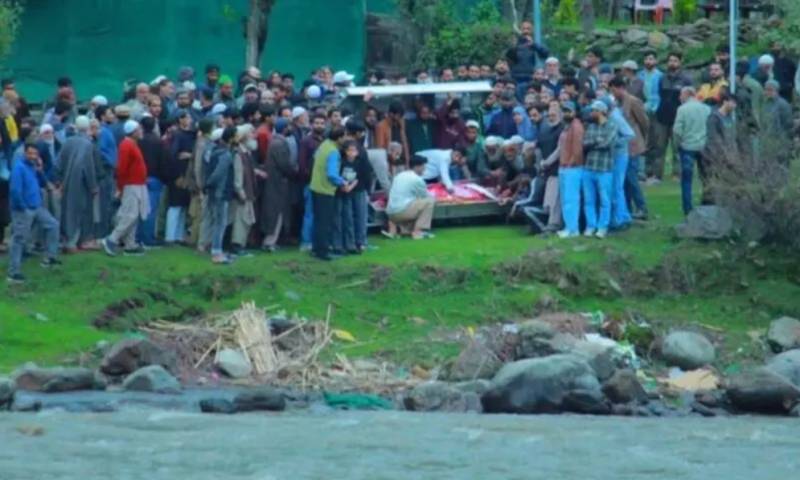
In April 2026, the death of Raja Liaquat Khan of Keran made this reality visible once more. His relatives on the AJK side gathered on the Neelum's bank as his funeral procession moved along the opposite shore. They could not cross. At one point, those carrying the coffin halted and uncovered his face towards the river so the family watching from the other side could have one final glimpse. The cries that rose from the AJK bank echoed along the valley.
It was not exceptional. It was ordinary—which is precisely what makes it so devastating. Border bereavement is not a historical wound in the Neelum Valley. It is a living condition, recurring each time illness or age takes someone on either side of a line that families did not draw and cannot cross.
For Iqbal, this kind of moment is not a news story. It is personal history, lived twice over.
"My children grew up, but my parents never saw their grandchildren," he says. "My mother never held my children's hands. My father never heard them call him grandfather."
What begins as a politically induced displacement becomes, over enough time, a family structure shaped around absence—the missing relatives present only as names, photographs, and memories that have become a form of inheritance passed between generations.
What a Line Does to a Family
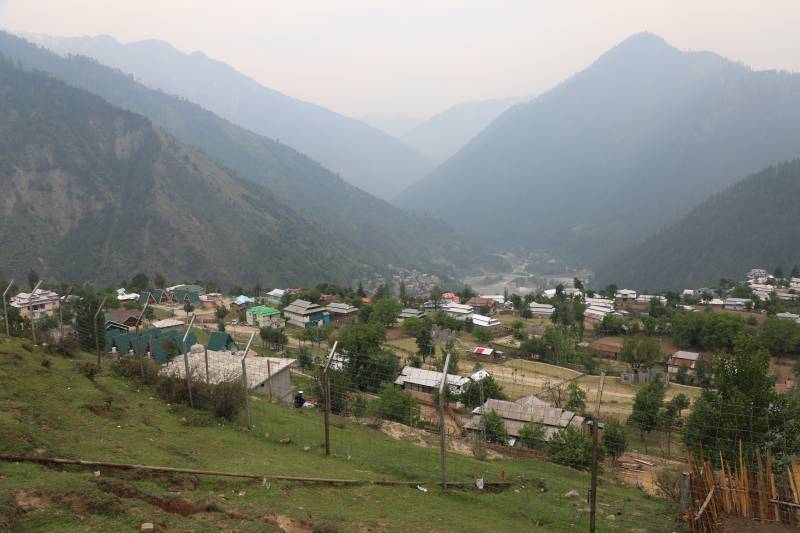
The mountains around Keran will not move, and the Neelum will continue to flow through the valley, indifferent to the borders drawn along its banks. Families will continue to stand on their respective sides, waving across the current, and on the days when grief is too large for a wave, wrapping whatever they have in cloth, tying it to a stone, and throwing it across. Iqbal will continue to live on this side, carrying the weight of two funerals he did not attend and two graves he has never been able to visit.
"People sometimes say that time heals everything," he says. "I don't think that is true. You learn to live with the pain, but the pain does not disappear. I did not only lose my parents. I lost the years in which I could have been their son, and they could have been grandparents to my children."
If he could speak to them today, he says, he knows exactly what he would do.
"I would introduce my children to them. I would say: these are your grandchildren. They grew up without you, but they have heard your names all their lives."
That introduction never happened and can never happen. He crossed the LoC once, in 1989, carrying a young man's certainty that he would soon return.
"I crossed the LoC once," he says. "I spent my whole life waiting to cross it again."
The Line of Control is, formally, a military boundary—separating administered territories, marking ceasefire positions, defining zones of control. But for the tens of thousands of families on either side, and for one man in Keran who has looked at home from the wrong side of the Neelum for thirty-seven years, it is the line that stood between a son and his parents' graves, the line that kept grandparents from their grandchildren, the line that turned a family's most ordinary wish into a hope that outlasted the people it was meant for.
The family was never lost. It was separated. And sometimes, separation is its own form of forever.