

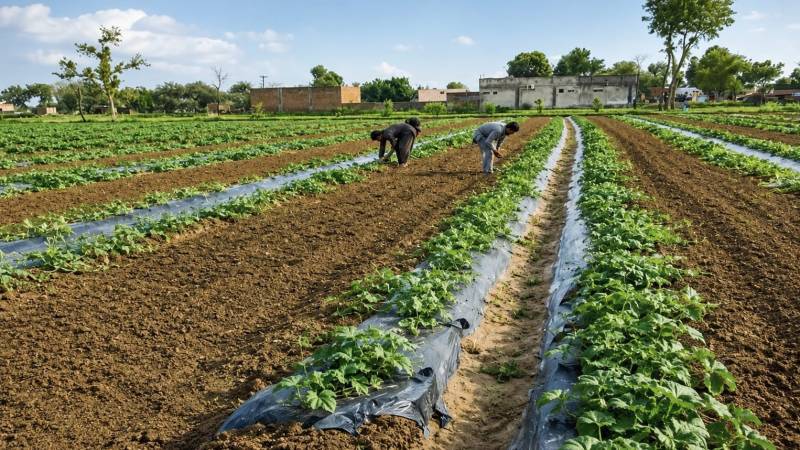
The road into Nali Mohal cuts through the fertile plains of Pakistan’s Punjab, passing endless fields before arriving at a village that, at first glance, appears perfectly ordinary. Brick houses have replaced mud huts. Motorcycles weave through narrow streets. Schoolchildren in crisp uniforms wait for buses, while young men prepare to leave for jobs in the Gulf and Europe. It is difficult to imagine that only fifty years ago, almost everyone here was landless.
The families who lived in Nali Mohal cultivated fields they did not own. They lived in homes that belonged to landlords, surrendered a large share of every harvest and, when called upon, provided unpaid labour. Their livelihoods, political choices and social standing were shaped by a feudal order that dominated much of rural Pakistan. Today, many of their descendants own farmland and work as teachers, police officers, civil servants, entrepreneurs, and professionals. Their transformation offers a rare window into one of Pakistan’s least understood social revolutions and raises an uncomfortable question that still resonates today.
Can land reform really dismantle inequality, or does it simply create a different elite? The answer, it seems, is both. When Pakistan emerged as an independent country in 1947, it inherited one of South Asia’s most unequal agrarian systems. Across Punjab and Sindh, a small number of powerful families controlled vast estates, while millions worked as tenants with few rights and little security. Land represented far more than wealth. It determined political influence, access to justice, and social prestige. In many villages, landlords exercised enormous authority over elections, policing, and local administration. Owning land often meant exercising power. Many countries faced similar challenges after the Second World War. Japan, South Korea and Taiwan introduced sweeping land reforms that redistributed farmland and invested heavily in rural education, infrastructure and agricultural support. Those reforms helped reduce inequality and became part of their broader economic success.
Pakistan attempted something similar but with mixed results. The country’s first land reforms, introduced in 1959, imposed limits on land ownership but left much of the traditional landed elite untouched. More ambitious reforms followed under Prime Minister Zulfikar Ali Bhutto in 1972 and again in 1977. Their aim was not only to improve farming but also to weaken feudal power by giving land to those who cultivated it. Many historians argue that the reforms were incomplete. Wealthy landowners often found ways around legal restrictions by dividing estates among relatives or exploiting administrative loopholes. At the national level, their influence remained remarkably resilient. But national statistics do not always tell local stories.
Nali Mohal is one of those stories. Farming families established the village by settling on land owned by Bhatti landlords from the neighboring village of Dohatta Azmat. Like countless tenant communities across Pakistan, generations worked the same fields without ownership or security. Their future largely depended on landlords’ decisions. Everything changed after the 1972 reforms. For the first time, many tenant households received ownership of the land they had cultivated for years. They also acquired residential plots, ending generations of dependence. The immediate benefits were economic, but the lasting impact was social. Land ownership changed how families imagined their future. Parents who had once struggled simply to survive began sending their children to school. Sons entered colleges and universities. Daughters, too, pursued education in growing numbers, later becoming teachers, nurses and government employees. A generation once excluded from state institutions gradually entered them.
Land reform should never be viewed as a single legislative act. Redistributing land may open the door to social mobility, but lasting equality depends on quality education, effective local government, fair courts, functioning public institutions and equal access to opportunity.
Migration accelerated the change. Some villagers found work in Pakistan’s cities, while others traveled overseas. Money sent home from the Gulf and Europe financed new houses, agricultural investment, and higher education. Land provided security. Education created opportunity. Migration generated prosperity. Together, these forces transformed a village once trapped in poverty into one increasingly connected to Pakistan’s middle class. Yet the story did not end there.
As former tenant families accumulated wealth, many purchased additional farmland—sometimes from the same landlord families who had once dominated them. Government jobs, business success and overseas earnings strengthened their position even further. Gradually, a new local leadership emerged. Village disputes, political influence and access to state institutions increasingly revolved around educated and economically successful families rather than hereditary landlords. The faces of power had changed. Its structure had not.
Across the developing world, historians have observed that land reform rarely eliminates hierarchy. Instead, it often reshapes it. Redistribution weakens established elites, but unless it is accompanied by strong institutions—good schools, reliable courts, accessible credit and accountable local government—new forms of inequality emerge. Pakistan illustrates that challenge clearly. Although the reforms created opportunities for thousands of rural families, they were not followed by sustained investment in education, healthcare, agricultural support or local governance. Land administration remained inefficient, political patronage endured, and rural public services developed unevenly. As a result, land ownership alone could not guarantee equality.
Today’s rural Pakistan increasingly rewards education, professional employment, and access to networks as much as farmland ownership. Families that combined agriculture with government service, business, or migration generally prospered most. Nali Mohal reflects this transition. Within two generations, descendants of landless sharecroppers entered universities, the civil service, the police, healthcare, and business. Women pursued careers once unimaginable. Economic independence opened doors that had remained closed for generations.
But success has also created new divisions. Some households accumulated larger farms, stable salaries and business capital, while others remained small farmers or agricultural laborers. Access to opportunity became increasingly linked to education, income and social connections. The village escaped one form of inequality only to encounter another. That does not diminish its achievements. Nali Mohal demonstrates that public policy can transform lives across generations. Giving people productive assets enabled them not only to increase their incomes but also to invest in education, diversify their livelihoods, and imagine futures beyond subsistence farming. Its experience also carries an important lesson. Land reform should never be viewed as a single legislative act. Redistributing land may open the door to social mobility. Still, lasting equality depends on what follows: quality education, effective local government, fair courts, functioning public institutions and equal access to opportunity.
Without those foundations, wealth and influence can gradually become concentrated once again. More than half a century after Pakistan’s most ambitious land reforms, Nali Mohal stands as both a success story and a warning. It shows that deeply rooted inequality can be challenged. Families once trapped in dependency can become landowners, professionals, and community leaders within a generation. Yet it also reminds us that power rarely disappears. It adapts. The road into Nali Mohal no longer leads to a settlement of landless tenants. It leads to a community whose history reflects modern Pakistan’s aspirations and contradictions. The village proves that redistributing land can change lives. Whether future generations inherit institutions capable of preserving those gains remains the more difficult and more important question.