

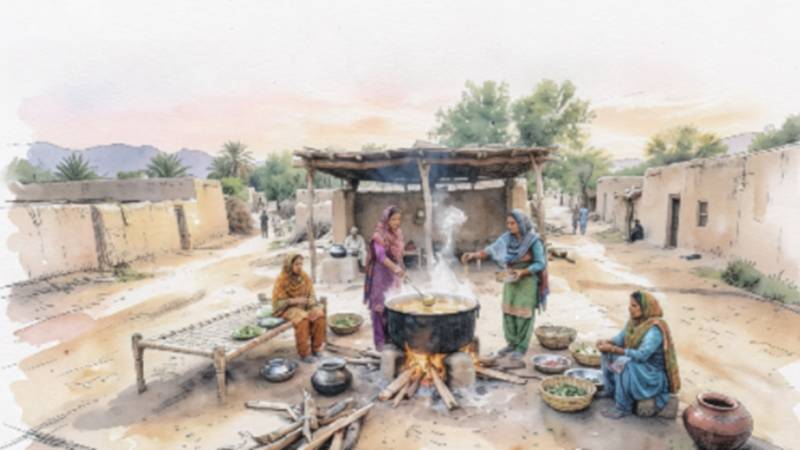
The memory of childhood does not leave easily. For many people born in the 1950s and 1960s, the village became part of their identity. Even after leaving, they carry its stories, faces, and images. When they recall those years, the village returns with a warm, almost golden glow.
They remember neighbours who helped one another, cared for the sick, respected elders, and trusted each other. They recall villagers who dug wells, cleared watercourses, welcomed visitors as guests, and gathered for social and religious feasts. Such memories carry both happiness and nostalgia.
In Sindh, much of that village life now belongs to a bygone era. Encroachment has narrowed streets. Wastewater gathers around houses. Employment has almost disappeared, and irrigation water has stopped. Women face harassment, children face abuse, petty disputes turn into fights, and families with means leave for towns and cities.
Boriri, a village in Taluka Khairpur Nathan Shah, District Dadu, reflects these changes. Yet its old life survives in the memories of those who grew up there. When I met some of them for this article, their faces brightened as they recalled their childhood. They spoke warmly about the objects once shared by the whole village, especially the cauldron.
They opened up and offered diverse views on the cauldron and its uses. One participant immediately pointed out that it cooked food for gatherings and feasts. Another noted that it crossed household boundaries and brought people together. As I listened, I realised that the story of the cauldron offered a glimpse into Boriri’s social life: who cooked, who shared, who helped, and who gathered. Their memories brought back the people, places, and customs that once bound the community together.
Before going into detail, it seems appropriate to introduce the social and physical layout of Boriri village. The residents belong to several surnames. Its main streets run roughly east–west, with several paras/lanes branching off from them. Boriri lies along the Khairpur Nathan Shah Link Road. To the east, the road connects with the main highway at Kakar, Khanpur, and Khairpur Nathan Shah. The nearest railway station is Piro Goth Railway Station. In the past, Sita Road Railway Station served as the nearest station.
I spoke with a group of villagers and used a simple checklist to guide our conversation. The questions helped me bring their memories together. What began as a story about an old cooking vessel soon became a story about village life itself.
A Cauldron in the Village
No one was sure who first brought a cauldron to Boriri. Everyone agreed, however, that each paro had one. It had become an unwritten rule: every paro should have its own cauldron. Boriri had about fifteen paras. These neighbourhoods largely followed family surnames. Yet a single surname could have more than one paro when families of the same lineage or surname lived in different parts of the village.
The story of the cauldron offered a glimpse into Boriri’s social life: who cooked, who shared, who helped, and who gathered
The cauldron entered into the village’s social world gradually. Its arrival often reflected the economic position of the household that could afford to buy one. As the number of cauldrons grew, so did the village’s capacity to host large social and religious gatherings.
Bashir Ahmed Mangi has cooked for weddings, circumcisions, milad sharif gatherings, and charitable occasions for nearly three decades. The villagers prepared a list of the cauldrons and checked it with their grandmothers. They counted about thirty-five in all. These vessels served the village during weddings, religious gatherings, and other communal occasions.
Material, Market, and the Cauldron
The older cauldrons were made of pital, brass. Later, some families brought copper cauldrons into the village. By the late 1960s and early 1970s, owning a cauldron had become a mark of status. Families bought them mainly in Sukkur. One villager recalled that Sukkur was then the preferred place to buy guards, iron goods, and metal utensils, including cauldrons. People trusted the quality of its iron, brass, and other metal goods. Karachi-made goods, another villager added, were sometimes dismissed as jugaṛ—inferior or makeshift products.
Sukkur also had a practical advantage. The railway made it easier to transport heavy goods back to the village. When one participant made this point, he suddenly stopped and looked towards the elders, as if seeking their approval. No one responded.
The Idea of Name Inscription
I couldn’t find any cauldron in the village that doesn’t bear an engraved name on the upper body of the cauldron. Those inscriptions reveal another layer of village life. The names were almost always male. If a cauldron belonged to a joint family, the family often engraved the name of its youngest son or, in some cases, its first grandson.
I asked an elderly woman in the village why families did not engrave the names of girls. Her answer was practical. The cauldrons travelled. Families lent them to people from other paras, other surnames, and even other villages. If a girl’s name appeared on the vessel, she explained, it would travel with it. Once a girl became a woman, people across the sajo jag—the whole village, or even the wider world—might come to know her name as someone’s daughter.
She paused before adding that this was simply her practical explanation. Girls, she insisted, were as dear as boys. But she also acknowledged a harder reality: many families still viewed daughters as a burden or an unwanted expense.
The cauldron, then, carried more than food. It carried family names, status, gender assumptions, and the boundaries of village society. When it moved from one paro to another, it carried those social meanings with it.
A Day of the Cauldron
After the wheat harvest in chet, a Sindhi month (mid-March to mid-April), families fixed marriage dates, usually around the twelfth to sixteenth night of the lunar cycle. The timing made practical sense. The harvest had filled homes with grain, while the moon provided enough light for wedding preparations. Electricity had not yet reached many remote villages, so the moon often served as the village lamp.
Once the date was fixed, preparations began. Families arranged a chhano, a temporary shelter for guests. Young men moved from house to house, gathering pillows, quilts, and cots. The family then decided whom to invite. One or two men took responsibility for carrying invitations to relatives and neighbours, sometimes walking to nearby villages. The invitation carried important social information. It gave the day, date, time, and place of the wedding. It also indicated whether the invitation was charho, a single-person invitation, or saghro, an invitation extended to the whole family, particularly the women. The choice depended on the relationship. A close relative might receive a saghro invitation, while a more distant acquaintance might receive a charho. Friendship, kinship, and social standing shaped the guest list.
Once the family estimated the number of guests, the radho, the village cook, entered the picture. He did not simply arrive and start cooking. He first asked a series of questions. How many guests would attend lunch? How many would stay for dinner? How many would remain for breakfast? What dishes would the family serve? Their answers helped him prepare the list of ingredients and plan the cooking.
Two dishes rarely left the menu: chahera, a savoury rice dish, and meṭho, sweet rice or zarda. Their quantities helped determine how many cauldrons the wedding would need. They also helped the family estimate the number of open hearths or cooking pits required.
Then came another small but important social task: borrowing the cauldrons. Strong young men carried messages from the groom’s family to cauldron owners in different paras. The request was simple: the wedding needed their cauldrons. But the response, however, was not always simple. A cauldron owner might agree but remind the messenger of an earlier wedding or social gathering. He might complain that the vessel had returned late, that nobody had cleaned it properly, or that the borrower had not sent even a small measure of rice as a token of affection and remembrance. Such complaints were not merely about a cooking vessel. They recalled the history of relationships between families.
A skilled messenger knew how to handle such moments. He listened, softened the complaint, and offered assurances. Sometimes he even took responsibility for returning the cauldron on time. He might also promise to send one or two plates of cooked food, such as rice, roti, and pieces of chicken. But a poor messenger could make matters worse. If he carried an old grievance against the groom’s family or the cauldron owner, he might return with a twisted message and add a sting of his own.
At this point, Bashir Ahmed Mangi, who has cooked at village weddings for decades, interrupted the discussion. Every wedding, he explained, had people who placed conditions on their help. Others used the occasion to settle old scores. Even the number of cauldrons could become a subject of village talk.
The question most often asked, he said, concerned the number of chahero and meṭho cauldrons used at a wedding. The question sounded simple, but it carried a measure of the groom’s family’s standing. People wanted to know not only how many cauldrons had been used but also what size they were.
A regular cauldron could hold about 24 kilograms of rice, while a smaller one held about 20 kilograms. The difference was small in weight but large in social meaning. A wedding with more and larger cauldrons showed that a family could feed a larger crowd. Mangi recalled that, after a marriage event, people often talked about the person who had paid for the largest number of cauldrons.
Cauldron Count and Family Prestige
Until the 1990s, Muhammad Bux Channa of village Boriri was known for this distinction. Mangi recalled that, at the marriages of Channa’s son and nephew, he had 55 regular cauldrons cooked. Each cauldron held about 24 kilograms of uncooked rice. Together, the 55 cauldrons required about 1,320 kilograms, or 1.32 tonnes, of rice. He recalled that people arrived in groups with their children. Many also brought their own pots to take rice home for their families. Mangi estimated that the rice could serve between 8,000 and 10,000 people, depending on portion sizes and the other food served at the feast. He added that the number measured more than rice. It reflected the scale of the feast, the host’s generosity, and the family’s social standing.
Just as we were ending the discussion, Comrade Nisar Ahmed raised his hand. He sought attention to say something. He halted the parting conversation. When we gave him attention, he said one point was still left to be discussed. He continued: how these cauldrons were maintained and made ready for the next season—and, he mischievously added, the season of marriage. He had raised a valid point. We reassembled and became attentive.
He responded that in the off-season, some Brohis from Balochistan, immediately after the wheat harvest, used to come with their tools and equipment and perform kalai on the cauldrons. He explained that cauldrons were re-tinned. A thin layer of tin was applied to the inside surface of the vessel. The cauldron was heated over a fire, and the kalaiwaro spread a thin coat of tin across its interior—a traditional process known as kalai.
The Passing of the Old World
When the formal discussion ended, we sat over cups of tea and returned to the past. They remembered a time when a village marriage belonged to everyone. The whole village took part. Even after the feast, people talked about it for days.
The change, they agreed, began in the 1980s. Decoration services arrived with tents and replaced the old chhano. Motorcycles and the new link road allowed guests to return home the same night. Families stopped collecting pillows, quilts, and cots from their neighbours. The new services also brought their own cauldrons and cooking equipment. Now, marriage became a one-day affair. Families began to manage their own arrangements. The village no longer planned the work together.
The old cauldrons still survive in some homes. But their fires have gone cold. A new world has taken their place—faster, easier, and more private. But in the memories of those who lived through it, the old cauldron still holds the warmth of a village that once cooked, ate, and celebrated together.