


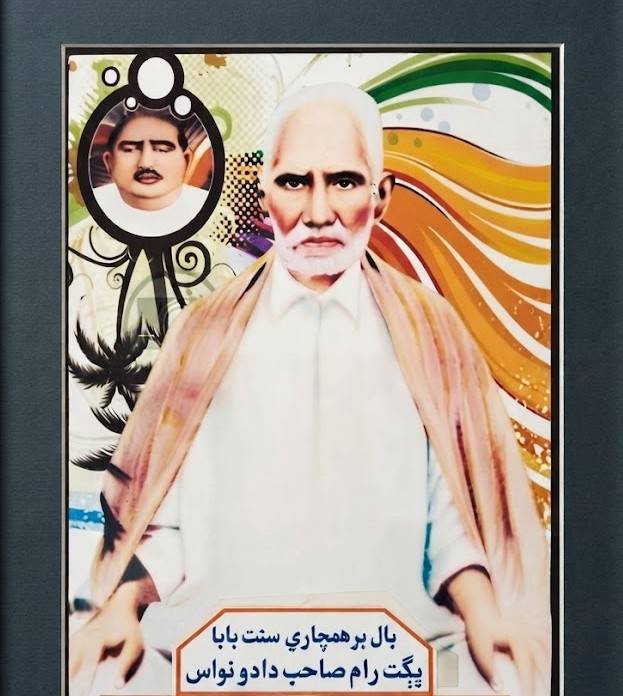
Three names. One life. One extraordinary journey. Born as Paiso in Dadu, he later became Ramji, the devoted disciple of his guru, and was ultimately revered as Bhagatram. Each name marked a new stage in his spiritual growth. Together, they tell the story of a boy whose life of seva, humility, and devotion inspired generations and left a lasting spiritual legacy in Sindh.
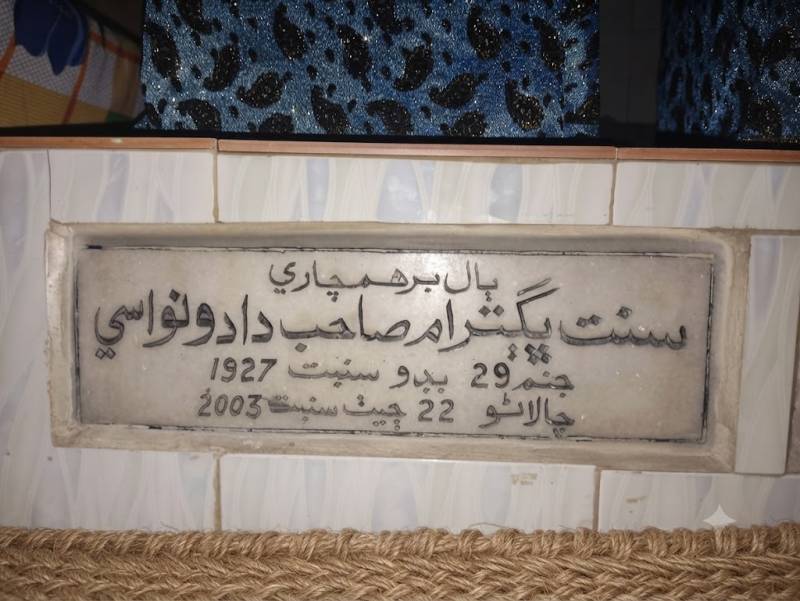
Born in Dadu on the 29th of the Sindhi month badho, samvat 1927 (approximately September 1870 CE), Paiso grew up in a town where ordinary householders inhabited a shared social world. His decisive spiritual turn came when he encountered Maharaj Devi Dina Ram (died in 1908 AD). Maharaj Dwarka Parsad Rochiram Sharma, author of Dadu Ja Bb Likal Lal, preserves a revealing moment from their early association. He writes:
“When Maharaj Devi Dina Ram asked the young Paiso what he desired, the boy gave a remarkably simple answer: ‘seva—service, especially service to his guru.’”
That answer defined the rest of his life.
Maharaj Devi Dina Ram accepted him. In time, he entrusted the young disciple with the keys of the asthan (a worship place, an abode of pious person), placing both responsibility and confidence in his hands. Paiso began to devote his days to his guru and to the affairs of the sacred establishment. Through service, discipline replaced youthful impulse; responsibility deepened devotion. Paiso became Ramji.
Yet another name awaited him.
With affection, Maharaj Devi Dina Ram began calling his disciple Bhagto. What began as the guru's intimate expression of love gradually acquired a larger meaning among the devotees. They added reverence to affection and called him Bhagatram. Thus, the name by which later generations remembered him emerged not from inheritance or formal office, but from a relationship between guru, disciple, and community. The journey from Paiso to Ramji and from Ramji to Bhagatram mirrored his spiritual transformation.
Seva Before Succession
Life at the asthan rested on devotion, but devotion also required a material foundation. Maharaj Devi Dina Ram's followers regularly offered dan (gifts made for religious and charitable purposes). Some donated agricultural land. Whatever people gave as a dan, it was accepted. One day, Seth Jethanand of Kathia village, in the Khairpur Nathan Shah area, arrived happily at Maharaj Devi Dina Ram's asthan. He came not to ask for something, but to give. As dan, he donated agricultural land lying on both sides of the railway station at Dadu. Some people also donated buildings, shops, and cash. Agricultural produce generated income, while rented properties yielded a regular revenue. Together with dan, or offerings made by devotees, these resources sustained the daily life of the asthan.
The money did not merely accumulate. It circulated through acts of service. The asthan maintained a langar (community kitchen), supported a Vidyalaya (a school for religious learning), received travellers, and patronised bhagats (religious persons) and spiritual gatherings. Land, shops, crops, and rents thus entered a spiritual economy: worldly property sustained sacred work.
But wealth also invited worldly ambition.
After the death of Maharaj Devi Dina Ram, some relatives began to look towards the gadi (a seat) of the asthan as an inheritance. Among the claimants was Maharaj Phaganmal, who based his claim on kinship with Maharaj Devi Dina Ram. As a cousin, he maintained that blood relationship gave him a legitimate right not only to the gadi but also to the agricultural land and buildings attached to the asthan.
The dispute raised a question larger than property: Could a spiritual inheritance pass through blood, or did it belong to the disciple who had lived the guru's teachings?
Mants, pandits, gurus, and other respected figures from Karachi, Hyderabad, Larkana, and Naseerabad gathered to deliberate. Their reasoning turned upon Maharaj Devi Dina Ram's own life. He had remained a brahmachari (celibate) and had never married. More importantly, the assembly concluded that he had not built his spiritual tradition around claims of blood, family, or kinship. The gadi, therefore, could not simply descend as family property.
Land may be taken and buildings may disappear, but a life devoted to service endures as a memory that time cannot erase
After prolonged deliberation, the panchayat (traditional council) recognised Bhagatram as Maharaj Devi Dina Ram's true disciple and spiritual successor. The man who had once asked only for the privilege of serving his guru was now invited to occupy the guru's seat.
Bhagatram accepted the responsibility, but not the grandeur that might have accompanied it. Out of reverence, he reportedly refrained from using Maharaj Devi Dina Ram's personal belongings. For him, succession did not mean becoming Maharaj Devi Dina Ram; it meant continuing his guru's work.
Phaganmal, however, refused to accept the panchayat's decision. He turned to the colonial courts, seeking either control of the gadi or a share in the institution's buildings and agricultural lands. Litigation continued for years in the civil court at Larkana. Eventually, Seth Jethanand Naromal intervened as mediator. A settlement granted Phaganmal some agricultural land and property, after which he withdrew his claim from the court.
When Land Became Seva
Over time, the land acquired new purposes. A portion on one side of the railway line was given to the Sindh Police for residential quarters. On the other side, the institution constructed shops, a school, and a dharamshala.
The dharamshala became much more than a building. It offered shelter to bhagat performers, mants, bavas, sadhus, and other travellers who came to meet Bhagatram or attend religious gatherings in and around Dadu. Travellers heading towards Larkana, Jacobabad, Sukkur, Quetta, and other destinations could stop there, eat, rest, refresh themselves, and resume their journeys. Hospitality itself became worship.
The asthan also filled with tunes and melodies. Bhagat, devotional songs, katha (religious stories), and stories of wisdom drawn from sacred literature formed part of its religious life. Significantly, the intellectual and devotional world cultivated there was not confined to a single religious tradition. Teachings and stories from different religious books could enter its gatherings, reflecting the socially interwoven world in which Bhagatram lived.
The Spirituality of Carrying Water
Perhaps Bhagatram's character emerges most clearly not from the property he administered or the gadi he occupied, but from a far more ordinary act: carrying water.
Every afternoon, at about four o’clock, Bhagatram would lift a wooden yoke onto his shoulders. Two tin containers hung from its ends. He then walked some distance to fetch water for the asthan.
The work was exhausting. Water was required in considerable quantities because visitors arrived regularly, devotional gatherings often continued late into the night, and the langar served food every day. Dal and roti commonly formed part of the meals, along with other items prepared for those who gathered there. Water was also needed for bathing, cleaning, cooking, drinking, and caring for animals.
Bhagatram could easily have assigned the task to someone else. He had devotees around him. People regarded him as a spiritual guide. Yet he carried the water himself.
When someone offered assistance, he reportedly refused. The act embodied his understanding of seva: a guru who stopped serving would betray the very path through which he had become a guru.
The same discipline governed his relationship with cows. Devotees frequently donated cows as dan, sometimes more than one at a time. As their number increased, tending them demanded considerable labour. Bhagatram nevertheless cared for them himself. Fetching water and tending cattle consumed hours of physical work, but he did not regard these duties as beneath his spiritual station. On the contrary, humble labour formed part of that station. His spirituality lived in his hands as much as in his words.
A Sacred Space Without Social Walls
The seating arrangement at the asthan reflected both the customs of its time and the social diversity of those who gathered there. Bhagatram sat simply, on a rough mat. Before him stood a slightly raised space where a tounri, a mat woven from the soft reeds or grasses associated with the Manchhar lake and Bubak area, was reserved for Brahmans. Nearby lay a farsi, a floor covering on which ordinary visitors sat.
Hindus and Muslims came to hear Bhagatram. Men sat among the gatherings, while women appeared regularly with concerns drawn from everyday family life. Some carried newborn babies and asked for a sacred thread. Others brought sick children. Mothers worried about the future of their sons and daughters and sought blessings. Some requested nothing more than that Bhagatram place his hand upon a child's head.
The sacred thread associated with him became sufficiently popular that Sindhwarkis (Sindhi traders in foreign lands), whether living in Hyderabad or overseas, sometimes asked relatives and friends to obtain one for them.
However, Bhagatram resisted claims that he possessed miraculous powers. On religious occasions, he reportedly reminded devotees:
“I have acquired no special spiritual power. I am only a servant of the Brahmans. I believe in the shastras and mantras, and astrology has its effects according to the destiny of each person.”
Whether one reads these words as humility, theological caution, or both, they reveal the image Bhagatram wished to project. People might approach him as a holy man, but he continued to describe himself through service.
From Asthan to Dharma Trust
Bhagatram guarded the finances of the asthan carefully. Property, rent, agricultural income, donations, and religious expenditure required disciplined administration. The wealth belonged to the institution and its purposes, not to the person sitting on the gadi.
At some point, Bhagatram decided to undertake a long yatra (pilgrimage) to India's sacred places. Such a pilgrimage could keep him away for more than a year. The prospect raised an important question: Who would safeguard the asthan, its property, and its mission during his absence—and after him?
Rather than leave the matter to personal loyalties, Bhagatram sought an institutional solution. After consulting friends and associates, he decided to transfer his heavy personal spiritual authority into an organisation governed by written responsibilities.
The original trustees included Bhagatram, adopted son of Maharaj Devi Dina Ram and a resident of Dadu; Maharaj Vishno, son of Nainaram of Hyderabad; and Dolatram, son of Seth Sangatrai of Dadu. Later, Jaiandas and Dr Permanand Hardasmal joined them.
The Trust Deed reveals what Bhagatram believed the institution should preserve after him. The Trust would welcome visiting sadhus, brahmans, and scholars and commemorate Maharaj Devi Dina Ram's death anniversary. It would continue Maharaj Devi Dina Ram’s Vidyalaya and preserve the original asthan in Shahi Bazar at Dadu as the centre from which its activities would be administered.
The deed also carried service beyond the walls of the asthan. Land given to Dadu Municipality was to become a park named after Maharaj Devi Dina Ram. If the municipality failed to establish the park, the land was to serve another dharma or charitable purpose. Rent from one shop would meet expenses associated with Shri Jagannath Mandir. During disasters and calamities, the Trust would provide financial relief.
Bhagatram also looked beyond Sindh. At Haridwar, the Trust was authorised to spend Rs. 10,000 to establish an ashram or dharamshala in Maharaj Devi Dina Ram's name.
Administrative continuity mattered equally. Trustees could appoint two additional members. When a trustee died or resigned, another would replace him. Each year, around Maharaj Devi Dina Ram's death anniversary, the trustees would choose a chairperson, who would present an annual report together with financial accounts. Trustees would receive no remuneration, though the Trust could reimburse legitimate travel and related expenses.
The Registrar formally signed and issued the Trust Deed on the 18th of October 1940. In legal language, these were clauses. In spiritual terms, they represented an attempt to make seva survive the sevadar.
During the 1940s, political divisions between Hindus and Muslims sharpened across British India. Arguments once conducted in legislatures and political meetings travelled into towns, villages, neighbourhoods, and even remote settlements. Dadu could not remain untouched.
Bhagatram died in the Sindhi month Jeth, Samvat 2003 (approximately June 1946 CE). His hathios (bones, ash) were buried at the place where he had first learned to serve. His samadhi at the main temple in Shahi Bazar, Dadu, became a material reminder of that memory.
At the time of migration, one of the earliest trustees, Dolatram Sangatrai Choudhari, submitted a compensation claim to the Government of India for approximately Rs. 542,000. The government reportedly accepted a claim of only Rs. 316,014. The size of the claim indicates the considerable material assets associated with the asthan.
Communities that had spent generations building schools, parks, dharamshalas, temples, asthans, businesses, and homes experienced Partition as far more than the drawing of a boundary. It fractured a lived landscape. Places once shared by Hindus and Muslims were suddenly recast within a new political order. Families left, trustees migrated, and properties were abandoned, leaving behind a landscape marked by absence.
After Partition, dharamshalas, school buildings, agricultural holdings, and other properties became vulnerable to occupation, appropriation, and disputes. Some were partially or illegally occupied, allegedly with the help of local revenue officials. Institutions once devoted to serving communities now struggled simply to retain their land.
The land-grabbing that began after Partition continues to this day. A sacred complex that once covered thousands of square feet has been reduced to a fraction of its original size. But the asthan’s legacy was never measured in land. It survives in langar, seva, katha, bhagat, and vidya—traditions of service, learning, devotion, and community passed from one generation to the next. Land may be taken and buildings may disappear, but a life devoted to service endures as a memory that time cannot erase.