

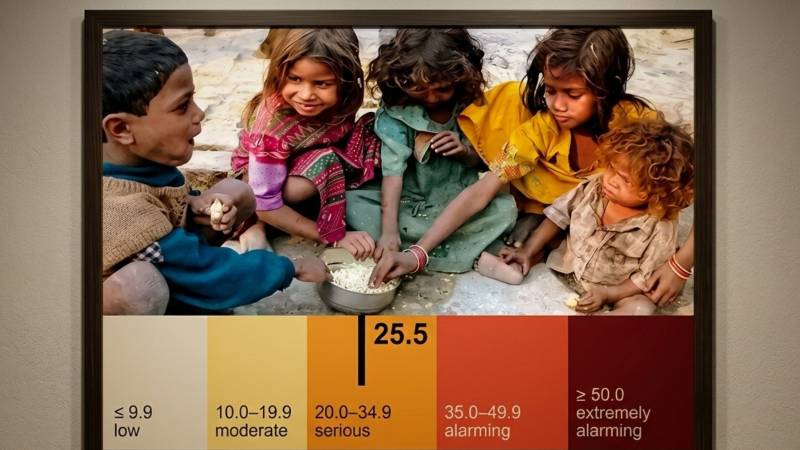
Pakistan's hunger crisis did not emerge overnight. It grew quietly through years of neglected warnings, deferred decisions, and difficult conversations left unresolved..The latest Global Hunger Index 2026 should have triggered a national conversation. Instead, it generated a few headlines, the usual expressions of concern, and then quietly joined the growing archive of reports that Pakistan acknowledges but rarely allows to shape its priorities.
The report places Pakistan as the worst-performing country in South Asia on hunger indicators and notes a deterioration from its recalculated 2018 score of 24.0 to 25.5 in 2026. For a country that debates almost everything, our silence on matters affecting the wellbeing of millions is remarkable. We passionately contest political slogans, constitutional interpretations and every passing controversy, yet evidence of worsening hunger rarely survives a news cycle. Perhaps that indifference is itself the story.
Pakistan has never suffered from a shortage of diagnoses. Reports, assessments, alerts, cautions and recommendations emerge with remarkable regularity. Researchers write them, international organisations publish them, development agencies fund them and public institutions acknowledge them. Yet somewhere between diagnosis and action, urgency evaporates. Problems that could have been addressed when they were manageable are allowed to mature into crises.
Poverty, child labour, food insecurity, poor learning outcomes, weak healthcare systems, environmental degradation and unemployment did not arrive unexpectedly. They have accompanied us for decades, growing steadily while governments changed, committees were formed, plans were launched and fresh studies commissioned to explain what earlier studies had already explained.
Hunger is the cumulative outcome of multiple failures occurring simultaneously. It reflects inadequate incomes, weak human capital, poor educational attainment, low productivity, limited economic opportunity and vulnerability to recurring shocks. In many respects, hunger is the final report card of governance.
Part of the answer lies in our tendency to avoid difficult conversations until circumstances leave us with no choice but to confront them. Among those conversations is the question of population growth..The subject often generates more emotion than analysis. It is quickly wrapped in ideological, cultural or religious sensitivities, as though discussing demographic realities somehow diminishes human dignity or faith. It does not. Every child is a blessing, but every blessing also carries a responsibility. A society that celebrates births without equally contemplating its obligations towards those children risks confusing aspiration with planning.
The question was never how many children we could bring into the world. The question was whether we intended to provide them with nutrition, healthcare, education, safety and meaningful opportunities. It is a question we postponed for far too long. Millions of children remain outside the formal education system. Many enter the labour market before they should. Others grow up in conditions marked by deprivation, poor nutrition and limited prospects for upward mobility. One need not rely exclusively on statistics to observe this reality. It is visible at traffic intersections, in workshops, in markets and across communities where survival frequently takes precedence over childhood itself.
The tragedy does not end there. A child deprived of nutrition often encounters learning difficulties. Learning deficits reduce employability. Limited employability constrains earnings and productivity. Economic insecurity then passes from one generation to the next. Hunger is therefore not merely a symptom of deprivation; it is one of the mechanisms through which deprivation reproduces itself.
This reality becomes even more concerning when viewed through the lens of Pakistan's youth population. For years we have celebrated the idea of a demographic dividend. Yet a demographic dividend is not a demographic entitlement. It emerges only when a large youth population possesses the education, skills and health necessary to contribute productively to economic growth.
Recent learning assessments reveal that a large majority of Pakistani children cannot read and comprehend an age-appropriate text by the age of ten. These shortcomings eventually surface in labour markets where employers increasingly struggle to find workers equipped with even basic literacy, numeracy and problem-solving abilities.
A large population becomes an asset only when it is educated, skilled, healthy and productively engaged. Otherwise, it remains merely an over-grown population. Experiences from elsewhere in Asia demonstrate that demographic pressures can be managed through deliberate policy choices. Countries such as Bangladesh, Indonesia and Vietnam invested consistently in female education, maternal health, family planning and broader human-capital development. They recognised that economic ambitions and demographic realities could not be treated as separate conversations.
Pakistan has too often done the opposite. We postpone uncomfortable debates, ignore inconvenient evidence and assume that persistent problems will somehow resolve themselves. Then we express surprise when the consequences appear in the form of poverty, poor educational outcomes, food insecurity and social vulnerability. Economic instability, inflation, climate shocks and weak public services undoubtedly contribute to hunger. Yet population growth interacts with each of these challenges and magnifies their impact. It increases demand on households, stretches public services and enlarges the number of people exposed to economic vulnerability. It may not explain everything, but it influences almost everything.
Our hunger crisis did not arrive unannounced. It grew in the space created by problems we identified but failed to address, warnings we acknowledged but failed to heed, and realities we preferred not to examine too closely. Nations rarely fail because they cannot diagnose their problems. More often, they struggle because they continue diagnosing the same problems for decades while postponing the remedies. Pakistan's hunger crisis is therefore not merely a story about food. It is a story about governance, accountability, priorities and choices. Above all, it is a story about a problem we should have seen long ago, but somehow failed to see until it had grown too large to ignore.