

Pakistan has a long and often turbulent history of federal intervention in the provinces, with the centre repeatedly resorting to governor’s rule and emergency powers when a provincial government seemed unable to function constitutionally. The practice began as early as January 1949 in Punjab, when the federal government dismissed the ministry of Nawab Iftikhar Hussain Mamdot, and was repeated in Sindh in December 1951. Later episodes under the 1973 Constitution included Balochistan (1973, 1975–76, 2013), the then-NWFP, now Khyber Pakhtunkhwa (1975, 1994), Sindh (1988) and Punjab (2009). Each left lasting questions about provincial autonomy and federal responsibility.
A Proclamation of Emergency under Article 232 is issued when the President is satisfied that a grave emergency threatens the security of Pakistan, or any part of it, through war, external aggression, or internal disturbance beyond a provincial government’s control. For internal disturbance, a resolution of the provincial assembly concerned is also required. The federal government may then direct the province, Parliament can legislate for it beyond the federal list, and the proclamation lasts initially two months unless Parliament approves its continuation.
Article 234 permits the President, usually after a report from the governor, to declare that a province’s government cannot be carried on in accordance with the Constitution. The President may assume the provincial government’s functions, or direct the Governor to do so, except the High Court’s powers, and the assembly’s powers pass to Parliament or its authority. In practice, the powers of the chief minister, cabinet and advisers pass to the Governor. The assembly is not dissolved but cannot function meanwhile, so the elected executive is displaced for the duration. Governor’s rule lasts two months initially, can be extended by a joint sitting, and cannot exceed six months in total. The High Court continues to function.
Pakistani courts have examined these powers. In Pir Sabir Shah v. Federation of Pakistan (PLD 1994 SC 738), the Supreme Court held that Article 234 is temporary in character. Unlike Articles 58(2)(b) and 112(2)(b), it does not require “an appeal to the electorate”; it addresses a temporary breakdown of constitutional machinery, not an irreversible situation. The case is also cited for the view that a proclamation can suspend a chief minister but cannot remove him, meaning the executive is set aside for its duration only. On Article 236(2), which on its face bars court challenges, the Court held that the bar does not cover a proclamation that is without jurisdiction, coram non judice or mala fide, which superior courts may review. That position was affirmed in later decisions, including Zafar Ali Shah v. Pervez Musharraf (PLD 2000 SC 869). These authorities suggest Article 234 is temporary and not wholly beyond judicial review.
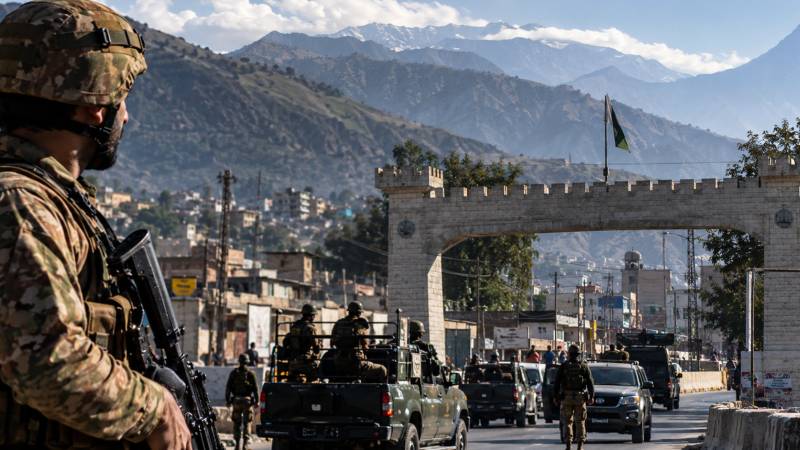
On 11 October 2026 these powers were exercised again. President Asif Ali Zardari, on the advice of Prime Minister Shehbaz Sharif following a cabinet recommendation, imposed both an emergency and governor’s rule in Khyber Pakhtunkhwa. Governor Faisal Karim Kundi took charge, supported by an eleven-member advisory council. The army was authorised under Article 245 to assist civil administration, and a separate secretariat now runs twelve districts, according to the Law Minister, directly under the federation. The centre cited escalating militant violence and the provincial government’s deliberate disengagement from a unified counter-terrorism effort.
The confrontation therefore rested on two incompatible readings of the same facts. The centre saw a provincial government that had allowed militant space to expand, while the provincial leadership saw a federal government that preferred force over dialogue.
Security reports presented to the cabinet recorded a 195% increase in terrorist incidents between March 2024 and September 2026, with 181 IED attacks in 2025 and 159 by September 2026. Police and security personnel were targeted in 73 percent of 2026 attacks, and drone attacks on them, unreported in 2024, reached 170. The reports also noted 9,000-plus vacant police posts, Safe City coverage confined to Peshawar, and chronic shortages in the Counter-Terrorism Department.
The federal government said political obstruction compounded this deterioration. Interior Minister Mohsin Naqvi said the provincial side had agreed in early October talks to sign a written security package. According to Naqvi, it included review of the Police Act to curb political interference, elimination of terrorist safe havens, unequivocal condemnation of the Tehreek-e-Taliban Pakistan and affiliates, support for the Afghan refugee policy, coordinated decisions on the former tribal districts, and full implementation of the National Action Plan. He said the provincial side, under Chief Minister Sohail Afridi, withdrew from these commitments at the final stage, warning that security could not be subordinated to politics while the province was under attack.
Information Minister Attaullah Tarar went further, alleging that the PTI provincial government maintained a “nexus” with terrorist organisations, that militants influenced several districts, and that an “unholy alliance” gave terrorists relative freedom of movement while other parties faced attacks. He said the provincial government had never condemned the TTP or its Afghan counterpart and stayed silent when drones came from Afghanistan, and later told foreign media the government held “credible evidence” of PTI contacts with the TTP, which he promised to present. Law Minister Azam Nazeer Tarar cited deteriorating law and order and the provincial government’s lack of support against terrorism, and other ministers echoed the charge of sympathy toward banned groups.
The centre also pointed to public statements by Afridi. On 7 October 2026, while leading the PTI long march through Khyber, he declared: “I will not allow another military operation in Khyber Pakhtunkhwa; I will resist anti-people policies till I am the chief minister,” and that he would “never become a part of this policy.” On election as chief minister in October 2025 he had told the assembly that “military operations are not a solution” and “no operation will be allowed” while he held office, calling them sources of displacement and “collateral damage” that increased militancy. The federal government presented this as a refusal to support measures security institutions saw as necessary.
Federal officials also cited political distance from the human cost of terrorism. Naqvi told the Senate that police and security personnel were sacrificing their lives while Afridi would deliver speeches against them the next day, and Tarar said PTI leaders did not visit Kurram or express solidarity with the armed forces after attacks there. Such conduct, the government argued, showed no ownership of the fight waged by the province’s police and armed forces.
PTI rejected the narrative, saying the province had paid the heaviest price against militancy and lacked adequate federal support. Afridi disputed Naqvi’s account of the talks and said lasting peace required political consensus, an end to displacement, and a review of the approach toward Afghanistan. PTI chairman Barrister Gohar Ali Khan called the move a serious political mistake and on 14 October filed a petition in the Peshawar High Court seeking to have the proclamations declared unconstitutional. Lawyers differ over whether the court can hear it while the army is deployed under Article 245, and the National Assembly and Senate have approved the emergency. Afridi and some cabinet members were also reportedly taken into preventive custody.
The confrontation therefore rested on two incompatible readings of the same facts. The centre saw a provincial government that had allowed militant space to expand, rejected the National Action Plan’s operational requirements, publicly ruled out military operations, and kept its distance from the security forces. The provincial leadership saw a federal government that preferred force over dialogue and used security as a pretext to neutralise an elected opponent. The surge in violence, the collapse of the October talks as described by the federal government, Afridi’s statements against operations, and ministers’ public allegations of facilitation formed the core of the federal case. Whether they amounted to a constitutional breakdown, and how the Article 232 requirement of a provincial assembly resolution applies, will be tested in the courts, in Parliament and in the results of the intervention.