

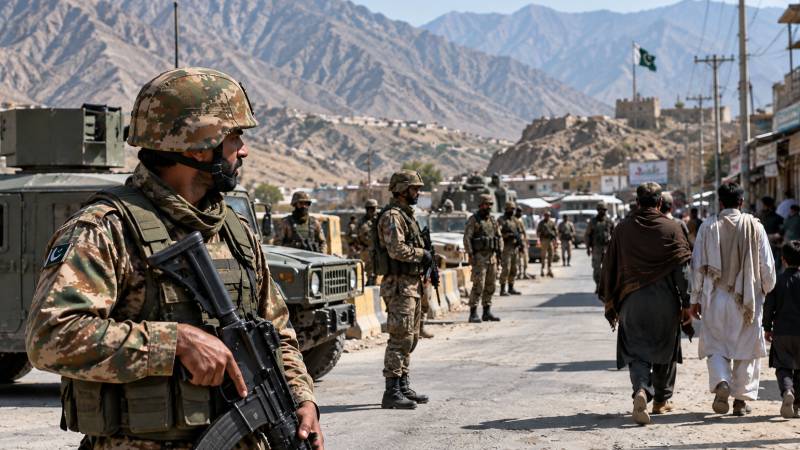
From the dusty checkpoints of Bannu to the restive valleys of North Waziristan, the ground truth in Khyber Pakhtunkhwa is unforgiving. For more than thirteen years, Pakistan Tehreek-e-Insaf has dominated the province’s politics, governing from 2013 to 2018 under Pervez Khattak, 2018 to 2023 under Mahmood Khan, and again from 2024 onward under successive chief ministers including Ali Amin Gandapur and now Sohail Afridi. What began as a promise of “change” and a model province has calcified into a cycle of emotional mobilisation, governance shortfalls, and a security environment that leaves ordinary Pashtuns paying the highest price. The leader whose image still saturates the narrative sits in Adiala Jail, incarcerated since August 2023 on multiple convictions he and his party call politically motivated. Meanwhile, the province he once claimed to transform remains trapped.
The emotional vulnerability of Pashtun society is no secret. When praise is offered, or when a charismatic outsider frames himself as the sole defender of honour and dignity, collective judgment can dissolve into fervour. That fervour has been systematically cultivated. Rallies, social-media amplification, and a cult of personality around one figure have turned political loyalty into something closer to devotion. Local YouTubers and diaspora voices, many operating from relative safety abroad, have monetised this devotion, extracting clicks and dollars. At the same time, the streets of Peshawar, Dera Ismail Khan and the former tribal districts absorb the human cost. The question that hangs in the air among those who still live here is blunt: beyond the theatre of grievance and the mobilisation of Pashtuns for marches and unrest, what tangible improvement has this prolonged hold on power delivered?
Security data paints the starkest picture. After a period of relative decline in the mid-2010s following major military operations, terrorist violence has surged again. According to the South Asia Terrorism Portal, Khyber Pakhtunkhwa recorded hundreds of fatalities annually in recent years, with totals climbing sharply: roughly 941 in 2023, over 1,300 in 2024, more than 2,300 in 2025, and continuing high numbers into 2026. Civilians, police, and soldiers have been killed in ambushes, suicide attacks and IEDs across southern and tribal districts. Police casualties alone have risen dramatically in 2026. The province has become the primary theatre of the Tehreek-e-Taliban Pakistan’s resurgence, with cross-border dynamics involving the Afghan Taliban (TTA) complicating every response. Thousands of lives have been lost across the broader period of PTI dominance. Families bury sons who wore the uniform or walked the wrong road at the wrong time.
Khyber Pakhtunkhwa does not need another cycle of charismatic absolution or diaspora cheerleading. It needs clinical governance, an unambiguous rejection of militant groups, investment that actually reaches classrooms and clinics, and a politics that treats Pashtuns as citizens rather than emotional capital.
Yet the provincial narrative has often shifted blame outward. Security forces are frequently cast as the problem rather than partners in a shared fight. Kinetic operations are painted as excesses; the structural failures of policing, intelligence coordination, and political will are downplayed. This scapegoating is not merely rhetorical. It erodes the social space required for sustained counter-terrorism. When political leadership is reluctant to name the enemy clearly, or when past advocacy for talks and “rehabilitation” of militants is remembered more fondly than the cost of those experiments, the message to both the public and the militants is hesitation.
That hesitation has fuelled persistent allegations of a soft corner. Federal officials have repeatedly accused the PTI-led provincial government of functioning, in effect, as a political facilitator for the TTP and of echoing narratives convenient to the TTA. Historical record is clear on one point: during Imran Khan’s federal tenure, negotiations with TTP elements were publicly pursued, and language of forgiveness and reintegration was advanced. In the province, funding patterns toward certain seminaries and muted condemnation after major attacks have kept the charge alive. Whether this amounts to deliberate synergy or simply political calculation born of fear and electoral arithmetic is debated. What is not debated on the ground is the result: militants operate with greater freedom, police lack adequate equipment and numbers in many districts, and the civilian population lives under a low-grade siege.
Development indicators offer little consolation. Education budgets rose, teachers were hired, and initiatives such as the Sehat Card were launched. Yet millions of children remain out of school, learning outcomes lag, and female secondary enrolment trails other provinces. Unemployment perceptions remain high; industrialisation has been anemic. Flagship projects such as the Peshawar Bus Rapid Transit became cautionary tales of cost overruns and delayed delivery. Billions allocated for counter-terrorism and former FATA development have not translated into commensurate security or economic transformation. The province continues to receive substantial federal transfers, including the one-percent NFC share for terrorism-related losses, yet the gap between resources and results remains glaring. Geography and history are real constraints; they are not permanent excuses after more than a decade of uninterrupted political control.
Equally corrosive is the hijacking of Pashtunwali itself. The code of honour, hospitality, and collective responsibility has been selectively invoked to justify perpetual confrontation and emotional blackmail. When criticism of the party or its leadership is framed as betrayal of the entire ethnicity, genuine debate is shut down. Pashtuns are reduced to a political instrument useful for street pressure, disposable when the costs of that pressure arrive in body bags. This is not cultural preservation; it is cultural instrumentalisation.
The current political turmoil only intensifies the sense that a province is being held hostage. Confrontation with the centre over protests demanding the release of the incarcerated leader, mutual accusations of bad faith, and periodic talk of constitutional measures such as governor’s rule create an atmosphere of permanent crisis. Governance becomes secondary to the politics of survival and mobilisation. Ordinary citizens, shopkeepers in Kohat, farmers in Swat, teachers in Bajaur, are left navigating both militant threats and the secondary effects of political paralysis.
This is not to deny that previous administrations also failed the province, or that the structural challenges of the Afghan frontier are formidable. Nor is it to ignore that PTI introduced certain administrative experiments and retained significant electoral support. But thirteen years is long enough to measure results against rhetoric. The data on violence, the stagnation in human development, the pattern of narrative deflection, and the emotional capture of a proud people form a coherent and disturbing picture.
Khyber Pakhtunkhwa does not need another cycle of charismatic absolution or diaspora cheerleading. It needs clinical governance, an unambiguous rejection of militant groups, investment that actually reaches classrooms and clinics, and a politics that treats Pashtuns as citizens rather than emotional capital. Until the province is freed from the grip of personality cult, selective grievance, and strategic ambiguity toward those who kill its people, the hostage situation will continue. The cost is measured not in headlines or YouTube views, but in the quiet funerals that never make the international feed. The Pashtun nation has survived empires and invasions. It should not be undone by the politics of its own emotional vulnerability.