

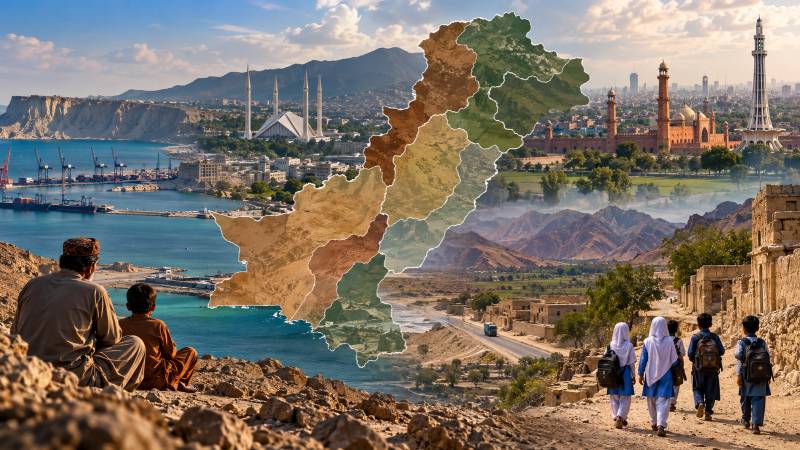
Pakistan stands at a critical juncture in its constitutional and administrative development. The country, with approximately 252 million people, continues to govern its citizens through just four provinces. A question, however, arises in minds: whether the country can govern their citizens within four provinces. This raises an important policy question: whether the government of Pakistan can address the diverse economic, social, geographical and security challenges of rapidly growing populations. The answer is yours; in my view, creating new provinces is not merely about drawing new boundaries but about equitable resource distribution, human security and the future of Pakistan’s federal structure. In my view, creating new provinces has both pros and cons and requires serious consideration. The government of Pakistan should follow the constitutional principles, empirical evidence, the will of the people and human security before moving forward.
According to the national population survey, Punjab has approximately 127.7 million people, while Balochistan is one of the largest provinces, with 44 percent of the country but containing only 6.2 percent of its population. Most people in Balochistan and Punjab live in remote districts. For example, Gwadar is 910 kilometers away from Quetta, while Rahim Yar Khan (or Rajanpur) is approximately 585 to 606 kilometers away from Lahore. Such long distances can complicate access to quality education, healthcare, land administration and other fundamental services. In this case, my answer will be yes, and the new provinces are crucial for Pakistan to remove the governance gap. Human development is yet another crucial factor for the country. According to the economic survey of Pakistan 2025-26 more than 28% children out of schools and if we breakdown by gender, male out of school rate 25% while female are 31% in all provinces of Pakistan. We further break down by provinces.
In Balochistan, it is 45%, while in Sindh it is 39%. In Khyber Pakhtunkhwa, 28%, while in Punjab, 21% of children are out of school, which creates an alarming situation for the entire provinces. Another factor in these provinces is the stunted growth of children. The new survey describes that 33.6% of children are affected by stunting and malnutrition, above the South Asian regional average. Similarly, the undernourished population has increased by 16.5%, with approximately 11 million people experiencing severe hunger pain in the country. Food insecurity further exacerbates the problem, and it rose from 15.9% to 24.4% compared to 2018-19. At the same time, public health spending stands at 0.8% of total GDP allocation of Rs. 19.37 billion, which has become a great challenge for the government.
Creating new provinces is not merely about drawing new boundaries but about equitable resource distribution, human security and the future of Pakistan’s federal structure.
A debate on new provinces in Pakistan has been adopted from a published report by the digital debates titled " The Case for new provinces in Pakistan. The report claims that the recent statement of Interior minister Mohsin Naqvi, the DG ISPR and senior minister at the Ministry of Planning has proposed 15 federation units and the detail has been shared that Proposed provinces and their populations must include Faisalabad with 24.8 million populations, Lahore 22.8 million, potohar 20.4, Chenab 18.8, Multan 14.1, Bahawalpur 13.4 while Derajat 12.9 million populations. In contrast, Sindh should be divided into Southern Sindh with 21.5 million, Karachi with 20.4, and Northern Sindh with 13.8 million population. Similarly, Khyber Pakhtunkhwa should be divided into Peshawar with a population of 20.5 million, Southern KP with 14.1 million, and Hazara with 6.2 million. Moreover, Balochistan should be divided into Northern Balochistan with 7.9 million and Makran–Kalat with 7.0 million.
It is expected that new provinces could provide more accessible political leadership, enable the government to develop policies suited to regional needs and improve administrative coordination within new provinces; however, this can materialize if the smaller provinces receive meaningful authority with accountable institutions and adequate resources. Creating new provinces is not free from certain challenges despite its potential advantages; these have also been discussed in short form. For example, the creation of new provinces would redistribute political authority, administrative positions, legislative representation and fiscal resources. This will ultimately bring new chaos in the country because political resistance is a major obstacle for new provinces. Secondly, Article 239(4) of Pakistan’s constitution mentions that creating new provinces will require a two-thirds majority in the affected provincial assembly and parliamentary approval. Such a proposal requires sustained negotiations among political parties. In such circumstances, it is difficult to bring broader consensus as per the constitutional requirements.
Every new province would require administrative institutions, including an assembly, a secretariat, and other public bodies, and this requires financial sustainability, which is not possible in the current situation because the country has already collapsed, as stated by the Interior Minister. Creating new provinces requires national strength rather than turning it into a source of political confrontation. To protect the minorities, strengthen the federation and respect cultural identities, the ethnic and linguistic sensitivities must be handled with careful management. Ignoring such linguistic sensitivities may further become an obstacle for new provinces in Pakistan.
These are some policy options for new federation units in detail. Firstly, the federal government should establish an independent provincial commission comprising experts from constitutional law, public administration, economics, and civil society. This commission should assess population, administrative accessibility, geography, development disparities and revenue potential while creating a new province. Secondly, fiscal arrangements and the NFC framework should be reviewed to ensure the distribution of financial resources. Without financial clarity and administrative reform, new provinces will become a headache for the incumbent government. Thirdly, article 140 A of the constitution declares that creating additional provinces requires political forces, financial authority and administrative units for elected local government because, without strengthening the local institutions, new provinces will just become a big problem for the whole country. Fourthly, citizens in affected regions should participate through transparent hearings, accessible public information and representative forums. Without public preferences, a free and fair process can never be guaranteed before moving to new provinces. Last but not least, creating new provinces on the basis of populations, administrative coherence, geography and financial viability, with short political interests and fairer resource distribution, is just a waste of time. A stronger federation is not necessarily one with few provinces but one in which every administrative unit serves its people effectively for a more resilient, inclusive and prosperous Pakistan.