

“No person shall be deprived of his property save in accordance with law”—Article 24, Constitution of Pakistan
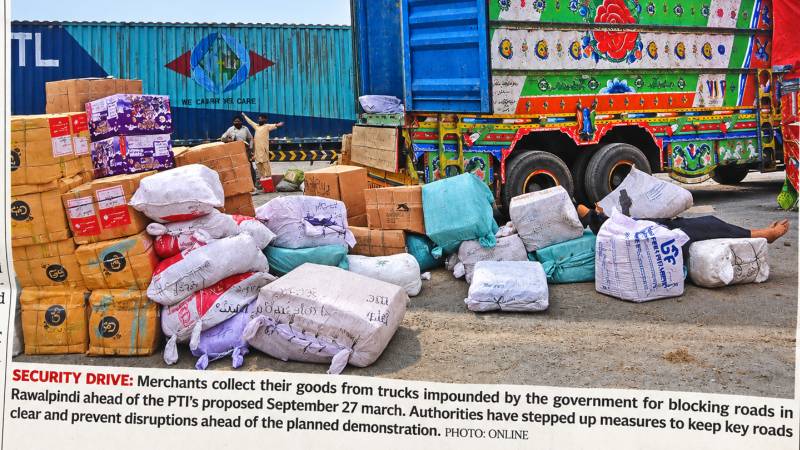
There is something profoundly disturbing about the photograph before us. Cartons, bundles and merchandise lie scattered beside brightly painted trucks while commercial containers stand immobilised. These vehicles were not manufactured as barricades. They were not purchased by the State as instruments of crowd control. They belong to transporters and businesses whose purpose is remarkably mundane: to carry goods from one place to another.
Yet whenever political protest threatens Islamabad, Karachi, Lahore or another major city, a familiar ritual begins. Containers appear across highways and intersections. Roads are sealed. Transporters complain that vehicles are stopped, cargo becomes stranded and drivers are detained or prevented from leaving. Commerce becomes collateral damage in a political confrontation to which the trader, exporter, importer or truck driver may have absolutely no connection. This is not an argument about whether any particular political party should be permitted to paralyse a city. Pakistan's Constitution guarantees as fundamental right a peaceful assembly without arms under Article 16, but expressly subjects that right to reasonable restrictions imposed by law in the interest of public order.
The Islamabad High Court recently went further in the context of the proposed September 27 ,2026 long march, holding that political activity cannot lawfully obstruct roads in a manner that prevents citizens from moving freely, conducting business or reaching hospitals and educational institutions. Fair enough but surely the same concern for citizens' rights must apply to the State itself.
If protesters cannot appropriate public roads indefinitely for political purposes, why should authorities be able casually to appropriate private commercial property to stop them? Article 24 of the Constitution is instructive. It protects property from deprivation except in accordance with law and provides that compulsory acquisition or taking possession for a public purpose must be under lawful authority providing for compensation.
Public order is unquestionably a legitimate responsibility of government, but legitimate purpose does not automatically legitimise every method adopted to achieve it. This distinction becomes especially important when containers are not empty. Goods transporters complained earlier this month that commercial trucks and containers carrying industrial goods and export cargo worth enormous sums were being detained ahead of the proposed protest. Their very reasonable question was why loaded commercial vehicles should be commandeered when empty containers are available for rent. More recent reports make the problem still harder to dismiss. The All Pakistan Goods Alliance claimed that thousands of goods vehicles had been taken into custody across Islamabad and Punjab, with drivers and helpers also prevented from leaving police premises in many instances.
Wholesale dealers separately warned that containers carrying fruits, dry fruits, medicines and other goods were being stranded long enough for perishables to deteriorate and supply chains to be disrupted. Who pays for that? The police? The district administration? The taxpayer? Or, as usually happens, the businessman who was simply trying to deliver somebody else's merchandise? This question becomes still more important in the present economic environment. Pakistan Bureau of Statistics reported year-on-year CPI inflation of 11.1 percent in August 2026, up from 9.2 percent in July. Rural inflation stood even higher at 12.2 percent.
At such a time, deliberately interrupting the movement of food, medicines, industrial inputs and commercial cargo is hardly economically inconsequential. Every stranded truck represents a chain of people. There is the transporter paying financing costs. The driver earning his livelihood. The importer waiting for merchandise. The manufacturer awaiting raw material. The exporter facing a delivery deadline. The wholesaler expecting stock. The retailer waiting to sell it. And eventually there is the consumer, upon whom increased costs have an irritating habit of descending.
A permanent legal and administrative framework should specify when private property may be requisitioned, under whose written authority, for how long, at what rental, with what inventory of cargo, who assumes responsibility for damage, and how compensation will be assessed and paid within a fixed period.
The irony is difficult to miss. Government speaks repeatedly of attracting investment, increasing exports and lowering the cost of doing business. Yet when faced with a political procession, one of the first objects it sometimes reaches for is the very infrastructure through which business moves. There must be more intelligent ways. If the State believes physical barricades are genuinely necessary at selected sensitive locations, it should maintain or contract a dedicated inventory of empty barriers and containers, procured transparently and paid for from the security budget.
Indeed, transporters themselves have suggested that the authorities rent empty containers instead of impounding loaded commercial vehicles. Islamabad has already been arranging containers through contractors; reports say 1,550 containers for the latest security plan were to cost about Rs. 46.5 million per day. If money can be budgeted for security, there is little justification for transferring its hidden cost to unwilling businesses.
Containers should also be the last physical instrument, not the first. Modern crowd management offers less destructive alternatives: negotiated protest routes; designated assembly grounds large enough for political expression without choking commercial arteries; temporary steel barricades owned by government; layered police cordons; controlled access points; advance traffic diversions; protected emergency corridors; and continuous communication between organisers, police, traders and transport authorities.
Rawalpindi traders themselves recently suggested designated protest places and agreed timings after another demonstration and the resulting container blockades paralysed commercial areas. That is not an attack upon the right to protest. It is an attempt to make competing rights coexist. Organisers, too, must accept responsibility. Peaceful assembly does not confer a licence to occupy every road, prevent ambulances from passing, close schools, damage property or force unwilling citizens to participate in political disruption.
Likewise, government cannot reasonably answer one threatened obstruction by creating a larger obstruction of its own. There is also the question of compensation. This is not theoretical. In January 2025, the Lahore High Court ordered the Punjab chief secretary to constitute a committee to examine the legality of impounding private vehicles for roadblocks and to determine compensation where owners had suffered losses after containers and cargo were damaged during earlier protests. Why should such questions arise after every confrontation?
A permanent legal and administrative framework should specify when private property may be requisitioned, under whose written authority, for how long, at what rental, with what inventory of cargo, who assumes responsibility for damage, and how compensation will be assessed and paid within a fixed period. Better still, ordinary commercial cargo should simply be declared off-limits except in a genuine emergency defined by law.
Interestingly, the immediate march that triggered the current preparations was originally announced for September 27, 2026 and has since been postponed to October 4, 2026. Yet the containers, the expenditure and the disruption do not vanish merely because a political date changes. That itself tells us something.
Pakistan has normalised an extraordinarily primitive method of governing political disagreement: when politics becomes difficult, block the roads. Protesters sometimes do it. Governments sometimes do it to stop the protesters. Caught between them is the citizen trying to get to work and the businessman trying to move his goods. Surely governance should aspire to something better.
A State entitled to demand obedience to law must itself demonstrate respect for law, property and proportionality. Security cannot mean treating somebody's truck as free government equipment and somebody else's merchandise as acceptable collateral damage. Those bundles lying beside the road in the photograph are more than cargo. They represent capital, labour, contractual commitments and somebody's livelihood.
A government may have compelling reasons to stop violence. It may regulate a procession. It may protect sensitive installations. It may insist that roads remain open but the goods of an innocent citizen should never become the barricade behind which the State protects itself. Public order is the responsibility of government. Its cost should not be forcibly loaded onto the back of a private citizen.