

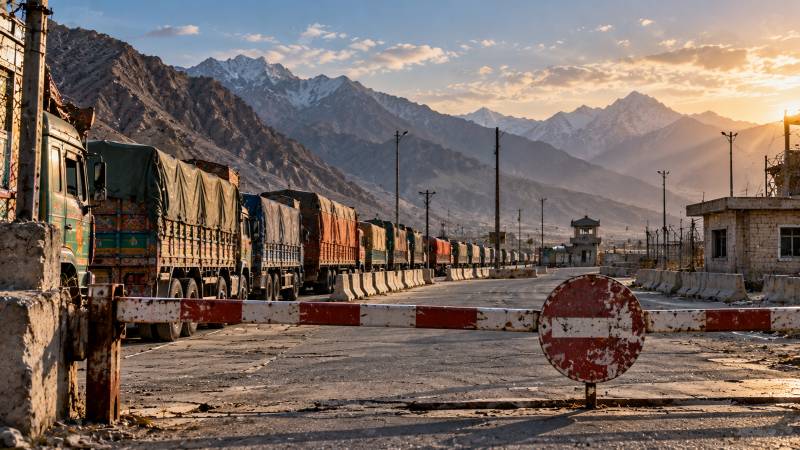
Pakistan’s only eastern neighbor is India whereas; its western neighbors are Afghanistan and Iran. All the eastern and western borders of Pakistan are frozen because of lack of trade, commercial and travel connectivity. Only a small strip of Pakistan's northern border with China is open and that too with severe travel restrictions. With no trade with India, Afghanistan and Iran, Pakistan is a unique state because almost all its neighbors are with closed borders particularly for trade and travel purposes.
Can a state regionally isolate itself and expect to have a vibrant economy, travel and tourism? Frozen border with India is a reality since last several years and there is no direct trade and travel connectivity. Pakistan closed its border with Afghanistan and Iran which caused serious economic losses particularly in areas close to the border of the two countries. In a situation when 250 million people of Pakistan are holed up with frozen eastern and western borders, at stake is trade potential amounting to billions of dollars. There may be reasons for Pakistan to freeze its borders with India, Afghanistan and Iran, but how can a state survive in isolation particularly when its economic predicament, political instability, crisis in governance and absence of rule of law tend to add to its fragility.
Relations with India reached its lowest ebb when on August 5, 2019 New Delhi revoked the autonomous status of Jammu & Kashmir which was somewhat guaranteed under article 370 and 35-A of the Indian constitution. Since then trade, travel and all sorts of direct connectivity between India and Pakistan has ceased to exist. There is 10 billion dollars of trade potential between India and Pakistan which is advantageous to both the neighboring countries. But, unfortunately standoff between India and Pakistan continues and there is no indication for the resumption of normalization of ties and resumption of peace process. What Pakistan can do to mend fences with India by agreeing to the absorption of J&K by New Delhi and subscribing to India’s stance on terrorism? Certainly, it should be a bilateral solution and India needs to deal with the issues which it faces with Pakistan.
As far as Afghanistan is concerned, freezing of trade and closing of border has caused enormous economic losses and hardships to traders from Pakistan and Afghanistan. Whereas, Pakistan had trade surplus with Afghanistan but closing of border with its western neighbor has made things difficult for trading community of both countries. Closing of border and trade with Iran has to do with security situation in the Persian Gulf and Iran-U.S conflicts. But, trade with Iran was beneficial for Pakistan and the areas bordering Iran. Pakistan shouldn’t have come under the U.S pressure to isolate Iran and cease its trade ties with Tehran. It was because of American pressure which forced Pakistan to cease working on Iran-Pakistan gas pipeline.
It is through trade, travel and tourism that hostility and conflicts between neighbors can be mitigated.
It means that out of four neighbors of Pakistan, three are not having normal relations with Islamabad as not only borders are closed but trade, commercial and travel ties are also affected. The cost of Pakistan’s semi or below normal ties with India, Afghanistan and Iran is an interesting phenomenon because if a country is isolated in the region it cannot have economic development or positive transformation of its economy. One can understand about Iran’s economic predicament because of its conflicts with the U.S and Arabian Gulf countries, but the economy of Afghanistan is doing well particularly in terms of value of its currency vis-à-vis U.S dollar. As far as India is concerned, freezing of trade and travel ties with Pakistan has not negatively impacted on its economy. According to the World Bank, Indian economy is rising at the rate of 7% and its foreign exchange reserves are more than 700 billion dollars. The value of Indian rupee comparing Pakistani rupee is three times. Pakistan’s economic growth rate is hardly 3.5% and its foreign exchange reserves are meager 22 billion dollars. It means that freezing of borders with India, Afghanistan and Iran is to the disadvantage of Islamabad than New Delhi, Kabul or Tehran.
One needs to analyze Pakistan frozen eastern and western borders from three standpoints. First, 250 million people of Pakistan are holed up in a country which has no connectivity with its neighbors which is having adverse social and economic ramifications. Is it not a plausible situation that out of four neighbors three are not having normal relations with Pakistan? Even China which shares a limited border with Pakistan doesn’t encourage travel connectivity with Islamabad. It means it is by default that Pakistan is facing an abnormal situation along with borders.
By engaging in diplomacy and dialogue to deal with Iran-U.S conflicts and recent armed conflict between Saudi Arabia and Yemen while freezing its trade relations with India, Afghanistan and Iran, Pakistan is not playing its cards well. Instead of Middle East, Pakistan should focus on South Asia and take steps to unfreeze its ties with India provided New Delhi reciprocates in this regard. Second, it is high time that proper research is done to estimate economic losses caused by freezing of trade with India, Afghanistan and Iran. As pointed earlier, it is not impacting on India, Afghanistan and Iran if trade with Pakistan has been suspended and borders closed. Certainly, Pakistan is losing billions of dollars every year by not having trade with three of its neighbors.
When China and India, despite having their contentious issues can have around 150 billion dollars of yearly trade and when China is India’s largest trading partner, why it has not happened between India and Pakistan? Same is true in case of Pakistan and Afghanistan and Pakistan and Iran as normal ties with their western neighbors is mutually beneficial. Particularly, if Pakistan pursues an independent approach and establishes normal trade relations with Iran by focusing on energy, Islamabad will benefit a lot. Before the suspension of Pak-Afghan trade, it was Pakistan which had trade surplus with Kabul. Therefore, it is in the interest of Pakistan to embark on survey research aiming to examine losses which Islamabad is facing by not having normal trade with India, Afghanistan and Iran. Additionally, it is not only the absence of trade with India, Afghanistan and Iran which hurts its economy, freezing of borders with three out of four of its neighbor is also negatively impacting on travel and tourism.
Finally, it is through trade, travel and tourism that hostility and conflicts between neighbors can be mitigated. Unfortunately, it has not happened in case of India and Pakistan but if there is political will and determination the two neighbors can certainly move forward in mending fences by unfreezing their borders. For that matter, it is India which needs to take an initiative and restore peace process by using dialogue and diplomacy. Political prudence exercised by the leadership of India and Pakistan by mitigating ego centric approach will go a long way in resuming trade and travel ties.
If India needs to express positive attitude with Pakistan on normalizing its relations, Islamabad need to take steps for dealing with contentious issues as far as Kabul is concerned. By closing border and restricting trade will worsen the situation. Likewise, why Pakistan has closed its border with Iran which has also ended its trade with Tehran? It is high time that strategic planning is done by Pakistan to examine how borders with its western and eastern neighbors be managed and normal trade, commercial and travel activities be resumed. Otherwise, Pakistan’s economy will be further jeopardized and brain drain of people outside the region will further intensify.