

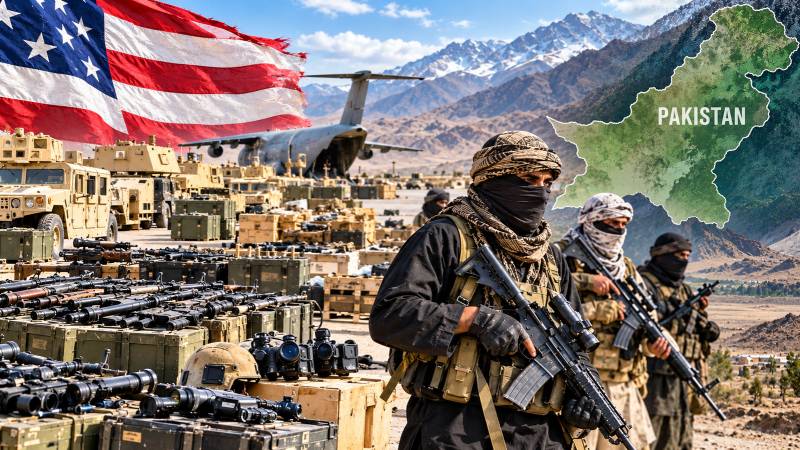
The United States withdrew from Afghanistan in August 2021, ending two decades of occupation. But the weapons they supplied to Afghanistan are still shaping the security environment of the region. An estimated $7.1 billion worth of military equipment and weapons remained in Afghanistan when the American-backed republic collapsed, and the Taliban took control of Kabul. This stockpile of military equipment passed into the control of Taliban who emerged as the sole rulers of Afghanistan after American withdrawal. It is now well documented—American administration and military officials have publicly admitted and there have been a numerous research reports and media stories describing how these weapons and military equipment landed into the hands of Pakistani militants. Pakistani officials say that both TTP and BLA have been using American weapons in their attacks on Pakistani government and military installations and personnel.
Official American reports in July 2023 estimated that NATO and US forces left behind 167,550 rifles, 41,500 machine guns and 265 mortars at the time of 2021 withdrawal. NATO also left behind over 40,000 military vehicles, including 12,000 Humvees. While critical voices started raising concerns about the decision of American military leaders to leave behind such a large stockpile of weapons that could fall into the hands of militant and terror groups which started to control the government in Kabul. US Administration and military officials tried to explain their decision by pointing out that this stockpile of military equipment was the property of Afghan National Army which collapsed with little resistance the moment Taliban entered Kabul.
The Taliban immediately took control of this stockpile, making the possibility and fear of these weapons landing into the hands of terror and militant groups, allied with Taliban, a regional security concern. American military and political leaders were completely silent about the regional security implications of their decision to leave behind this military equipment at the time of their withdrawal from Afghanistan. For Americans this situation required a good media management strategy which could explain the whole situation because of collapse of Afghan military structures.
For the Pakistani security planners, it turned out to be the most sinister implication of American withdrawal from Afghanistan. Now Pakistani counter terrorism formations were faced with militants who were now substantially more well equipped to carry out attacks in the dark of the night. This meant counter terrorism operations were now more difficult and costly in terms of human life. In 2024 United Nations Security Council Monitoring Team in its report documented that Taliban commanders supplied TTP with advanced weapons, including M24 sniper rifles, M4 carbines with ACOG scopes and M16A4 rifles with thermal scopes. Next year US official Special Inspector General for Afghanistan Reconstruction (SIGAR) report also noted that TTP accessed former Afghan army weapons, either transferred by Taliban authorities or acquired through black markets.
Night-vision devices, thermal optics and advanced sniper rifles have given militants the ability to exploit darkness, detect troop movements and launch coordinated attacks while reducing their own exposure to security forces.
There was clear evidence which points to diversion of these weapons into terrorist hands as a large portion of it was sold by middle-tier Afghan Taliban Regime commanders. General Directorate of Intelligence (GDI) Afghanistan also distributed weapons to terrorist groups including TTP and BLA for use in terror activities on Pakistani soil. By 2025, Pakistan’s security forces had recovered 293 US-made weapons from eliminated terrorists, comprising 208 M16s, 53 M4s, 7 machine guns, 4 sniper rifles and 21 miscellaneous sights. Afghanistan serves as a source and transit hub for weapons, ranging from small arms to military-grade equipment, with criminal and terrorist networks operating in these markets. A 2025 Washington Post investigation traced serial numbers of at least 63 weapons seized in Pakistan from terrorists to weapons supplied by US to Afghan forces before 2021.
In videos circulated by terrorists, M16 and M4A1 rifles, rifles fitted with Under-Barrel Grenade Launchers (UBGLs), bullet-proof jackets, PVS-14 night-vision goggles and rifle laser sights are a common sight. In fact, M4 rifles along with US made machine guns (M249 Squad Automatic Weapon, M240B, M2 Browning) have become standard weapons for terrorist. Latest sniper rifles and night-vision devices, along with handheld communication devices are recovered from every group of two to three killed terrorists. Beyond firearms, availability of approximately 17,500 pieces of helmet-worn night-vision devices (NVDs) and surveillance and GPS devices reflect magnitude of capabilities of terrorists. TTP and BLA terrorists have utilized these NVDs and thermal optics to improve their visibility, surveillance and targeting. Thus, carrying out attacks with greater precision while reducing exposure to security forces.
Possession and use of such weaponry by terrorists have far-reaching consequences. The night-fighting capability that American military equipment confers on militant and terror groups has markedly improved their capabilities, making counter terrorism operations difficult and costly in terms of loss of life. Element of surprise in Counter Terrorism operation has become difficult because terrorists are well-equipped and wield their Night Vision Devices to detect movement of troops. This enables terrorists to exploit darkness, conduct coordinated attacks and evade detection during security operations.
Another implication of American weapons’ availability to Pakistani militants in their attacks on security forces is the acquisition of sniper capability by terror and militant groups. This has made night sniping a regular feature. Level of weaponry acquired has made terrorist better equipped than a lot of armies in world. Access to advanced weapons and equipment increased their range, precision and firepower, complicating Counter Terrorism operations.
Pakistan is paying a huge price for unchecked spread of terrorism. Terrorist attacks surged from 89 in 2021 to 699 in 2025, a nearly eightfold increase. In 2025 alone, these attacks killed at least 1,378 Pakistanis and injured 2,672. In 2026, toll has already reached 1,327 killed and 2,484 injured, a grim reminder that the consequences of Afghanistan’s terrorist sanctuaries and weapons proliferation are being borne by Pakistan in innocent lives. US political and military leaders need to come forward with more rational explanation for why they left behind such a large stockpile of weapons in Afghanistan. Was it simply carelessness? Or was it more than carelessness? Who could claim that American security planners were not aware of implications of leaving behind this stockpile, for regional security?