

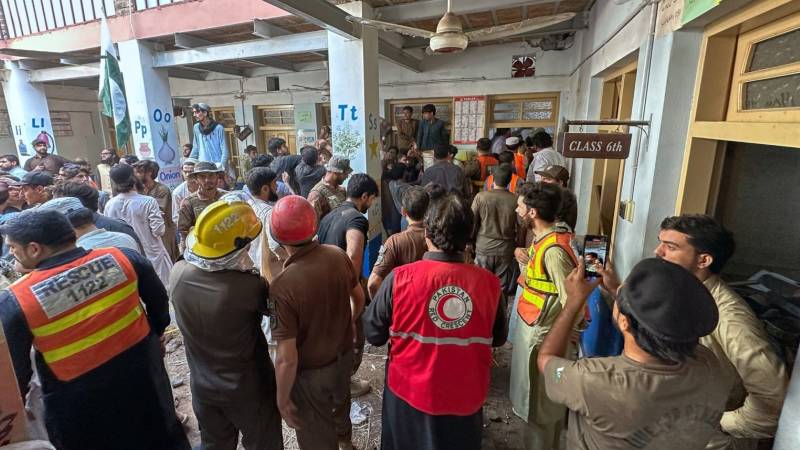
On 15 October 2026, in Dir Colony Peshawar, the roof of the Al-Khair private school fell on the children sitting under it. At least thirty-one died. More than fifty are in hospital. Almost none were older than fourteen. On 16 December 2014, six militants walked into the Army Public School on Warsak Road and killed 132 schoolchildren. The country stopped. The 21st Amendment stood up military courts for civilians. A twenty-point National Action Plan was written in a week.
A child killed by a Kalashnikov and a child killed by an unsupported brick batten die of the same thing. One death the state calls terrorism and mobilises an army for. The other it calls weather, and arrests the landlord for. The Al-Khair school was not operating illegally. That is the point. The Khyber Pakhtunkhwa Private Schools Regulatory Authority registered it earlier this year. A file was opened, a fee collected, a stamp pressed onto paper. No certified structural engineer ever climbed the stairs to look at what was holding the upper storey up.
What was holding it up was fragile T-iron and loose brick battens resting on load-bearing masonry walls with no reinforced-concrete columns and no seismic tie-beams. The upper classrooms had been added later, without permission, to a house never designed to be a school. The rain did not break this building. The rain exposed a building already built to break. In June, fourteen students died in Lahore’s Kahna. Four more in Dera Ghazi Khan the same week. Four more in another Lahore collapse in July. Dir Colony is not an incident. It is a quarterly report.
Thirty one children died in a few seconds in Peshawar. Twelve million are dying more slowly. The National Nutrition Survey tells us that 40.2 percent of Pakistani children under five are stunted; permanent damage to the brain and immune system during the first thousand days of life. A generation grows up smaller, sicker and cognitively poorer than it was born to be. On public education across every tier combined, budget spends between 0.8 and 1.77 percent; a meagre amount even compared with most of the developing countries. Only a fraction of that sliver is capital expenditure, and only a fraction of that ever touches physical safety, retrofitting or inspection.
Until the physical safety of a classroom is defended with the same ferocity as a national border, we will keep burying children and calling it rain. The roof that fell in Peshawar was never only a roof. It was the ceiling of a country’s moral imagination. It is still falling.
Meanwhile, the UNDP has calculated that preferential tax treatment and subsidies for powerful corporate groups, large landowners and military-commercial interests cost Pakistan roughly 17.4 billion dollars a year — more than six percent of GDP, and over four times the federal education allocation. The children in Dir Colony are not the cost of poverty. They are the cost of priorities. None of what follows requires a new statute. Article 9 of the Constitution says, no person shall be deprived of life in accordance with law; in Shehla Zia v. WAPDA the Supreme Court ruled that "life" means dignity, health and an environment free from hazard. Article 25-A makes free and compulsory education for every child aged five to sixteen as a fundamental right. The state cannot discharge its duty under 25-A by herding children into rooms that violate their rights under 9.
Under the Penal Code, arresting only the landlord is a legal evasion. Section 322, Qatl-bis-sabab, covers manslaughter by unlawful act or omission. Section 119 punishes a public servant who conceals a design to commit an offence he was required to prevent. Together, these reach the certifier, the inspector and the department head; not only the man who collected the rent. (Section 288, often cited after collapses, is narrower: it covers negligence during the demolition or repair of a building where life may be endangered, and carries only six months in prison; a reminder that the Code itself needs sharper teeth for mass-fatality regulatory failure.) The 2020 Gulbahar case in Karachi produced convictions and millions in Diyat. It can be done. It is simply not being done.
A country that treats its borders as sacred and its classrooms as disposable has misunderstood what it is defending. Reversing that is not expensive. It is political. Strip inspection away from generalist education officials and hand it to a dedicated Educational Infrastructure Safety Cadre inside the Pakistan Engineering Council, with licensed structural engineers who answer professionally for their signatures. No PEC sign-off, no operating licence. Make the unauthorised conversion of a residential building into a school a non-bailable offence; for the landlord, the owner and the official who looks the other way, and treat regulatory dereliction resulting in mass child fatality as institutional manslaughter.
Ring-fence a share of every provincial education budget for retrofitting, fire egress and seismic strengthening, and raise cumulative education spending toward four percent of GDP on a binding timetable, paid for by trimming the elite subsidies the UNDP has already mapped. Designate school buildings as Critical National Infrastructure. The Safe Schools Declaration, which 123 states have now endorsed and which Pakistan has yet to sign, was written to protect schools from armies. Pakistan should sign it and go further. The doctrine must protect classrooms from contractors, from inspectors with blank certificates, and from a bureaucracy that treats a child’s life as an administrative externality.
The children in Dir Colony were killed by a permit, a stamp, a budget line, a culture of regulatory shrug. Until the physical safety of a classroom is defended with the same ferocity as a national border, we will keep burying children and calling it rain.
The roof that fell in Peshawar was never only a roof. It was the ceiling of a country’s moral imagination. It is still falling.