

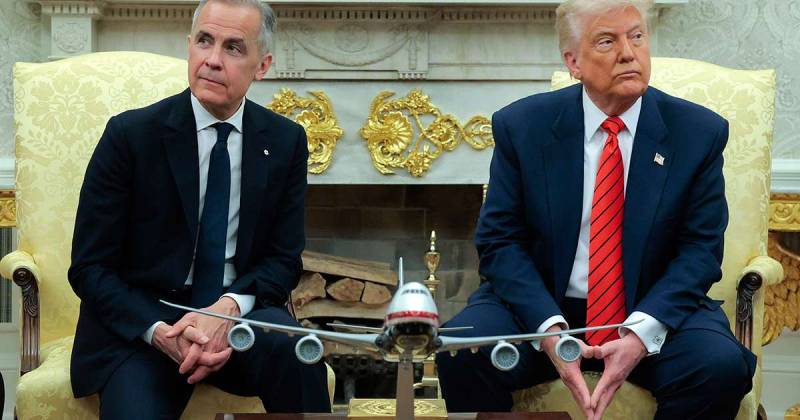
For more than 150 years, Canada and the United States have enjoyed a remarkable relationship as neighbours, trading partners, and allies; a relationship that has served as a model for many other countries. It not only survived but flourished under successive US presidents, both Democratic and Republican. However, after a series of trade-related conflicts between the two neighbours, that once-remarkable relationship now appears to be on the brink of collapse.
In a 1961 address to the Canadian Parliament, President John F. Kennedy famously said: “Geography has made us neighbors. History has made us friends. Economics has made us partners, and necessity has made us allies. Those whom God has so joined together, let no man put asunder.” Those four powerful words, neighbours, friends, partners, and allies have since become the four pillars of a relationship that has continued to deepen and solidify between the two nations.
This enviable relationship was seriously tested during Donald Trump’s first term as president. Although it survived, it became considerably strained. Before his election in 2016, Trump had repeatedly complained that the free-trade agreement between the US, Canada, and Mexico, known as the North American Free Trade Agreement (NAFTA), was “the worst trade deal ever made by the US.” He vowed to abandon the agreement and negotiate a new one if elected.
He did exactly that. Following tough negotiations and concessions from both Canada and Mexico, a new agreement was signed in 2020: the United States-Mexico-Canada Agreement (USMCA). Trump described it as the “fairest, most balanced, and beneficial trade agreement” the US had ever signed and frequently referred to it as the “biggest trade deal ever made.” Yet, soon after winning the presidential election in November 2024 and even before beginning his second term in January 2025—Trump resumed his attacks on Canada, falsely blaming the country for a number of domestic problems in the United States. In particular, he accused Canada of having lax border controls that allowed drugs and illegal immigrants to enter the US through its northern border.
Trump also began talking about making Canada the “51st State” of the United States. Initially, many Canadians viewed the comments as a joke between two friendly neighbours. It soon became apparent, however, that Trump was serious. When asked whether he would use military force against Canada, he said no, but added that he would use “economic force” to achieve his objective.
When Trump began his second term in January 2025, he called the USMCA—which he himself had negotiated and signed five years earlier “a bad deal for the US” and demanded major changes to it. Then, in April 2025, when he imposed tariffs on imports from countries around the world, he imposed both sector-specific and country-specific tariffs on Canadian goods, including products that were protected under the USMCA.
Geography has made us neighbors. History has made us friends. Economics has made us partners, and necessity has made us allies. Those whom God has so joined together, let no man put asunder.
The final straw in the deepening Canada-US rift came with the latest round of Trump’s 50% tariff on a wide range of Canadian goods, worth approximately $28 billion annually. Many of these goods were protected under the USMCA. The tariffs took effect on August 22, 2026, following the collapse of negotiations between US and Canadian trade teams in Washington, DC, a day earlier. In a somber but passionate speech delivered hours after the talks collapsed and the new US tariffs took effect, Canadian Prime Minister Mark Carney briefed the nation on the efforts made by Canadian negotiators to reach a fair agreement in good faith. He said those efforts had been thwarted by what he described as unreasonable and unacceptable demands from the US side.
“In short, they asked too much and offered too little,” Carney said. “We cannot accept what they’ve offered, and we will not give what they’ve asked.” Carney accused Trump of launching a trade “war.” “You’re at war when you get attacked. We got attacked,” he said. He subsequently instructed Canadian negotiators to suspend the talks and return to Ottawa. Trump’s principal justification for the US tariffs has been his claim that the United States runs a trade deficit with Canada and is therefore being “ripped off.” The reality, however, is that the small US merchandise trade deficit with Canada exists largely because the United States buys substantial quantities of energy from its northern neighbour.
Instead of appreciating Canada as a reliable supplier of essential energy products, helping fuel the American economy amid the continuing volatility of energy markets in the Middle East and elsewhere; the US is using that trade imbalance as a justification for imposing punitive tariffs on Canadian goods. Carney pointed out in his speech that Canada supplies 99% of US natural-gas imports, 85% of its electricity imports, and 60% of its crude-oil imports. He quipped, “I don’t think they want us to stop sending it.”
Carney also vowed to impose retaliatory tariffs, dollar-for-dollar, on certain US imports beginning September 8 in order to protect Canadian workers, farmers, families, and businesses. The trade war could escalate further, as US officials have already indicated that Washington may take additional measures in response to Canadian retaliation. Many trade experts have warned that a prolonged trade war would harm the economies of both countries. As economic pressures mount, both sides will face increasing pressure to find an off-ramp and return to the negotiating table.
Two and a half years ago, I wrote an article in this space titled “Canada-US Trade Partnership: A Model for Pakistan and India,” in which I highlighted the benefits of the strong Canada-US trade relationship, peace, security, and prosperity and presented it as a model for the neighbouring countries of Pakistan and India to build upon. Little did I know that, in less than three years, I would have to eat my words.
In the United States, Trump’s new tariffs have triggered a backlash, with many warning that a trade war with Canada will lead to higher prices. US lawmakers, governors, and business leaders have warned that the tariffs on Canadian goods will increase costs for American households and businesses.
Governors of states bordering Canada, many of which have deep economic ties with their northern neighbour, have also condemned the tariffs. They fear that the measures will damage their state economies and increase the cost of goods for their residents. Canadian counter-tariffs, meanwhile, could hurt American businesses that export to Canada and potentially lead to job losses.
Trump’s former vice president during his first term, Mike Pence, remarked, “The last thing we need right now is a trade war with Canada.” Andrew Weinstein, a former US delegate to the United Nations, said: “The United States and Canada have been friends, partners, and allies for more than 150 years across 32 presidential administrations. And now, because of the arrogance, incompetence, and ego of the current occupant of the White House, that relationship is being driven straight toward a cliff. It’s a failure of leadership on a scale that’s hard to overstate.”
The reaction in Canada has been equally strong. Canadians are concerned about difficult economic times ahead and many feel betrayed and deeply hurt by the US government’s actions. Even opposition parties have largely supported the government’s response. The friendship and bonds between the peoples of Canada and the United States are decades old and will likely survive this crisis. But the relationship may never be quite the same. As the saying goes, “Friendship is like Chinaware—rich, exquisite, and rare. Once broken, it can be mended, but the cracks are always there.”