

To His Excellency, Prime Minister Muhammad Shehbaz Sharif,
With the greatest humility, I beg your pardon in advance for addressing you directly through this open letter. I do so not out of presumption, nor with any intention of questioning your authority or sincerity, but because I am deeply concerned about the direction of Pakistan’s power sector and the consequences it may have for our beloved country. After spending decades working around energy, water, environment, and national development issues, I feel a personal responsibility to speak when I believe the national interest is at stake. Please accept these words as those of a concerned Pakistani engineer who wishes only to see your government succeed and Pakistan prosper.
Your statement on September 11, 2026, directing that load-shedding should not exceed two hours a day across the country deeply saddened me. Pakistan has invested billions of dollars in electricity-generation capacity, yet we are still discussing how many hours our citizens can remain without electricity. This is not merely an electricity problem anymore. It is a national economic problem, a question of industrial survival, and ultimately a matter of our economic sovereignty.
Prime Minister, you are widely known for your extraordinary energy, discipline, and long working hours. You have often been seen beginning your day soon after Fajr and personally following administrative matters from early morning until late at night. We also witnessed your determination during 2015–2018, when major energy projects, including imported coal-fired power plants, were completed. You therefore understand better than most politicians the enormous financial and technical effort required to create generation capacity.
That is why I respectfully believe the present situation must concern you deeply. Despite your personal commitment and relentless work ethic, the power sector appears to be undermining the very economic progress you have worked to achieve. Our citizens are struggling with electricity bills, industries are reducing production or closing, employment is being lost, exports are becoming less competitive, and potential foreign investors are naturally discouraged by exceptionally high energy costs.
As an experienced industrialist, you know that no factory can survive for long when electricity becomes one of its highest and least predictable operating costs. When Pakistani industry cannot compete because of the price of electricity, the consequences go far beyond the monthly bill. Factories close, workers lose employment, exports decline, investment leaves, and eventually the economic strength of the country itself is weakened.
Please do not allow Pakistan to become a country that built power plants but cannot provide affordable electricity, accumulated capacity but also accumulated circular debt, and possesses energy infrastructure while its industries struggle to survive.
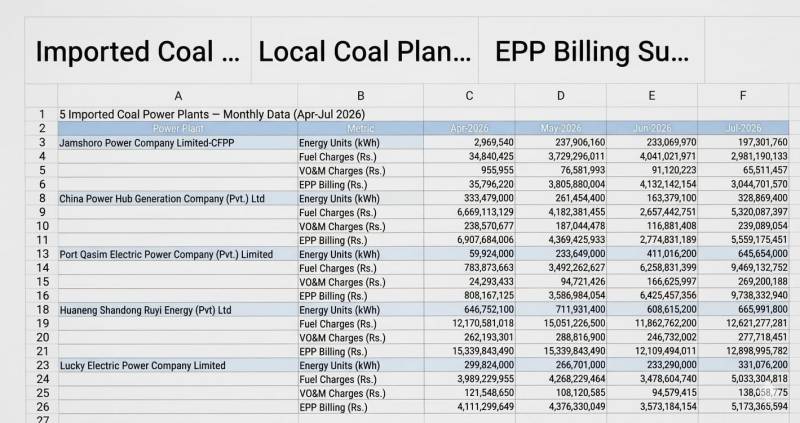
I respectfully draw your attention to the management and utilization of major imported-coal power plants, including China Power Hub Generation Company, Port Qasim Electric Power Company, Huaneng Shandong Ruyi Energy, and Lucky Electric Power Company. These plants represent enormous national investment and were established to strengthen Pakistan’s electricity supply. Yet CPPA-G generation data reportedly shows China Power Hub Generation Company and Port Qasim Electric Power Company are both designed and expected to generate over 700 million units per month; their actual generation has fallen significantly short of this benchmark in most months. China Power Hub Generation Co. generated only 333.5, 261.5, 163.4, and 328.9 million units from March 2026 to July 2026, while Port Qasim Electric Power Co. produced 60, 233.6, 411.0, and 646 million units, respectively. In nearly every instance, actual output remained well below the 700-million-unit target. These figures highlight a persistent and substantial gap between expected and actual generation, indicating chronic underutilization of these plants' capacity. I humbly ask: how can Pakistan continue paying substantial capacity payments while expensive generation assets remain underutilized and citizens are simultaneously asked to accept load-shedding? This contradiction deserves your personal attention and an independent technical examination.
I therefore respectfully urge you to order a truly independent forensic audit of the power system, covering generation availability, dispatch decisions, merit order, actual utilisation factor of imported coal power plants, capacity payments, CPPA-G settlements, NEPRA determinations, and the relevant Power Purchase Agreements. The purpose should not be to blame individuals. It should be to discover why Pakistan is unable to convert the generation capacity it has already paid for into affordable electricity for its people and industries.
Prime Minister, I fear that the power crisis is now threatening not only your political legacy but the economic sovereignty of this great nation. A country cannot be genuinely sovereign if its industries cannot afford electricity, if its exports cannot compete internationally, if investors cannot justify productive investment, and if the state continues borrowing simply to sustain an inefficient energy structure. Energy sovereignty is economic sovereignty, and economic sovereignty is an essential foundation of national sovereignty. This is why I believe artificial intelligence can provide an important part of the solution. NEPRA and CPPA-G should become modern, transparent, data-driven institutions where plant generation, availability, fuel consumption, dispatch instructions, outages, capacity payments, and tariffs can be monitored continuously. AI cannot replace human wisdom or honest leadership, but it can expose anomalies, identify inefficiencies, strengthen accountability, and help decision-makers see the complete picture without political or bureaucratic distortion.
Prime Minister, history will not remember only how many hours you worked. It will remember what changed because you worked so hard. You still have an opportunity to transform this crisis into your greatest national achievement: an affordable, transparent, technologically advanced, and economically sustainable power system. I again tender my sincere apology for addressing you so directly. I do so only because I believe the matter has become too serious to remain confined to files, meetings, ministries, and official summaries. I have no personal position or financial interest to seek. I simply wish to offer whatever professional experience I possess for the national good. Please do not allow Pakistan to become a country that built power plants but cannot provide affordable electricity, accumulated capacity but also accumulated circular debt, and possesses energy infrastructure while its industries struggle to survive. The time has come to rescue Pakistan’s power sector not merely to reduce load-shedding, but to protect our industry, our economy, our children’s future, and above all, the economic sovereignty of Pakistan.
With the highest respect and humble regards,
Engineer Arshad H. Abbasi