

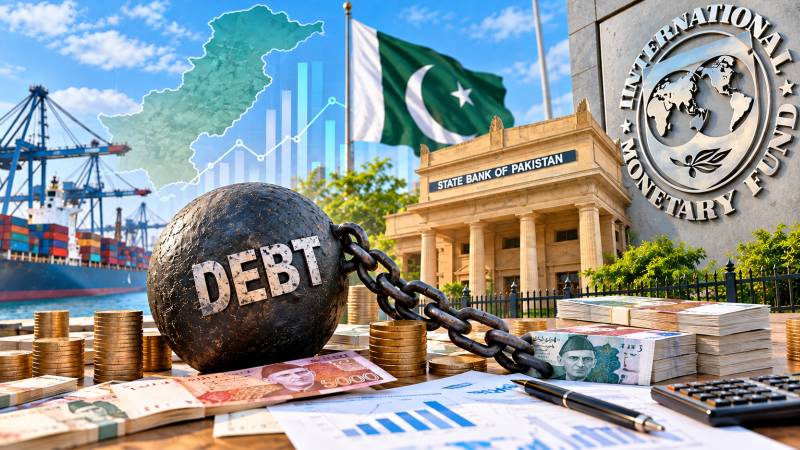
Pakistan’s debt debate is trapped in the wrong question. Each budget season produces another argument about whether public debt has risen or fallen as a percentage of gross domestic product (GDP), whether the International Monetary Fund (IMF) has imposed too much austerity, and whether the country should borrow more or less. The arithmetic matters. It does not explain the political economy of dependence.
A sovereign does not service debt with GDP. It services debt through revenue, exports, foreign exchange, domestic savings and the confidence required to refinance obligations as they mature. Debt becomes alarming when these capacities remain weak. It becomes developmental when borrowing enlarges them. This distinction is central to Pakistan’s predicament.
World Bank data put Pakistan’s GDP at about US$407.3 billion in 2025. Gross capital formation was only about 14.3 percent of GDP and exports of goods and services around 10 percent. The World Bank’s Human Capital Index for Pakistan remains 0.41, meaning that a child born today is expected to become only 41 percent as productive as she could be with complete education and full health. These are not peripheral social indicators. They determine how much debt an economy can carry without sacrificing development. This is why international comparisons based on debt-to-GDP ratios can mislead. Japan can carry public debt exceeding twice its GDP because much of it is yen-denominated, held in deep domestic markets and supported by a highly productive economy and substantial public assets.
The United States borrows in the principal reserve currency of the world. Canada’s gross debt looks large while its net public debt is far smaller because the public sector owns substantial financial assets. India carries a higher general-government debt ratio than Pakistan but has a much larger domestic financing base, deeper markets, greater reserves and stronger growth. Pakistan’s headline debt ratio is lower than several of these countries. Its room for manoeuvre is also narrower. The IMF’s May 2026 review assessed Pakistan’s debt as sustainable under its baseline, while simultaneously recording large external financing requirements and stressing that repayment capacity depends critically on policy implementation and timely external financing. There is no contradiction. Sustainability is not sovereignty.
The more useful concept is debt-carrying capacity. That capacity is weakened when three failures reinforce one another. Low revenue forces the state to borrow. Low exports restrict the foreign exchange available to service external obligations. Low productivity prevents rapid expansion of both the tax base and exports. Interest payments then compress development expenditure, weakening the human and physical capital required for future productivity. Debt becomes both consequence and amplifier of the low-growth trap.
Pakistan’s fiscal structure compounds the problem. For decades, governments have relied on what might be called revenuecracy: extracting revenue from those easiest to identify rather than building a broad, equitable fiscal contract. Salaried persons, formal businesses, importers, electricity consumers and bank depositors are visible. Withholding and indirect taxes provide immediate cash. Powerful or difficult-to-tax sectors remain relatively protected or inadequately documented.
The result is not merely unfair taxation. It is an economic structure in which the state repeatedly seeks cash without sufficiently enlarging production. Debtocracy follows revenuecracy. When revenue cannot support expenditure and exports cannot support external payments, refinancing becomes a recurring condition of governing.
Pakistan then negotiates another programme, rollover, commercial loan or multilateral facility. The IMF does not conquer territory, appoint collectors or exercise a Diwani. Pakistan remains a sovereign member that negotiates and accepts programmes. The relevant question is subtler: how much effective policy freedom remains when old obligations can be honoured only through new financing? The answer cannot be found by blaming creditors alone. Domestic political choices create the vulnerability on which creditor leverage operates.
The World Bank’s new Country Partnership Framework describes Pakistan’s growth model in unusually direct terms: a structural fiscal deficit, low private investment and productivity, government borrowing that crowds out private credit, and debt servicing that crowds out public investment. This is the circle that must be broken. Breaking it requires another distinction: borrowing to build versus borrowing to survive.
China’s historical relationship with the World Bank offers an instructive case. A Bank evaluation found that lending to China consistently emphasised infrastructure and that budget support was not an important instrument. China was also reluctant to accept policy conditionality. External finance was inserted into a domestic development strategy rather than allowed to become the strategy.
India’s first World Bank loan, in 1949, financed railways. Later assistance supported power, steel, ports, highways and institutions associated with infrastructure. This does not mean every Chinese or Indian project succeeded, nor that either country avoided waste or debt problems. It means that a significant part of external borrowing left identifiable productive capacity behind. Pakistan too has productive borrowing. Dasu Hydropower is an obvious example. A long-lived asset capable of generating electricity and reducing dependence on imported fuel is fundamentally different from borrowing used to close a recurring fiscal gap. The same test should apply to institutional loans.
Pakistan has borrowed hundreds of millions of dollars for tax administration and justice reform. A reform loan does not leave behind a dam or railway, but it must leave an institutional asset: better tax capacity, faster justice, professional administration, reliable data, lower compliance costs or stronger accountability. If another externally financed reform programme is required a decade later to solve substantially the same institutional problem, the return on earlier borrowing deserves rigorous public examination. The financial system reproduces the same pattern domestically.
The State Bank of Pakistan has identified a strong sovereign-bank nexus. Persistent fiscal deficits make government securities attractive to banks, while lending to farmers, small businesses and new exporters requires information, risk assessment and monitoring. Private-sector credit remains exceptionally low relative to the size of the economy. The state absorbs savings that productive enterprise needs and then wonders why production and exports remain weak. This is where the experience of cooperative and development finance becomes relevant. Rabobank grew from local Dutch agricultural credit cooperatives formed because farmers lacked affordable finance. The importance of that history is not the brand. It is the institutional principle: local information, pooled savings, shared risk and finance structured around productive cash flows.
Rabo Partnerships now works with institutions in emerging markets, including models in India that use cooperatives, technology and alternative data to extend credit to small farmers. Pakistan has agricultural banks, microfinance institutions, cooperative structures and expanding digital infrastructure. What it lacks at sufficient scale is an integrated structure connecting savings, insurance, storage, markets, technology and patient finance.
Pakistan needs specialist institutions rather than generalist administrative control; empowered local governments rather than fiscal centralisation; predictable, low-rate and broad-based taxation rather than withholding-led extraction; export competitiveness rather than protection of inefficient rents; and public investment evaluated by measurable social and economic returns.
Economic sovereignty requires reform on both sides of the state’s balance sheet. Government must mobilise revenue more fairly, but it must also stop consuming such a large share of financial resources. Banks must finance productive risk. Capital markets must provide long-term finance. Cooperative and specialised institutions must reach borrowers whom conventional collateral-based banking excludes. Local governments require predictable fiscal space to build urban and municipal infrastructure.
This brings us to the government’s US$1 trillion economy ambition for 2035. The target should neither be mocked nor celebrated. It should be debated and tested. Moving from US$407.3 billion in 2025 to US$1 trillion in 2035 requires nominal dollar GDP to grow at roughly 9.4 percent annually for a decade.
The government speaks of sustained 6 percent real growth and exports exceeding US$100 billion. Both would be substantial achievements. It needs to be noted that 6 percent real growth does not automatically produce 9.4 percent dollar growth; inflation and exchange-rate movements matter. More importantly, US$100 billion of exports in a US$1 trillion economy would equal only 10 percent of GDP—approximately Pakistan’s present export ratio. An export-led transformation requires exports to grow faster than the economy.
Investment must also rise. An economy investing around 14 percent of GDP cannot plausibly sustain East Asian-style transformation without a substantial increase in productive public and private investment. Human capital cannot remain an afterthought. A country with an HCI of 0.41 cannot become a high-productivity economy through infrastructure and digitalisation alone. Nor can transformation be administered through the same structures that produced repeated cycles of stabilisation and crisis.
The World Bank’s Pakistan@100 framework points towards 2047 through physical and human capital, productive allocation of resources, sustainability and governance. That centenary horizon is more meaningful than any single GDP milestone. A trillion dollars by 2035 would matter if it represented rising productivity, exports, investment, skills and per-capita income. It would matter much less if nominal expansion merely coexisted with low human development, weak institutions and recurrent external rescue.
Pakistan does not need to prove sovereignty by borrowing from nobody. Modern economies borrow. The test is whether borrowing expands the capacity to repay and the freedom to choose. That requires moving from revenue extraction to fiscal democracy; from sovereign-bank dependence to productive finance; from borrowing for recurrent survival to borrowing for transformation; and from externally anchored reform to domestically owned institutions capable of sustaining it. Economic sovereignty is not isolation from the world. It is the capacity to engage the world without repeatedly negotiating from financial necessity. By 2047, the decisive measure of independence will not be the absolute size of Pakistan’s debt, nor even whether GDP has crossed a politically attractive threshold. It will be whether its citizens, firms and institutions possess the productive capacity to finance their own future.