

When we think of the Jammu and Kashmir conflict, the conversation usually begins with borders, military strategy, or politics. Maps are drawn, treaties are cited, and governments defend their positions with unwavering certainty. Yet, somewhere between these legal arguments and diplomatic negotiations are millions of ordinary people whose lives have been shaped by a conflict they did not choose. This is where one of international law's most difficult questions emerges: what happens when a state's right to protect its sovereignty comes into conflict with the fundamental rights of the people living within its borders?
The dispute over Jammu and Kashmir has existed since the partition of British India in 1947. What began as a disagreement over the accession of a princely state has evolved into one of the world's longest-pending territorial conflicts. India and Pakistan have fought multiple wars over the region, and decades later, the issue remains unresolved. Each government continues to defend its legal and political position, while generations of Kashmiris have grown up knowing little other than uncertainty and violence.
For India, the issue is largely one of sovereignty. The Indian government maintains that Jammu and Kashmir is an integral part of the country and argues that decisions regarding its governance fall within India's domestic jurisdiction. National security also forms a significant part of India's position, particularly in light of cross-border militancy and terrorist attacks that have affected the region over the years. From this perspective, measures taken to maintain security are presented as necessary to protect both territorial integrity and civilian lives.
Pakistan, on the other hand, views Kashmir as an internationally disputed territory and argues that the people of Kashmir should be allowed to determine their own political future through the principle of self-determination. Islamabad has consistently sought greater international involvement in resolving the dispute and has frequently raised the issue before the United Nations. At the same time, Pakistan has also faced criticism regarding human rights concerns in the areas under its own administration, reminding us that no state is immune from scrutiny.
The Role of International Law
This is where international law becomes particularly fascinating. It does not ask us to choose between sovereignty and human rights. Instead, it asks whether both can exist together.
International law recognises that every state has the sovereign right to govern its own territory without external interference. At the same time, it also recognises that governments have legal obligations towards the people living within those territories. Treaties such as the International Covenant on Civil and Political Rights protect freedoms including liberty, expression, peaceful assembly, and due process. These rights do not simply disappear because a region is experiencing conflict.
The difficulty lies in balancing these competing interests. States unquestionably have the responsibility to protect their citizens from violence and terrorism. Few would argue otherwise. However, international human rights law requires that even legitimate security measures remain lawful, proportionate, and necessary. National security cannot become a blanket justification for every restriction on civil liberties.
The Human Cost of Conflict
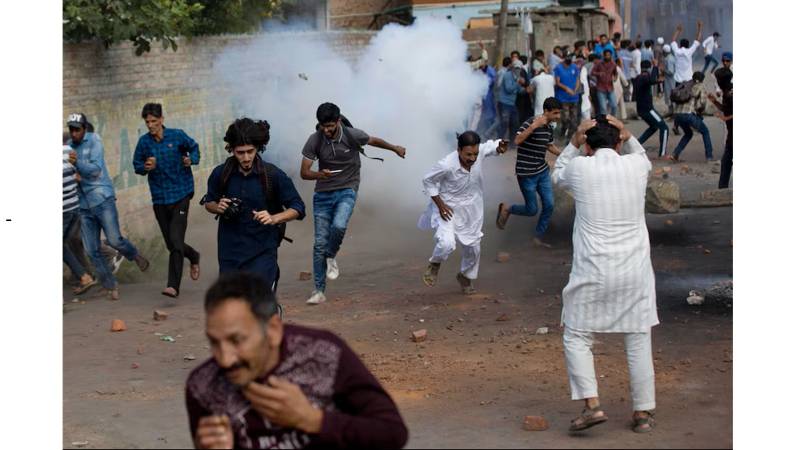
Over the years, international organisations have raised concerns regarding allegations of arbitrary detention, restrictions on freedom of expression, enforced disappearances, excessive use of force, and prolonged communication blackouts in Indian-administered Kashmir. Armed militant groups operating in the region have likewise been responsible for grave human rights abuses, including attacks on civilians. These realities remind us that suffering in Kashmir cannot be viewed through a single lens. Violence against civilians is unlawful regardless of who commits it.
International law does not ask us to choose between sovereignty and human rights - instead, it asks whether both can exist together
What often strikes me about discussions surrounding Kashmir is how easily the people themselves disappear from the conversation. Political leaders debate sovereignty. Lawyers discuss constitutional powers and international treaties. News headlines focus on diplomatic tensions between two nuclear powers. Yet, the voices of ordinary Kashmiris are frequently overshadowed. For many families, the conflict is not an abstract legal dispute but a daily reality that affects education, employment, movement, mental health, and the simple hope of living peacefully.
A Path Forward
Perhaps this is why Kashmir presents such a compelling case study for anyone interested in international law. It demonstrates that legal principles rarely exist in isolation. Sovereignty is not merely a question of territory, just as human rights are not merely words written into international conventions. They intersect in the lives of real people, forcing governments, courts, and the international community to confront difficult questions with no easy answers.
Ultimately, I do not believe the debate should be framed as sovereignty versus human rights. The two are not inherently incompatible. A sovereign state has every right to protect its borders and ensure national security, but it also has a responsibility to uphold the dignity and rights of those living within its territory. Likewise, any meaningful discussion of Kashmir must acknowledge that all parties to the conflict carry obligations under international law.
Nearly eighty years after the conflict began, the legal questions remain unresolved. But perhaps the most important lesson Kashmir offers is that international law is not simply about borders or governments; it is about people. Any lasting solution will depend not only on political negotiations between India and Pakistan, but also on ensuring that the rights, voices, and dignity of Kashmiris are no longer treated as secondary to the dispute itself.