

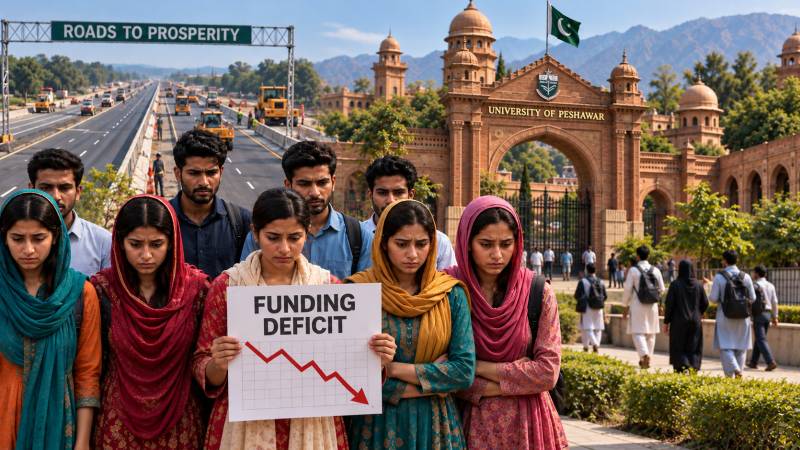
A recent (October 2026) Peshawar High Court hearing highlighted the non-payment of need-based scholarships to around 90 University of Peshawar students. These students had approached the court over the non-implementation of an earlier judgment concerning funds under the Higher Education Commission’s Need-Based Scholarship Programme. While the students maintained that the remaining funds should be released and eligible students paid, the university cited a deficit of more than Rs2 billion. Its representative also informed the court that salaries had been delayed and that funds for the current month's salaries were not yet available. The proceedings offer an opportunity to look at the matter from a broader perspective. At one level, it concerns students awaiting financial assistance and a university dealing with serious financial constraints. At another, it reflects the wider question of how public universities are financed and supported.
For a financially disadvantaged student, a need-based scholarship can be an important part of continuing higher education. Delays in such assistance can affect the ability of students to meet fees, transportation, accommodation, books and other educational expenses. At the same time, the financial position of the university also deserves consideration. If a major public university is carrying a deficit of more than Rs2 billion and facing difficulties in meeting its recurring obligations, the matter extends beyond an individual scholarship programme. This raises a broader question: how should the financial sustainability of public universities be supported?
The University of Peshawar is one of Khyber Pakhtunkhwa's major public institutions of higher learning. Its financial condition has implications not only for students, but also for faculty, researchers, employees and the wider educational system of the province. This naturally brings several stakeholders into the discussion, including the university administration, the provincial government, HEC and the federal government. University administrations have an important role in maintaining financial discipline, strengthening governance and ensuring the effective and transparent use of institutional resources. The concerns raised during the court proceedings regarding university-owned land, rents, recruitment and the functioning of departments are therefore part of the wider institutional picture.
At the same time, the financial sustainability of public universities is also closely connected with public financing. Universities have significant recurring costs, including salaries, pensions, utilities, academic programmes, research, infrastructure and student support. Their ability to generate their own income is also naturally limited by their public-service character. This makes university financing a shared institutional and public-policy matter.
The question is particularly relevant for need-based scholarships. Such programmes are intended to enable students from financially disadvantaged backgrounds to continue their education. For this purpose, the timely flow of funds between the relevant authorities and universities is important. It may therefore be useful to distinguish between two related matters: the provision of scholarship assistance to eligible students and the broader financial health of the university. Both deserve attention, but they involve somewhat different financial mechanisms.
Need-based scholarships and institutional financing are connected but distinct issues: eligible students need clarity and timely payments, while universities facing persistent financial gaps require longer-term solutions for recurring expenditure and institutional stability.
A student who has been declared eligible for assistance needs clarity about when that assistance will be available. At the same time, a university facing a substantial financial gap requires a longer-term approach to its recurring expenditures and institutional finances. This also brings the discussion to the respective roles of provincial and federal authorities.
Public universities in the provinces operate within a wider public-financing framework. Provincial governments have an important relationship with universities under their jurisdiction, while HEC and the federal government have significant responsibilities concerning higher education and national scholarship and funding programmes. A coordinated approach could therefore be valuable, particularly where an institution is facing a persistent gap between its recurring requirements and available resources. Such an approach could also take into account the different circumstances of individual universities. Financial pressures may arise from several factors, including inflation, salary and pension costs, enrolment patterns, infrastructure requirements, research activities and the availability of public funding.
Understanding these factors is important before assessing the financial position of any institution. There is also room for universities to strengthen their own financial management and make more effective use of legitimate institutional resources. Better utilisation of university assets, careful expenditure planning, transparent governance and appropriate revenue-generation initiatives can all form part of a university's financial strategy.
At the same time, these measures cannot entirely replace public financing for institutions whose primary purpose is to provide affordable higher education and serve the public interest. The University of Peshawar case therefore provides an opportunity to consider a larger question concerning public higher education in Khyber Pakhtunkhwa: what kind of financial framework can allow public universities to remain stable while continuing to provide affordable education and support students from disadvantaged backgrounds? This is not necessarily a question for one institution alone. Similar financial pressures can affect public universities in different provinces and regions, although the circumstances may vary from one institution to another.
The discussion could therefore include the university administrations, provincial governments, HEC and the federal government, with each contributing according to its respective role. For students, the immediate concern remains understandably simple: receiving the financial assistance for which they have been found eligible. For universities, the challenge is broader: maintaining their academic and administrative functions while managing increasingly demanding financial commitments.
Bringing these two perspectives together may help move the discussion beyond the immediate scholarship dispute. The issue ultimately concerns more than the payment of scholarships to a group of students. It touches upon the sustainability of public universities, the financing of higher education and the ability of the system to ensure that financial difficulties do not become a barrier to educational opportunity. The question, therefore, is not simply how a university can meet one particular financial obligation. It is also how the wider higher-education system can provide universities with a stable financial environment in which they can fulfil their responsibilities to students, faculty and society.