

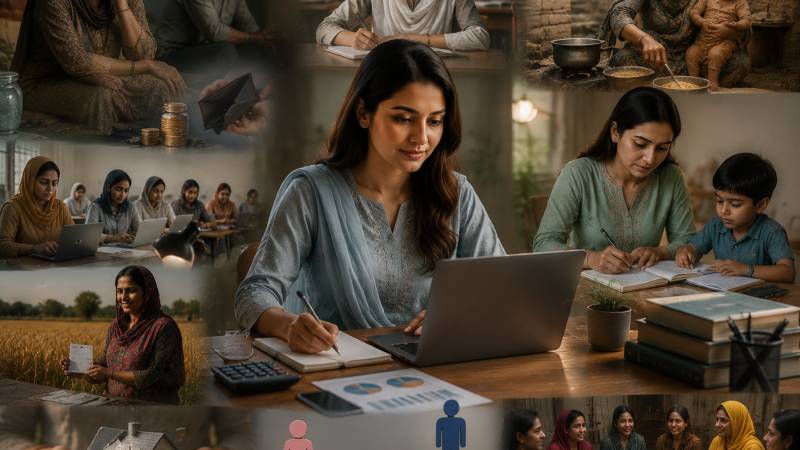
Of all manifestations of women's discrimination, financial dependence weighs heaviest on their life. That is, financial dependence on men not only subjects women's lives to subordination but also robs them of choice, potential, and a dignified living. Financial self-reliance, however, is mistakenly seen in a negative light and equated with an assault on the institutions of marriage and family. A woman’s monthly salary may not necessarily salvage her from financial dependence. The pay cheque may not financially empower the woman. The divide between earning and spending is not simply a story of jobs; it reflects restrictions that begin well before a woman reaches an office: differential access to education, unpaid care work, and men’s primacy in financial decision-making.
For generations, women have managed household scarcity with remarkable skill. They stretch grocery budgets, save for school fees, and respond to medical emergencies. Yet the same woman may never be told what the family owns, how much it owes, whether there is insurance, or where important documents are kept. She manages money daily but remains excluded from finance. That exclusion becomes dangerous when life changes. A husband may die, lose his job, become ill, or leave. A marriage may turn abusive. A family business may fail. At such moments, financial ignorance is not an inconvenience; it is exposure. A woman without savings, records, or banking access may discover that years of dependence have left her with responsibility but no protection.
Financial independence should not be confused with living in seclusion. A healthy marriage can include shared accounts, joint assets, and collective decisions. One spouse may earn more, while the other temporarily leaves paid work to raise children. Dependence becomes harmful when information and authority are concentrated in one hand.
A homemaker, too, requires financial security. Her work produces no pays lip, but it creates real economic value: children are raised, elderly relatives are cared for, and the household functions. She should have regular access to money, savings in her own name, awareness of family finances, and a recognized stake in long-term assets. Financial dignity cannot be reserved for women with office jobs.
Employment, however, is not a complete solution. Many working women carry two shifts: paid work outside the home and unpaid work within it. They are praised for being “independent” while cooking, caring, commuting, and meeting professional demands with little rest. Safe transport, protection from harassment, childcare, maternity support, and flexible work are the infrastructure of women’s economic participation.
A marriage may turn abusive. A family business may fail. At such moments, financial ignorance is not an inconvenience; it is exposure.
The road from income to independence begins with financial literacy. A woman should know how to prepare a budget, build an emergency fund, and distinguish productive borrowing from expensive debt. She should understand inflation, insurance, and pension. She should also know how to use digital banking safely and recognize fraud.
These are survival skills. A modest emergency fund may provide more freedom than an impressive salary consumed each month. A woman who understands the true cost of a loan is less vulnerable to predatory credit. One who begins investing early, even in regulated and diversified products, gives time the opportunity to work in her favor.
Pakistan’s financial sector has begun recognizing the gender gap. The State Bank’s Banking on Equality policy seeks to address barriers faced by women, while its financial inclusion framework now looks beyond account ownership towards access, usage, and quality. That shift matters because an inactive account controlled by someone else cannot empower its nominal owner.
Banks should therefore measure success not by how many accounts are opened in women’s names, but by whether women use them independently, save regularly, obtain suitable financing, and understand the products sold to them. The deeper change must begin at home. Sons and daughters should both learn budgeting, banking, and household responsibility. A daughter’s education should not be treated merely as preparation for marriage, while a son’s education is viewed as an investment. Girls should be included in conversations about property, inheritance, taxes, and savings before adulthood forces them to learn through crisis.
Financial independence does not guarantee equality, but it changes the terms on which inequality is confronted. It gives a woman bargaining power, confidence and, most importantly, options. She can contribute to family decisions without pleading to be heard. She can support her children, care for her parents, and plan for old age. If circumstances become unsafe, she is less likely to remain trapped. Financial autonomy is not a revolt against family: it is an insurance that a woman can appreciate her finances, live through an emergency, and participate in decisions that affect her life.