

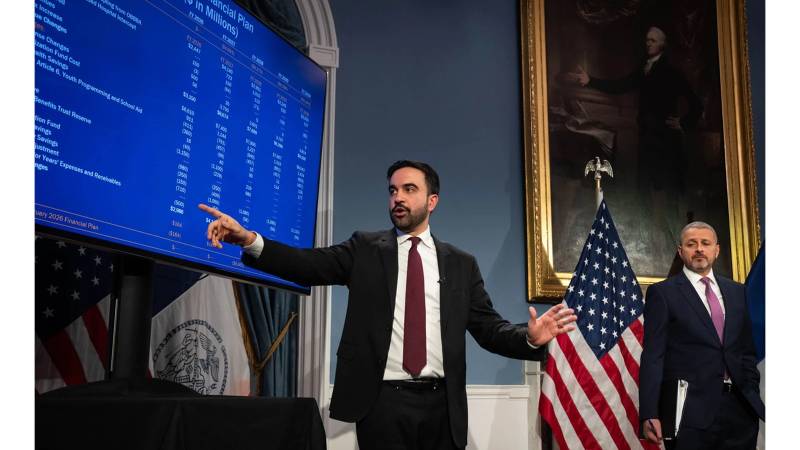
As Pakistan’s provinces and cities struggle with chronic municipal underbudgeting and budget gaps, New York City’s recent budget debate offers an interesting case study.
To understand the claims being made and verify their authenticity, an understanding of NYC’s budget is essential. Unlike other places, NYC does not propose and adopt a single budget. Instead, a Preliminary Budget is released at the start of the year, followed by the Executive Budget, which is adjusted to reflect any changes and take into account public concerns, and then finally the Adopted Budget, which is the legally binding budget approved by the city council. Additionally, not only do they include the budget for the current fiscal year, but for the next three fiscal years as well (or the ‘out-years’). Furthermore, the administration running the city is legally bound to ensure the upcoming fiscal year’s budget is balanced.
The Mayor’s Office of Management and Budget (OMB) drafts the budget and presents it, and the NYC Comptroller is the Chief Financial Officer and Auditor of the city, whose job it is to remain non-partisan and comment on the city’s budgets and financial performance.
Investigating the Claim
It has been claimed that Zohran Mamdani’s administration has presented a budget for FY27 that closed an inherited $12 billion gap (from the Adams administration). How accurate is this claim? Where did that gap come from, and how exactly was it closed? Answering these questions will require looking past political noise and into the city’s finances.
Unlike other places, NYC does not propose and adopt a single budget. Instead, a Preliminary Budget is released at the start of the year, followed by the Executive Budget, and finally the Adopted Budget
The adopted budget for FY26 is balanced (as required by law), with a projected gap of approximately $5 billion for FY27 (indicated by the highlighted numbers). This means that the city’s revenue and expenditure were the same for FY26, while it was expected they would need $5 billion extra to keep up with rising costs. Before continuing, one thing to be clarified is that these ‘gaps’ do not act as ‘debt’; these are mere year-by-year projections. It is sort of like saying, ‘If we continue the same policies without making any changes, this is how much money we are going to be short on to run the city in that fiscal year’.

So, where did Mayor Mamdani’s administration come up with the ‘inherited $12 billion deficit’ claim from? This is where the Comptroller comes in.
The Comptroller, as part of their job, publishes reports commenting on proposed budgets as well as their analysis of previously adopted budgets. In Comptroller Levine's 16th of January 2026 ‘FY2027 Budget Preview’, he states that the city’s budget situation is much worse than the numbers published by Adams’ administration suggested.
You can see above that the Comptroller is essentially adding on to the gaps projected by Mayor Adams’ administration (yellow bars refer to Mayor Adams’ numbers, while orange refer to the Comptroller’s).
Levine restated the city's official FY26-FY29 gaps by incorporating what he described as chronically underbudgeted expenses. His revised estimates showed a FY26 gap of $2.178 billion and an FY27 gap of $10.405 billion, totalling approximately $12.6 billion across the two years. This means that while Mayor Adams’ budget balanced FY26 and projected a gap of approximately $5 billion for FY27, in reality (according to the Comptroller), FY26 had a gap of $2.178 billion and FY27 a gap of $10.405 billion. This is where the Mamdani administration appears to have gotten the "$12 Billion inherited gap" figure from. Instead of sticking with Mayor Adams’ numbers and projected gaps, they are treating the Comptroller’s numbers and projections as closer to reality.

Adding on, according to Levine, a primary reason for the budget gap being larger than expected was that several predictable and ongoing costs were consistently underbudgeted, including rental assistance programmes, shelter operations, overtime, etc. Historical data highlights this pattern: in the FY23 budget, the ‘Public Assistance’ cost has been maintained at an unrealistic $1.65 billion for all out-years (even though this is a cost that usually increases over time). If the sensationalism is taken away and a nuanced picture is presented, a more accurate claim for Mayor Mamdani’s office to make would be: “When we took office, there were roughly $12 Billion worth of budget problems across FY26 and FY27, once you include the published gaps and the underbudgeted obligations”.
Mayor Mamdani’s ‘Fixes’
The OMB, acknowledging that the previous budget was underfunding certain services, has shifted things around to ensure that those previously underbudgeted obligations were actually funded. The administration says the gap was closed through: higher revenue projections ($6.5B), State commitments and legislation ($4B), and a savings programme ($1.7B). In simple terms, the gap was closed by projecting higher tax revenue (i.e., they estimate that NYC will collect more tax revenue than was initially expected), aid from the state of New York (referred to as Albany), and spending cuts that save costs.
Evaluating these measures, there are many concerns that have been pointed out. Observers have noted that these ‘fixes’ are short-term in nature. For example, they delayed $1.6 billion of pension contributions to FY27. Comptroller Levine warns the Executive Budget “relies on $2.8 Billion in one-time measures and $2.3 Billion in short-term pension savings”. Independent analysts warn that many of the savings are nonrecurring “band-aids,” and the plan assumes very strong tax growth and state support that may not last. This means that the core, structural issues (i.e., the city spending more than it earns) have not been resolved, and in reality, Mamdani has only managed to delay the financial troubles on paper. Nonetheless, supporters argue that the administration has technically balanced the budget without any tax increases or slashing of services. In fact, the Citizens Budget Commission’s Andrew Rein (while urging more cuts) admitted “the Mamdani Administration deserves kudos for presenting a budget that corrects prior underbudgeting”.
From all the information analysed thus far, the following conclusion can be drawn: Based on the Comptroller's January 2026 restatement of the city's finances, the administration inherited approximately $12.6 billion in combined FY26-FY27 budget gaps. They deserve commendation for managing to close the deficit without resorting to austerity measures or reserve (rainy-day) funds. However, many of the proposed measures do not seem durable in the long term and are instead temporary fixes and accounting manoeuvres, rather than permanent, structural reform. Evidence for this is the fact that despite the FY27 gap closure, substantial projected out-year gaps remain in FY28 and FY29. Hence, while unpopular tax increases may have been avoided for now, the budget does not itself cure the city’s structural imbalance. Future budgets will test whether these steps were a solid bridge or merely borrowed time.