

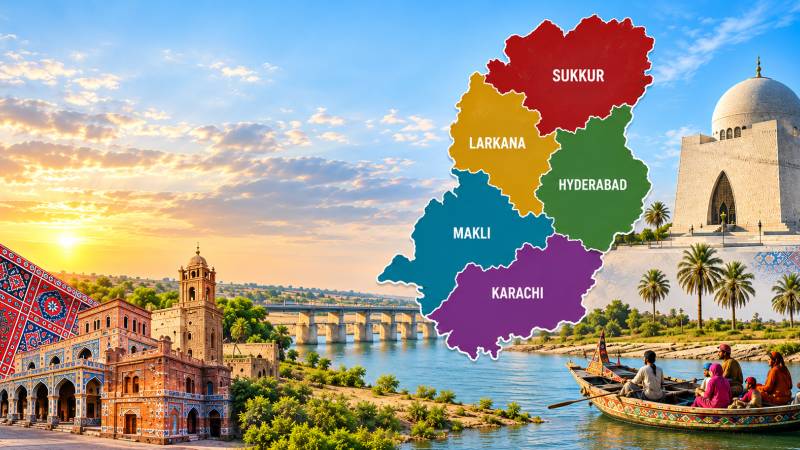
On 3 September, 105 Pakistan Peoples Party legislators stood on their benches in the Sindh Assembly holding banners that read "Sindh Dharti Maa". With the opposition walking out, the house had just rejected any plan to divide the province, detach any district from it, or place any of its territory under a separate or federal administrative arrangement. Two days later, in Lahore, Interior Minister Mohsin Naqvi said he would not back down. He first made his case for new administrative units at the Pakistan Economic Summit on 30 July, when he declared that the country's governance system had "collapsed", and the military's spokesman endorsed the idea the following day. Now he says no party or government can settle the question on the people's behalf.
I grew up in Tharparkar, studied in Hyderabad, and now live and work in Karachi. The unofficial maps of a divided Sindh that have circulated online since last November, none of them owned by anyone in office, all draw a border somewhere along that road. So I have followed this argument closely. What strikes me is how little of it concerns plumbing, by which I mean the pipes, literal and fiscal, that connect these places to Islamabad.
No bill has been tabled. A senior PML-N parliamentarian told The Nation last week that no consensus had been reached and that no draft had been shared with the PPP, whose votes the government needs. What exists is a set of reported proposals that has grown since November 2025, when Rana Sanaullah, the prime minister's political adviser, said the next amendment would deal with local bodies, the National Finance Commission and health. By May, reporting in Dawn and elsewhere had added the return of curriculum, population welfare and minerals to the centre, along with a looser floor on the provinces' share of federal taxes. Some accounts went further, describing a change that would let Parliament create provinces without the consent of the provincial assembly concerned. Ayesha Siddiqa told ThePrint on 9 September that a draft could be tabled by the end of the month.
If it is, this would be the third major rewrite of the Constitution in two years. The 26th Amendment went through in an overnight session in October 2024. The 27th, which created the Federal Constitutional Court and the post of Chief of Defence Forces, went from cabinet approval to passage in under a week last November. Neither came with much public debate. The provision to watch this time is Article 239(4). It says an amendment that alters a province's limits cannot go to the President until that province's assembly has passed it by two-thirds of its total membership. It is the only veto a federating unit holds over its own existence, and the PPP alone holds far more than the one-third of Sindh's seats needed to exercise it. While the clause stands, Sindh cannot be divided without Sindh. That makes the clause, more than any map, the thing being fought over.
Naqvi likes to cite India, which he says grew from 14 states to 29. It has 28 today, and the example teaches something other than what he intends. India's Parliament can redraw states without their consent; Telangana was carved out of Andhra Pradesh in 2014 after the Andhra assembly rejected the bill. But India's framers chose that design on purpose, for a union held together from the centre, and even so the country moved slowly, with a States Reorganisation Commission spending nearly two years on hearings before the redrawing of 1956. Pakistan's 1973 settlement starts from the other end. It treats the provinces as the units that came together to form the federation, which is why the Sindh resolution recalls that its assembly voted for Pakistan in 1943. Deleting 239(4) would change what kind of country the Constitution describes.
The real failure of devolution is not the distance between provinces, but the distance between citizens and local government.
Reorganisation is sold in the language of governance. The pressure behind it is fiscal, and the numbers do not help its case. This year's federal budget expects net revenue of Rs11.75 trillion after Rs8.85 trillion goes to the provinces. Against that, it has set aside Rs8.05 trillion for interest and roughly Rs3 trillion for defence. Those two lines alone absorb about 94 percent of what Islamabad keeps. Pensions, subsidies, the development programme, BISP and the running of the federal government are paid for, roughly nine rupees in every ten, with borrowed money.
Now run a redrawn map through the NFC formula. Under the 7th award, which expired in 2015 and has been rolled over every year since, the provinces collectively receive 57.5 percent of the divisible pool, divided among them 82 percent on population, with poverty, revenue and inverse population density making up the rest. Cut Sindh in two, or Punjab in three, and the new units inherit their parent's share between them. The federal 42.5 percent does not grow by a rupee. Overhead does. Each new province needs a governor, a chief minister and cabinet, an assembly, a high court, a public service commission, a police command and a secretariat, all paid out of the same pool. Far from creating fiscal space for the centre, new provinces would eat into what little exists.
What would move money is a change to Article 160(3A), which bars any NFC award from giving the provinces less than the one before it. Less noticed is that Islamabad has already found about a trillion rupees without touching that clause. Under the "cooperative federalism" arrangement announced with the budget in June, the divisible pool is frozen at Rs13.35 trillion, well short of the FBR's Rs15.26 trillion target, and the deal is to be renewed each year until 2028-29. The provinces will pass roughly Rs1.04 trillion back to the centre as grants under Article 164 (Punjab Rs556 billion, Sindh Rs264 billion), and they have separately been asked to run a combined surplus of Rs1.79 trillion.
One can fairly argue that a deal renegotiated every June is not a system, and that the imbalance will eventually need a constitutional fix. The provinces are hardly models of revenue effort either. Balochistan expects Rs800 billion from federal transfers this year against Rs170 billion from its own sources, and the IMF's May review pressed the provinces to collect more sales tax on services. Still, this year's budget settled two things. Islamabad's hole is an interest bill of more than Rs8 trillion, and moving money between governments does nothing to shrink a debt stock; that takes growth, cheaper borrowing and a tax net that reaches untaxed incomes, several of which fall under the provinces. And when the centre needed money from the provinces, it got it by bargaining inside the Constitution. Money can be bargained over. A veto either exists or it doesn't, which is why the change with the weakest fiscal case matters most.
My day job is materials planning for a consumer goods manufacturer in Karachi, so I tend to look at a proposal like this the way I would look at splitting a plant from its warehouse. The first question is what each side would suddenly have to buy from the other. Start with water. Karachi receives around 630 million gallons a day, while the Sindh government itself sets demand at 1,200. Well over four-fifths of that supply is Indus water, released at Kotri Barrage, carried by the Kalri Baghar Feeder to Keenjhar Lake in Thatta district and pumped onward from Dhabeji. Under the 1991 Water Apportionment Accord, it sits inside Sindh's allocation of 48.76 million acre-feet, flagged with an asterisk: "including already sanctioned Urban and Industrial uses for Metropolitan Karachi". Four provinces signed that accord. Make Karachi a fifth, and its taps would depend on an entitlement it never signed for, drawn from a river that reaches it only after passing through another province's barrage.
We already know how that works, because a smaller share of the city's water crosses a provincial line today. The Hub Dam, which supplies Karachi's western districts, sits on the Sindh-Balochistan border. When the city asked this year to double its draw from 100 to 200 million gallons a day, WAPDA replied that any change in allocation between the two provinces was a matter for the Council of Common Interests. Picture the Keenjhar supply handled the same way, and then consider the CCI's record. Article 154(3) requires it to meet every 90 days. The News reported in May that it had not met this requirement since April 2025, and that it had missed the deadline 21 times since 2010.
Then there is the gate. Anyone who has built a landed-cost sheet for goods arriving through Karachi knows the Sindh infrastructure cess, charged on goods entering or leaving the province by sea or air. The city's two ports carry the great bulk of Pakistan's seaborne trade, so the levy reaches well beyond Sindh. At 1.85 percent it tied up some Rs350 billion in litigation across more than 500 cases. When the province tightened collection on petroleum imports last October, oil marketing companies warned of shortages nationwide. Sindh cut the rate below one percent this year and exempted exports, and its excise minister told the assembly that the old rate had pushed factories to Punjab. Whatever you think of the cess, it showed that a provincial government sitting on the country's main gate can shift national costs with one notification. Draw a new border around that gate, and you create a government with that power and every incentive to use it, facing a hinterland that holds its water. When each side of a divorce owns what the other cannot live without, the usual result is a long custody fight. Here, a council that does not meet would referee it.
None of this lets the Sindh government off. Its resolution invokes history, and it has a case on history. But the government that waves the NFC floor at Islamabad has not issued a Provincial Finance Commission award to its own districts since 2007. In February 2022, the Supreme Court, ruling on a petition the MQM filed in 2013, held that Article 140A places a mandatory duty on provinces to give elected local governments real political, administrative and financial authority. It struck down sections of the Sindh Local Government Act that gave the province excessive control over councils and ordered that local governments receive their share through the PFC award. Four years on, councils are still funded under an award nearly two decades old.
Seen from Tharparkar, Mithi's relationship with Karachi can look a lot like Karachi's relationship with Islamabad: a distant capital holding the money, a slogan about unity, and a district waiting for a file to move. Punjab has little to boast about; its last PFC award was an interim one in 2016. Naqvi's complaint that government sits too far from the people it serves is, stripped of the maps, correct. It is a complaint about the third tier. Pakistan has three tiers of government on paper and something closer to two in practice.
Somewhere in the reported package is a good idea: binding provinces to share funds with local governments. It has been bundled with the worst one. If Parliament is set on a 28th Amendment, it should unbundle them. India offers the better template here, though not the one Naqvi quotes. In 1992, its 73rd and 74th amendments turned village panchayats and municipalities into constitutional bodies, gave state election commissions the job of running their polls on a five-year cycle, and required a State Finance Commission every five years to decide how much state revenue flows down. Pakistan's Article 140A has two short clauses that tell provinces to devolve, with no deadline.
An amendment that wrote PFC awards into the Constitution with a fixed cycle and a floor, in effect a 160(3A) for districts, and set a hard deadline for local elections once a council's term ends, would bring government closer to people in Thar and in Orangi without redrawing a single line. It would cost the provinces power, and that is what makes it a fair test. The PPP could not oppose it while defending the NFC floor. Islamabad could not claim to want devolution while blocking it. When a draft does appear, skip the map, if there is one, and read Article 239(4) first. Whether that clause survives will say more about the 28th Amendment than any number of new provinces.
The 1991 accord settled Karachi's place in Sindh with an asterisk. It has survived 35 years of quarrels over how to read it because four provinces agreed to it in the first place. Consent in a federation is slow and often maddening. It is also what makes the lines on a map stick. Take it out, and every line becomes provisional, including whichever ones Islamabad draws next.