

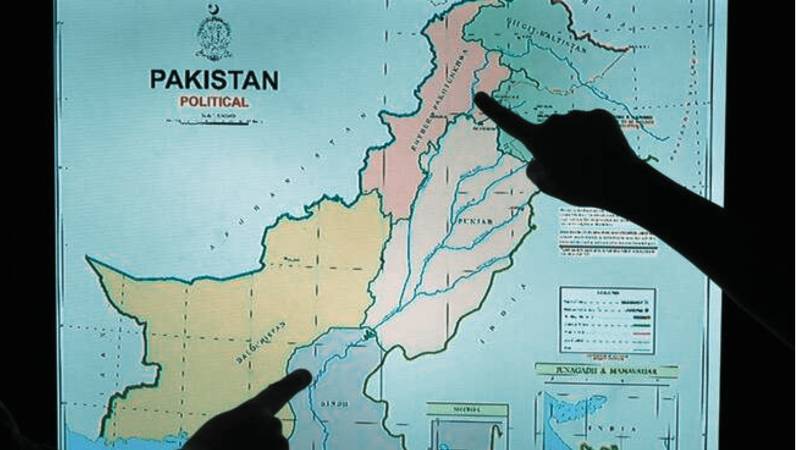
Pakistan is a unique country in the sense that following the abrogation of one unit in 1970, it has four provinces. The fifth province called as East Pakistan transformed into Bangladesh in December 1971. Azad Jammu & Kashmir and Gilgit-Baltistan are not the provinces of Pakistan because of the controversial nature of J&K. The debate to create new provinces in Pakistan is quite old arguing that when India can have 28 states (provinces) and 8 union territories and Afghanistan can have 34 provinces, why there is no change in the provincial map of Pakistan.
Pakistan most populous province is Punjab whereas Baluchistan which accounts for 44% of the country’s territory is least populated. There is certainly an asymmetry in the provincial map of Pakistan in terms of demography and territory. An ethnic and lingual variation in the provinces of Pakistan is also a reality. Almost half of Baluchistan is Pashto speaking whereas in Punjab around 40% of population is Siraiki speaking. In KPK, Hindku speaking population is concentrated in Hazara division. The most dangerous ethnic situation is in Sindh whereas Sindhi speaking population is 55% whereas Urdu, Pashto and Punjabi speaking communities account for 45%. Ironically, Karachi is the capital of Sindh but Sindhi speaking population in that city is around 15%. Given the ethnic and lingual contradictions in all the four provinces of Pakistan, the debate to create new provinces tends to reflect the reality that the country is facing a dilemma to redraw the provincial map of the country.
From time to time, there are demands and arguments to create new provinces in Pakistan either by upgrading divisions as provinces or to give provincial status to South Punjab, Hazara, Pashtun belt of Baluchistan and the urban centers composed of non-Sindhi speaking communities. The constitution of 1973 which created provinces has also a mechanism to create new provinces whereby the provincial assembly of the respective province must endorse a resolution the divide into province with two-third majority. That endorsement must be approved by the National Assembly. When the very idea to create new provinces is not supported by the powerful establishment and some political parties that matter is lingering since long. During the reign of PTI, a separate administrative machinery was established in Multan for facilitating the demand for southern Punjab but that mechanism exists no more.
Pakistan is a distinctive country in this world where provinces created the country and not the vice-versa. On these grounds, nationalistic forces argue that the state cannot undermine and ignore the reality that Pakistan was created by states and states can withdraw from federation. Why the provincial map of Pakistan is unchanged since 1972 needs to be analyzed with critical thinking. If MQM is supportive of dividing Sindh on ethnic and lingual basis, PML (N) is not in favor of dividing Punjab. Likewise, the Pashtun majority in KPK is against dividing the province by creating Hazara province. Whereas, the Baluch population in Baluchistan is not in favor of dividing their province on ethnic grounds. If the debate to create new provinces tends to generate opposition and hostility particularly in Sindh, Punjab and KPK the way out should be to approach people and seek their consent for redrawing the provincial map of Pakistan. The holding of referendum is termed as a way out to seek the consent of people if they support the creation of new provinces or want to maintain status quo. If an amendment is made in the constitution of Pakistan that by holding referendum the will of people about creating new provinces can be exercised then it may resolve the issue.
Given the ethnic and lingual contradictions in all the four provinces of Pakistan, the debate to create new provinces tends to reflect the reality that the country is facing a dilemma to redraw the provincial map of the country.
Imposing a decision about creating new provinces may be counter-productive and lead to serious unrest. Therefore, the state along with concerned stakeholders should formulate a plausible strategy to deal with the issue of creating new provinces. If the system has collapsed as narrated by federal interior minister what is the guarantee that by redrawing the provincial map of Pakistan the system will be stable?
The debate for creating new provinces needs to be analyzed with critical thinking from three standpoints. First, new provinces will not resolve issues particularly those related to finance and governance. Unless, those who will administer new provinces focus on generating resources to meet expenditures, the very idea to redraw the provincial map of Pakistan will fail to materialize. If 37 divisions are divided into provinces how resources to run such divisions named as provinces will be mobilized? What is the guarantee that Lahore, Peshawar, Quetta and Karachi provinces, apart from other 33 provinces will manage their administrative, financial and governance matters? How resources will be utilized at the local bodies’ level. If the bulk of financial resources are given to 37 provinces how the federal government will meet its expenditures like debt servicing, defense, development and amount required for running administration.
What is required is adequate brain storming to be done by pursuing a multi-stakeholder approach to find answers to questions related to financial, administrative and governance issues in proposed 37 provinces. Second, it makes sense to create new provinces not on ethnic and lingual grounds but by upgrading the existing 37 divisions are provinces. This would require consensus at the grassroots’ level and making required constitutional changes. The United States is a classic example of creating states not on ethnic, lingual or religious grounds. All the 50 states of the U.S are neutral while not reflecting ethnic, lingual or religious variations. More or less same is the case with India where half of 28 states are neutral like Hamachal Pradesh, Madhya Pradesh, and Andhra Pradesh and so on. What is required is new provinces should benefit local people instead of protecting perks and privileges of ruling elites. When professional approach is followed by creating new provinces one can expect bettering the lives of people.
If corruption and nepotism along with bad governance and absence of rule of law is the practice in new provinces, one can expect augmenting of more and more crises. But it doesn’t mean that no decision is made by the stakeholders to create new provinces. Finally, since Pakistan has four provinces since decades, any change to redraw provincial map of the country needs to be done in a professional and prudent manner. Conceptually, the plan to create new provinces must be realistic and devoid of emotions. Unfortunately, people with vested interests are responsible for derailing redrawing the provincial map of Pakistan. Logical and rational approach to create new provinces will certainly resolve issues which the country is facing by sticking to four provinces. The proposed 37 provinces will have their own assemblies, governors and chief ministers. It may enhance financial cost but if the stakeholders are above corruption and nepotism they can certainly find a way out to deal with the issue of redrawing the provincial map of Pakistan.