

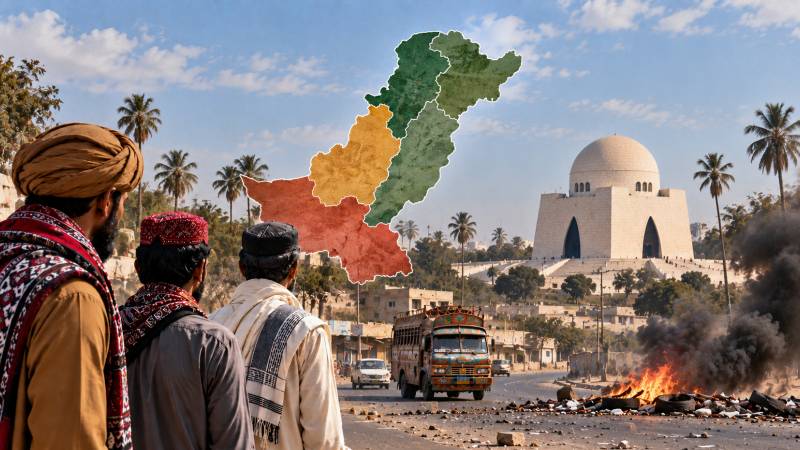
During Gen. Zia’s rule, the Pakistani state and society experienced a profound process of decadence, plunging the country into a long-term decline that cannot be attributed to a singular crisis; rather, it was the product of systemic institutional decay engineered under a decades-long dictatorship, accompanied by societal anomie and hysteresis, whose effects persisted for decades to come. As change was in the air, some exiled Baloch, Pashtun, and Sindhi leaders, including Mumtaz Bhutto, Abdul Hafeez Pirzada, Ataullah Mengal, and Afzal Bangash, had already formed the Sindhi–Baloch–Pashtun Front (SBPF) in London in 1985 to fight for the rights of the smaller ethnic groups as administratively constituted within the provinces of the country. According to the Front, the 1973 Constitution had failed and the federal system was not delivering the protection needed for the rights of the smaller provinces. It therefore proposed a confederation in which the central government would exercise limited powers, retaining only defence, foreign affairs, and currency, while advocating greater provincial autonomy through control over a wider range of affairs, including taxation and natural resources, to counter Punjab’s demographic and political hegemony.
Nationalist parties from the NWFP, Sindh, and Balochistan, along with left-wing parties and groups, founded the Awami National Party (ANP) on July 28, 1986, with Wali Khan and Rasool Bux Palijo as its president and general secretary, respectively. It emerged as a left-wing party committed to the struggle for constitutional rights and democracy within the framework of Pakistan, with provincial autonomy as one of its key points of departure, alongside the struggle for the rights of workers, peasants, and minorities, secularism, anti-imperialism, an independent foreign policy, and regional peace.
It was a welcome development in the new era, as nationalists and progressives joined hands in the struggle for oppressed nationalities, subaltern classes, and communities in the light of Left politics, while seeking to counter imperialist designs and policies. However, this political alternative was short-lived, as Baloch and Sindhi leadership retreated into their respective ethnic politics and the ANP gradually became predominantly a Pashtun party. The ideological confusion and political fragmentation that followed became quintessential features of ethno-linguistic movements during the 1980s and 1990s.
The progressive nationalist struggles for self-determination had initially gained impetus in the light of the Russian Revolution of 1917 and its influence across the colonial world. The hallmark of these movements was to work under enlightened and progressive leadership for a better world by forging international solidarity and waging a broader struggle against imperialism and its policies in Asia, Africa, and Latin America. Pashtun, Baloch, and Sindhi nationalist movements, despite their vacillations and compromises, adhered, in one way or another, to this worldview until the 1980s.
It was during this period that a transition took place from a nationalist struggle for self-determination towards ethno-linguistic politics aimed at safeguarding the interests of particular ethnic groups and their elites within the existing political framework. The ideological obfuscation and political euphemism associated with the so-called New World Order, articulated by George H. W. Bush in 1990–91, together with the ideologies of the free market and globalization and the expansion of information technology, marked the emergence of a new era. Concepts popularized in the media, such as the “global village,” appeared to offer new opportunities, particularly to middle and professional classes.
In Balochistan, this transition was also reflected in growing competition between Baloch and Pashtun ethno-nationalist forces over a greater share of the provincial quota in educational institutions and government employment. The roots of the Pashtun nationalist position went back to Khan Shaheed Abdul Samad Khan Achakzai, who opposed the creation of Balochistan as a province in 1970 following the dissolution of One Unit. While the NAP leadership welcomed the new provincial arrangement, Achakzai viewed the decision not to merge the Pashtun-majority areas of Balochistan with the NWFP as a betrayal of the struggle for a unified Pashtun province. He consequently broke with the NAP and formed NAP-Pashtunkhwa on 26 August 1970. This political tradition was later carried forward by the Pakhtunkhwa Milli Awami Party (PKMAP), founded in 1989, whose Pashtun nationalist politics came to be associated with the demand for a Pashtun province extending “from Bolan to Chitral.”
At the same time, Baloch nationalism remained relatively calm during this period, while the Baloch Students Organization (BSO), founded in 1967, was rapidly expanding its presence in educational institutions and exerting considerable influence among Baloch youth. By the late 1960s and early 1970s, the BSO had already established a strong presence in Baloch-majority areas, and its politics continued to inspire a significant section of the younger generation. Thus, even where open nationalist confrontation remained relatively subdued, educational institutions increasingly became important sites for the reproduction and mobilization of ethno-nationalist politics.
The transition from nationalist struggles for self-determination towards ethno-linguistic politics shifted political mobilisation towards safeguarding the interests of particular ethnic groups and their elites within the existing political framework.
In this era, Sindhi ethnic movements also faced fragmentation and increasingly came to see themselves through the prism of the MQM and the Punjabi Pashtun Ittehad (PPI), while remaining unable to extend their political appeal and consolidate a broad electoral constituency. As Adil Khan noted, “Interestingly, the unabashedly anti-Sindhi and anti-Bhutto MQM found its most visible sympathizer in the person of G. M. Sayed.” The MQM and Sindhi nationalists shared some objectives, although the operations in Hyderabad further widened political and ethnic polarization. During 1980s and 1990s, Sindhi and Pashtun ethnic movements mobilized large sections of the population in opposition to the proposed Kalabagh Dam on the Indus River in Mianwali district, Punjab, turning the project into a major inter-provincial political issue.
The Mohajir Qaumi Movement (MQM), renamed the Muttahida Qaumi Movement (United National Movement) in 1997, emerged in the urban centres of Sindh, particularly Karachi, and became a formidable political force in the subsequent era. At times, it also became an instrument in the hands of the Establishment for dealing with larger political parties, in return for political gains for the cities it represented. Its shifting political alliances contributed to uncertainty in the democratic process, as it changed sides and became instrumental in the formation and fall of governments, thereby playing a significant role in national politics. This unfolded as Pakistan was preparing to embrace the neoliberal mantra of market liberalization and economic reforms amid divisions within the ruling classes.
The MQM’s transition from a student group, established in 1978, to a political party in 1984 took only a few years. It emerged against the background of the quota system, language riots, and the reservation of seats in professional educational institutions and government employment. Initially, educated Mohajir middle classes became instrumental in expressing grievances rooted in their declining political influence and numerical presence following the shifting of the capital from Karachi to Islamabad, accompanied by the increasing presence of Pashtuns in the bureaucracy. From the perspective of the Left, the rise of Mohajir sentiment was also viewed as a counter-tendency to the Right, particularly the Jamaat-e-Islami and JUI, which had previously exercised considerable political influence among the Mohajirs of the cities.
The growing transport crisis in Karachi provided another important context for the intensification of these tensions. As the government encouraged the private sector under neoliberal policies to cope with the expanding city’s transport needs, the 1977 “Free Transport Policy” encouraged private operators to obtain route permits and run private buses, particularly 35-seater minibuses. In Karachi, many of these minibuses and their routes were initially owned predominantly by Pashtuns who had migrated from Hazara, Dir, Swat, and Khyber. Operators competed fiercely for passengers and fares to generate greater revenue and maximize profit, contributing to a systemic transport crisis and intensifying existing ethnic tensions.
Capitalizing on the 1985 death of a college-going girl in a minibus accident, the MQM mobilized youth and middle- and lower-strata sections of Mohajir society, galvanizing ethnic and linguistic grievances that contributed to riots spreading across Karachi like wildfire. These escalating tensions transformed into recurring ethnic riots and became a persistent phenomenon of the city’s political and social life. The MQM gathering at Nishtar Park in 1986 further emboldened Mohajir youth and subsequently paved the way for its massive victory in the November 1987 local bodies elections in Sindh, establishing it as a formidable political force and marginalizing almost all other political forces in the major urban centres of the province.
Responding to MQM-led power politics, middle-class Pashtun and Punjabi transporters and trading classes founded the Punjabi Pashtun Ittehad (PPI) in 1987, headed by Malik Ghulam Sarwar Awan, Malik Sikandar Awan, and Irfan Ullah Marwat, to safeguard the interests of their respective communities. Thus, an increasingly ethnicized political field began to emerge in Karachi, in which competing communities organized politically around access to employment, education, transport, markets, residential space, and other scarce urban resources.
Ethno-linguistic mobilization resulted in violent clashes, leading to the segregation and migration of communities, while residential areas became no-go zones, transport, shops, and businesses were burned, and strikes became the order of the day in Karachi. As markets and trading classes suffered severe disruption and demanded state intervention, the Pakistani state initiated its first army operation in Karachi against the MQM. By then, the organization had developed a formidable militant wing and an underground structure directly headed by Altaf Hussain, effectively creating what appeared to be a state within the state.
In the meantime, the MQM became an oppressive apparatus both externally and internally, extending its control even over areas under its influence. No one was allowed to openly voice dissent, join another political party or organization, or show allegiance to anyone other than Altaf Hussain. Consequently, workers and activists of the PPP, JI, JUI, and other political organizations were persecuted and, in some cases, killed, while many were compelled to migrate from areas under MQM control. The militant wing was therefore used not only against rival ethno-linguistic groups but also to suppress dissent and opposition within the organization, as a personality cult around Altaf Hussain increasingly developed.
Operation Clean-up coincided with growing factionalism within the MQM, culminating in the establishment of the MQM-Haqiqi in 1992, headed by militant group leaders such as Afaq Ahmed and Amir Khan. Altaf Hussain was already abroad by then. The military operation also contributed to the removal of many educated middle-class elements from the MQM’s organizational structure, leaving lower-middle-class cadres to bear the brunt of the army operations. They later emerged as unit and sector in-charges, directly controlled by Altaf Hussain. While the organizational structure continued to operate underground, the MQM’s political façade remained visible on the surface, dealing with the organization’s media, political parties, governments, and, to some extent, the problems of everyday life.
The Karachi Mass Transit Study (KMTS), initiated by the World Bank and UNDP in 1987 and envisaging the development of a modern Bus Rapid Transit (BRT) and Light Rail Transit (LRT) system—well before similar projects in Lahore and Islamabad—never fully materialized. The failure to develop an integrated mass-transit system further deepened the city’s structural transport crisis. State policies, meanwhile, contributed to a struggle over scarce resources and the provision of public goods, municipal and civic infrastructure in an ever-expanding Karachi, while the politics accompanying the neoliberal political economy proved particularly beneficial to the bourgeois classes.
This transformation also contributed to the fragmentation of the labour movement, as ethno-linguistic movements increasingly found an ideological anchor in postmodernism. The terrain of political struggle consequently shifted from class-based mobilization around civic and economic issues which could potentially benefit workers and residents across ethnic communities towards representation organized primarily on an ethno-linguistic basis. In this sense, the rise of ethno-linguistic politics was not merely a consequence of ethnic differences; it was also intertwined with the restructuring of the political economy, the fragmentation of class politics, the competition over increasingly scarce urban resources, and the retreat of broader progressive and class-based political alternatives. The ideological confusion and resultant shift towards ethno-linguistic politics and political fragmentation marked the era with increasingly violent forms of middle and lower-middle-class politics directed against the “other,” reinforcing inward-looking identity politics and undermining the possibility of a unified struggle against the ruling classes.