

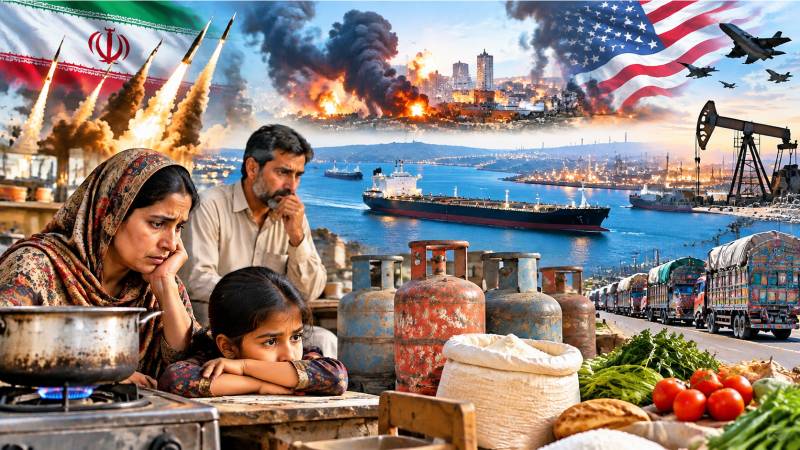
Thousands of kilometers away, a catastrophic war erupts as Iran, the United States, and the entire Middle East collide in a devastating spiral of violence. The missiles aren't fired at Pakistan, but make no mistake: 260 million Pakistanis are directly in the crosshairs. From the quiet homes of Azad Kashmir to the crowded kitchens of Lahore, Islamabad and Peshawar, families light their stoves only to realize the real cost of this war is already inside their homes. Empty gas cylinders. Unaffordable flour. Shuttered factories. A silent, terrifying economic execution is underway and Pakistan’s poor are being crushed first.
Since war choked the Strait of Hormuz in late February, the IEA has called this the worst energy security crisis ever. Global physical crude prices surged, a crippling cost imposed on Islamabad by world markets beyond its control. Pakistan sourced 99% of its LNG imports from Qatar under term contracts. When Iran struck Qatar's Ras Laffan facility on March 2, Qatar Energy declared force majeure two days later, and cargoes became hostage to a waterway we do not control. Pakistan received only two Qatari cargoes this October, against eight a year earlier. Engro's terminal has been shut since September 26 for lack of vessels, and the GasPort terminal has been idle since October 9. Spot purchases have cost over $1 billion, power shortfalls have reached roughly 3,400 megawatts, and winter heating demand is weeks away.
This was a policy choice, not an accident. Global LNG was shifting toward gas-to-gas pricing linked to Henry Hub. Pakistan tied itself to long-term, oil-indexed Qatari contracts priced off Brent, reported at around 13.37 per cent when signed, and added import terminals with take-or-pay obligations. IEEFA found that rigid long-term contracts and thin storage left Pakistan with surplus gas it could not absorb even before this war. We managed to be oversupplied and starved on the same contract. Officials are now working diplomatic channels with Qatar, Iran and the United States to coax cargoes through Hormuz, and scouting America and Azerbaijan for spot supply. A country of 260 million has become a global begging bowl for the molecules that cook its food.
The World Bank says petrol rose about 36 per cent between February and June, diesel 31 per cent and LPG 46 per cent, while transport fares rose about 30 per cent. Petrol now costs Rs377.71 a litre and diesel nearly Rs394. The official LPG price is Rs279 per kg, but in northern Pakistan it sells at Rs750, with cylinders heading toward Rs10,000. Cheap official gas is no use when nobody sells it at that price. Follow the cost down the chain. Dearer diesel raises the price of every truck journey, so flour, vegetables, milk and medicine all cost more. A day labourer who fed his family last year now cannot, and wages do not rise to match. Mothers cut meals, then switch from LPG to wood or dung, with the smoke and health damage that follows. Winter will be harsher for families who cannot afford heating, and infants and the elderly are most vulnerable to cold and unsafe stoves. Children leave school when bus fares become unaffordable, and debt grows against next month's wages.
The Strait of Hormuz will eventually reopen, but the next shock will find us in the same place unless we change what we choose. The war is far away, but the bill is in every Pakistani home.
Inflation hit 11.1 per cent in August according to the IMF, and the World Bank projects 8.2 per cent for this fiscal year. GDP growth in April to June slowed to 2.0 per cent, and industry contracted 4.7 per cent as gas shortages and costly spot LNG hit factories. Every closed production line is a set of wages unpaid. Official unemployment figures lag, but anyone who has watched a mill go quiet knows the direction. The World Bank names a prolonged Middle East conflict as the biggest risk to the outlook, noting that petroleum and gas were about a quarter of imports and the Gulf supplied roughly 80 per cent of them. The IMF warns that a Gulf recession could squeeze the remittances on which millions of families, and our reserves, depend. No agency has counted those lost to cold, unsafe stoves, untreated illness or despair over debt, but the pattern is plain: the poor are hit hardest.
None of this was inevitable. In 2018, the Hydrocarbon Exploration and Licensing Policy (HELP), "Way Forward to Self-Sufficiency in Oil & Gas", was released after consultation with leading national and international experts. It set a roadmap for unlocking conventional reserves and shale. Eight years on, it remains largely a document. Look at Argentina, a crisis-prone country with a long history of fuel imports. Its Vaca Muerta shale formation changed that. In 2015, under five per cent of Argentina's oil was unconventional; by 2020, less than 25 per cent; in 2025, 60 per cent. Oil output reached its highest level since 1998, and Vaca Muerta alone was producing over 447,000 barrels a day by March 2025, up 26 per cent in a year. In 2025 Argentina recorded a $7.8 billion energy trade surplus, its biggest in at least 33 years. It did not discover new geology; it deregulated, invited investment, built pipelines and let operators drill. Pakistan has potential too: US EIA assessments put its technically recoverable shale at roughly 9 billion barrels of oil and over 100 trillion cubic feet of gas. These are estimates, not proven reserves, and only drilling can tell us the truth. We have barely tried.
Even smaller, quicker options have been ignored. Pakistan has still not opted for pine pellets in Azad Kashmir, Gilgit-Baltistan, Khyber Pakhtunkhwa and Balochistan. Our pine forests shed vast quantities of dry needles and litter that feed forest fires every summer. Pressed into pellets, that material could replace imported LPG for cooking and heating in the very mountain communities now paying Rs750 a kilogram, thin the fuel that burns our forests, and create rural jobs. The market exists: Europe is the dominant regional consumer, making up roughly 70 per cent of global wood pellet demand. Instead, we import gas through a strait we do not control.
The uncomfortable reason is that imports are profitable and self-sufficiency is not, at least for some. Every cargo or cylinder we do not need is margin for someone who currently earns it. An entrenched oil and LPG import lobby, close to the Ministry of Petroleum, the regulator and the state exploration companies, has every reason to keep things as they are. I make no allegation against any named person or firm. But licences stall, state explorers are starved or politicised, a 2018 roadmap gathers dust, and LPG sells at nearly double its official price. A system that works this reliably against the public interest is usually working for someone.
A prosperous Pakistan is possible. Domestic oil, gas and biomass save foreign exchange, steady the rupee, shrink the import bill that drives every IMF programme, cut costs for industry, create jobs and remove our exposure to straits and sanctions we cannot control. But the barrier is not underground; it is in Islamabad. Capital and technology can be attracted, but not where licences are for sale, contracts are opaque, and policy is captured. Only leaders without greed for commissions will change that, and in a democracy they come from the ballot box. That is the hard and bitter truth. Pakistanis have too often chosen, or tolerated, leaders who find it easier to renew an import contract than to open a drilling programme. Until voters demand credible, honest leaders and punish those who trade the country's future for a margin, no policy document will matter. The Strait of Hormuz will eventually reopen, but the next shock will find us in the same place unless we change what we choose. The war is far away, but the bill is in every Pakistani home.