

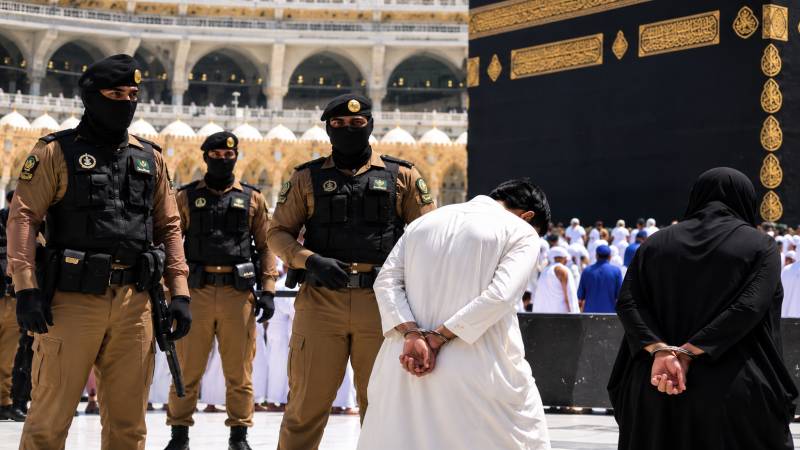
Two people are executed, their families are left searching for answers, and within hours the internet creates an entirely different story. They were newlyweds, some claimed. They had travelled to Makkah for their honeymoon, others suggested. A few posts even supplied romantic details and dramatic circumstances. Yet the emerging evidence tells a more disturbing and considerably less romantic story. The two Bangladeshis executed in Saudi Arabia on October 14, 2026, were migrant workers, not a married couple on a honeymoon. The man's family has explicitly denied that they were husband and wife. What remains uncertain is the precise offence for which they were condemned to death, how their trials were conducted, and why their country's diplomatic representatives were apparently unaware of the impending executions.
The Saudi Ministry of Interior identified the deceased as Nazrul Islam Abdul Basir and Siti Akhtar, also identified in Bangladeshi records as Sweety Akhtar. According to its announcement, the two were convicted of committing an immoral act inside a mosque in Makkah. The court-imposed capital punishment under ta'zir, a category of discretionary punishment in Islamic jurisprudence. The sentence was upheld through the relevant judicial process and implemented following a royal order. However, the official statement did not disclose the exact nature of the alleged conduct, the mosque involved, or the detailed evidence supporting the convictions. When a punishment is irreversible, the absence of such information becomes more than an administrative omission; it becomes a matter of public concern.
The story becomes especially painful when we move away from official announcements and look towards the families in Bangladesh. BBC Bangla's reporting, subsequently carried by other outlets, indicated that Nazrul had travelled to Saudi Arabia for employment and worked as a cleaner at a mosque. His family spoke of his contact with them during detention, while his father rejected the widely circulated claim that Sweety was his wife. Reports suggested that Nazrul had mentioned a romantic relationship, but no verified public account establishes the full nature of their association or the circumstances of the alleged offence. The difference is important. Two workers facing criminal allegations are human beings with individual histories and families, not characters in a sensational tale invented for social media.
For families living on modest means, sending a son or daughter abroad is seldom a casual decision. It may involve borrowing money, selling possessions or sacrificing years of savings. The expectation is simple: the migrant will find employment, send money home and gradually improve the family's circumstances. The journey carries uncertainty, loneliness and the strain of separation, but it is sustained by hope. In this particular case, Sweety's family reportedly borrowed money to finance her migration. The dream of economic security was eventually replaced by bewilderment over her detention and the devastating news of her execution.
A more troubling dimension emerged when The Daily Star obtained a confidential memorandum from the Bangladesh Consulate General in Jeddah. According to the document, both individuals had been detained since August 2023. Yet the prison list received by Bangladeshi officials on September 30, 2026, recorded separate allegations: a cybercrime-related offence against Nazrul and adultery against Sweety. Neither entry indicated a death sentence. These records do not necessarily represent the final charges or reveal everything that happened during the proceedings. Nevertheless, they introduce an obvious question: how did the recorded allegations develop into the offence described in the Saudi execution announcement, and what evidence connected the two defendants?
The Bangladeshi government's response adds to the concern. Its consulate stated that it had not been informed of the executions in advance and sought clarification through diplomatic channels. Bangladesh subsequently raised the matter with the Saudi ambassador, seeking information about the individuals, the legal proceedings and the circumstances of their deaths. The absence of prior diplomatic notification does not by itself establish every alleged procedural failure, but it raises serious questions about how foreign nationals are protected when they become entangled in another country's criminal justice system.
Behind the legal dispute lies another issue that deserves greater attention: the vulnerability of migrant workers. Millions of South Asians leave their homes in search of employment in the Gulf. They work as cleaners, drivers, construction labourers, domestic workers and technicians, often accepting circumstances that more privileged individuals would find difficult to endure. Many have limited financial resources, little knowledge of local laws and inadequate access to legal assistance. Their earnings support families, educate children and sustain households thousands of kilometres away. But when difficulties arise, their unfamiliarity with the legal system can become a serious disadvantage. Justice must never depend upon nationality, wealth or the ability to afford an influential lawyer.
A mosque deserves reverence, and human life deserves dignity. Protecting one should never require indifference towards the other.
The case also invites reflection upon the sanctity of religious places. Makkah occupies an exceptional position in Muslim spiritual life, and mosques deserve profound respect. Their dignity should be protected against conduct that violates the norms of worship and public decency. Yet there is an essential distinction between condemning inappropriate behaviour and deciding that it warrants the ultimate punishment. Respect for religion does not eliminate the need to examine the nature of an offence, the reliability of evidence and the proportionality of a sentence. Indeed, institutions associated with religious values should be particularly attentive to fairness, restraint and compassion.
International human-rights standards provide a significant point of reference. The United Nations Human Rights Committee interprets the death penalty under the International Covenant on Civil and Political Rights as permissible only for the most serious crimes involving intentional killing. It explicitly excludes sexual offences and adultery from offences for which capital punishment can be justified under that framework. Saudi Arabia is not a party to the covenant, but these principles remain important international benchmarks for evaluating proportionality and the protection of human life.
The Vienna Convention on Consular Relations is relevant here. Its Article 36 provides for communication between detained foreign nationals and their consular officials, including informing detainees of their rights and notifying the consulate upon the detainee's request. Whether these particular obligations were met cannot be determined without further records. Nevertheless, Bangladesh's reported lack of information about the death sentences is a legitimate concern, particularly given the prolonged period of detention.
There is also a serious ethical issue concerning the treatment of the dead. Islamic teachings discourage slander and unnecessary humiliation of deceased persons. Yet social media has converted this tragedy into an opportunity for sensational speculation. The false honeymoon narrative is an especially revealing example. Instead of waiting for documented facts, online accounts constructed a story of newlyweds visiting a sacred city, mixing romantic imagery with punishment and outrage. The result was not greater understanding but greater confusion.
Responsible journalism has a duty to correct such narratives without replacing them with fresh assumptions. Nazrul's family denied the marriage. The accounts obtained from Bangladeshi relatives and consular records indicate a background of migrant employment and prolonged detention. Beyond these reported facts, the nature of the alleged conduct remains insufficiently explained. That distinction must be preserved. A deceased person's reputation should not become a playground for invention, regardless of whether one agrees with the punishment imposed.
The case also exposes a contradiction in contemporary public discourse. We frequently demand justice for individuals whom we believe to be innocent, sympathetic or unfairly treated. But human rights become meaningful precisely when they apply to people accused of unpopular or morally objectionable conduct. The right to a fair trial is not a reward for good behaviour. Access to legal representation is not a privilege reserved for respected citizens. The protection against disproportionate punishment does not disappear because an allegation involves religion, sexuality or public morality.
For Pakistan and other labour-exporting countries, this tragedy offers a particularly relevant lesson. Millions of families depend upon relatives working overseas. Diplomatic missions must be equipped to monitor serious criminal cases involving their citizens, maintain effective communication with detainees and provide timely legal guidance wherever possible. Migrant workers should receive clear information about local laws and consular rights before departure. Cooperation with host countries should extend beyond employment agreements and remittance flows to the protection of fundamental legal safeguards.
Ultimately, the deaths of Nazrul Islam Abdul Basir and Sweety Akhtar represent more than an international news event. They raise questions about the vulnerability of migrant workers, the responsibilities of diplomatic missions, the circulation of misinformation and the extraordinary authority of states to impose irreversible punishment. They also remind us that every official announcement concerns actual human beings whose lives cannot be reduced to a legal category or a sensational headline.
We may not yet know everything that occurred inside the mosque or the courtroom. But we know enough to insist that the unresolved questions deserve answers. What were the precise offences? What evidence supported the judgments? What opportunities were available for defence and appeal? Why did Bangladeshi officials apparently remain unaware of the death sentences? These are questions of justice, not expressions of disrespect. A mosque deserves reverence, and human life deserves dignity. Protecting one should never require indifference towards the other. The true strength of justice is not demonstrated by the severity of punishment, but by the fairness, transparency and humanity of the process that precedes it. The two lives are gone. The responsibility to establish the truth remains.