

Some conversations stay with us for years. One such conversation took place in 1995 at a makeshift tea house near the Vice-Chancellor’s House at the University of Sindh, Jamshoro. The tea house stood beside a narrow road leading to Allama II Kazi Road and had become a favourite meeting place for teachers and students. One of its regular visitors was Jawaid Bhutto, then a teacher in the Department of Philosophy. He often came with a group of students. One day, a student asked him, “Was Vladimir Lenin the founder of the whole-timer or full-timer?”
Bhutto replied that the idea predated Lenin. Nineteenth-century European socialist and workers’ organisations had already developed forms of full-time political work, with people serving as organisers, secretaries, journalists, and political officials.
The conversation also raised another question for me: Could a political leader who devoted all his time to a party be called a full-timer?
To explore this, I spoke with Professor Himat Ali Pitafi, a former member of left-oriented political organisations and a founder member of the Watan Dost Inqlabi Party, Sindh. He drew a distinction between a party leader and a full-time worker. In his view, a leader might devote all his time to party affairs but would not necessarily qualify as a full-timer. A full-timer, he explained, was primarily a political worker who travelled from place to place, carried the party’s message, organised local units, trained new members, and politically educated the masses. He considered Salam Bukhari and Comrade Jam Saqi exceptional cases because they combined leadership positions with full-time political work. He also recalled that the Communist Party of Pakistan and other left-oriented political groups introduced and developed the culture of full-time political work in Sindh and other parts of Pakistan.
More than three decades later, I find myself returning to that conversation while exploring the history of the full-timer in Sindh, particularly within Rasool Bakhsh Palijo’s Awami Tehreek.
My research has brought me back to Bhutto’s answer, with one important qualification: Lenin did not invent the whole-timer. In What Is to Be Done? (1902), however, he argued that a revolutionary movement needed a stable organisation of people devoted professionally to revolutionary work and trained as organisers, propagandists, agitators, and political activists. In doing so, he gave the idea a systematic theoretical and organisational framework that profoundly influenced political movements worldwide.
Left-wing political literature offers several definitions of the “whole-timer” or “full-timer.” Broadly, the term refers to a person who leaves, or substantially reduces, a regular occupation to devote themselves full-time to a political organisation, movement, or ideological cause. Different movements and countries have used different terms, including full-time worker, whole-timer, party worker, professional revolutionary, cadre, organiser, propagandist, political secretary, and party functionary. In undivided India, the term pracharak was also used in some political organisations.
Advances in communication technologies made long-distance contact easier and reduced the need for workers to travel constantly from village to village, marking the end of a distinctive chapter in political history
The German Social Democratic Party was among the earliest important examples of a large-scale professional party organisation. Later, the Russian Social Democratic Labour Party, particularly the Bolsheviks, developed the idea of the professional revolutionary and made it central to their model of party organisation. Following the Russian Revolution, the Second Congress of the Comintern in 1920 further institutionalised this approach by emphasising disciplined party structures and systematic political work.
From Sympathiser to Full-Timer
Each country and political party developed its own method of recruiting full-timers. In 1970s–1980s Sindh, political groups used two main frameworks for full-time cadres: a closed, centralised top-down model and an open, decentralised bottom-up model. Awami Tehreek originally favoured the open model, where members progressed naturally from sympathisers to activists, with dedicated individuals advancing to leadership roles across student wings, labour unions, Hari fronts, and study circles. (However, the organisation shifted away from this open culture toward a more centralised, closed approach following the post-MRD era around 1987.)
The emergence of full-timers in the Awami Tehreek was neither a linear process nor an overnight development. It grew gradually as the organisation expanded and responded to new political challenges. Whenever the Awami Tehreek took a strong stand against an issue it considered harmful to Sindh’s interests, its response often attracted public support and brought new members into the organisation. As membership grew, the need for more full-timers also increased. They were needed to organise new members, strengthen local units, and provide them with political education.
In the early years of the 1970s, the campaign for the recognition of Sindhi as a national language was one such moment. It brought the Awami Tehreek into wider public attention and helped it reach sections of society beyond its existing supporters. Its position on land allotments, particularly the lands associated with the Ghulam Muhammad Barrage (now Kotri Barrage Command), also contributed to its growing appeal among rural communities. These issues connected the organisation with concrete concerns over language, land, livelihood, and rights.
The Awami Tehreek’s distinctive mobilisation strategy also played an important role. Rather than concentrating only on urban centres, the Awami Tehreek sought to reach small towns and villages, including remote settlements. Its cultural activities attracted young people, Haris, students, and ordinary villagers. Poetry, literature, cultural programmes, political meetings, study circles, and public campaigns created opportunities to discuss political ideas in a language and cultural idiom familiar to local communities.
As the Tehreek spread, however, its geographical reach created a practical problem. Sindh was vast, its villages were widely dispersed, and communication and transport facilities were poor. The central leadership could issue political calls, but it could not maintain regular contact with every village. A local activist might establish an initial contact, but without continued political education and organisational follow-up, that relationship could easily weaken. A village unit, too, could become inactive if nobody was available to organise meetings, recruit members, circulate literature, and communicate local concerns to the wider organisation.
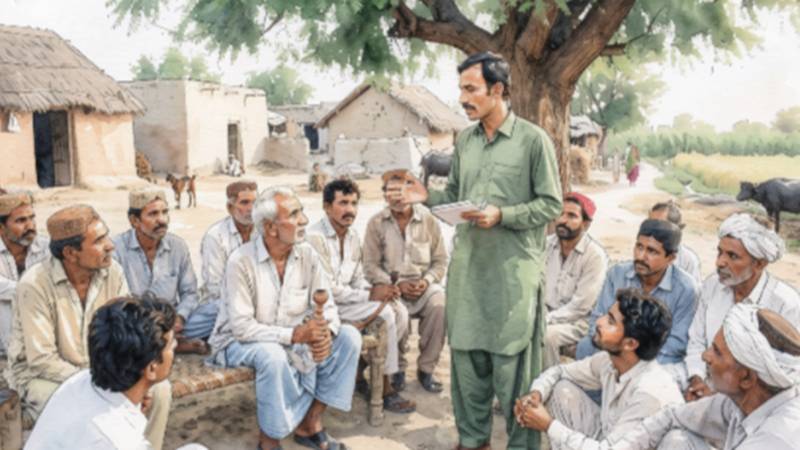
This was where the full-timer became increasingly important. A full-time worker could maintain contact with village units, introduce new members to the organisation, organise meetings and study circles, explain political positions, distribute literature, identify local activists, and report local problems to the leadership.
The full-timer thus became a human link between the central organisation and its dispersed membership. They stayed in contact with those who attended Tehreek meetings, whatever their initial reasons for coming. The worker introduced sympathisers to Sindh’s political issues and the Tehreek’s political outlook and encouraged them to take part in political activities. One of the main tasks was to bring these people together and form a local unit. In this way, public support gradually developed into an organised village group.
The Awami Tehreek needed more than numbers. It needed politically aware and capable members who could take responsibility for local work. Full-timers helped develop such members. They started study circles, led group discussions, held village meetings, organised political campaigns, and trained new activists. They also helped new members understand the organisation’s work and encouraged them to take greater responsibility.
Once a village unit developed capable local leadership and reached a certain level of political and organisational maturity, the full-timer moved to another village. The new village could then receive the same organisational support and political education. In this way, one full-timer could help establish and strengthen several village units.
The movement’s growth created a greater need for full-timers. The Awami Tehreek therefore developed different levels of political commitment. Some activists devoted themselves entirely to the organisation, while others contributed their available time and resources. A full-timer represented the highest level of commitment, making political work the central part of their working life.
Who Were the Full-Timers?
In detailed discussions with former leaders of the Awami Tehreek, this writer learned that the organisation had several categories of full-time and part-time political workers. These categories reflected the workers’ personal circumstances, the amount of time they could devote to political work, and the support they received from the organisation.
The first category consisted of full-time workers. They devoted themselves entirely to political work and received financial support from the organisation. This could include a regular allowance, travel expenses, and, in some cases, assistance for their families. Such support enabled them to remain politically active without depending on another regular occupation. Their work could include travelling to villages, attending meetings, organising local units, conducting study circles, following up on local issues, and maintaining regular contact with members and sympathisers.
According to names orally provided by former activists from different districts of Sindh, the number of Awami Tehreek full-timers reached approximately fifty-six. This figure should be treated as a preliminary oral record rather than a definitive organisational list. The names came from different parts of Sindh, including Tharparkar, the coastal belt, the Rann of Kutch region, and districts bordering Balochistan. Their geographical diversity reflects the extent to which the organisation sought to establish a presence beyond the major towns and cities.
The full-timers also came from different age groups. Some were in their twenties and thirties, while others belonged to the forty-to-fifty age group or were older. Their educational backgrounds were equally diverse. Some had received only a few years of schooling; others had completed matriculation, intermediate education, or a Bachelor of Arts. At the same time, the movement attracted highly qualified professionals. Among its workers were MBBS doctors, engineers, and other trained professionals. The full-timer, therefore, did not belong to a single educational or social category. Commitment, organisational ability, and willingness to devote one's working life to the movement appear to have mattered more than formal education alone.
Women also became part of this full-time organisational structure. Zahida Shaikh, Mumtaz Nizamani, and Mariam Gopang were among the earliest women associated with full-time political work.
To explore this further, I spoke with Ms Rehana Shaikh—the former Secretary General of the Sindhi Girls Students Organisation and now a development expert—about who could be considered the very first female full-timer of Awami Tehreek, even under strict standards. After a moment of thought, she confirmed that Zahida Shaikh was undoubtedly the party's first female full-timer.
Ms Shaikh noted that although Zahida worked primarily through Sindhyani Tehreek (the women’s wing of the movement), her responsibilities extended far beyond women’s mobilisation. Like other full-timers, she undertook broader political and organisational tasks, demonstrating how full-timers successfully connected specialised fronts with the wider organisation.
Among the senior full-timers remembered by former activists were Panahjigir Sindhi, Qadir Ranto, Rasool Bux Detho, Dr Zaffar Qadri, and Ali Muhammad Memon. Their assignments varied according to the needs of the organisation and the areas in which they worked. Some became closely identified with particular fronts or regions, while others performed a broader range of organisational duties. Over time, the work they performed could become part of their political identity within the movement.
Three Levels of Political Commitment
The Awami Tehreek developed three categories of political workers, based on the time they could give to the movement and the support they received from the organisation.
The first category consisted of full-timers. They devoted themselves entirely to political work and received financial support from the organisation. This support covered travel expenses, food, and an allowance for household needs. Since they had no regular employment, the support allowed them to remain available for political work.
The second category consisted of partial-karkuns, most of whom were students. They could not give all their time to political work, so the organisation assigned them short-term tasks or specific responsibilities. The organisation generally covered their travel expenses, while comrades in the villages arranged their food and accommodation.
The third category consisted of time-givers. They were mainly schoolteachers, clerks, and other employees who kept their regular jobs but gave their spare time to the movement. They received no regular payment from the organisation. Some also contributed their own resources to political activities.
These three categories allowed the Awami Tehreek to involve people according to their circumstances. Full-timers gave their entire working time, partial-karkuns gave time for specific tasks, and time-givers contributed whatever time they could spare. This arrangement gave the organisation a committed group of full-time workers while also allowing students and employed people to remain active in the movement.
The development of full-timers reflected the growth and changing needs of the Awami Tehreek. A full-timer was not simply a worker without another job; the role had a clear organisational purpose: to expand the Tehreek’s reach, develop local activists, strengthen village units, and sustain political work. Their rise marked the Tehreek’s shift from occasional mobilisation to a more organised and sustained political network across Sindh.
The End of the Full-Timer Era
The 1990s marked the gradual decline of the political full-timer. Political organisations in Pakistan adopted new ways to organise, communicate, and mobilise members. Advances in telephone, television, mobile phones, and other communication technologies made long-distance contact easier and reduced the need for workers to travel constantly from village to village.
Global changes also reshaped political culture. The collapse of the Soviet Union in 1991 weakened the ideological and organisational foundations of the Left and affected left-wing politics in Pakistan and Sindh. Traditional cadre-based politics lost much of its influence, while new forms of political participation and communication emerged.
The full-timer did not disappear immediately. Some continued their political work, while others returned to regular employment or moved into different forms of activism. The political environment that had sustained the full-timer, however, changed rapidly. The older models relied on workers to carry ideas, literature, instructions, and organisational links from village to village. At the close of the 1990s, that model had largely faded, marking the end of a distinctive chapter in the political history of Sindh and Pakistan.