

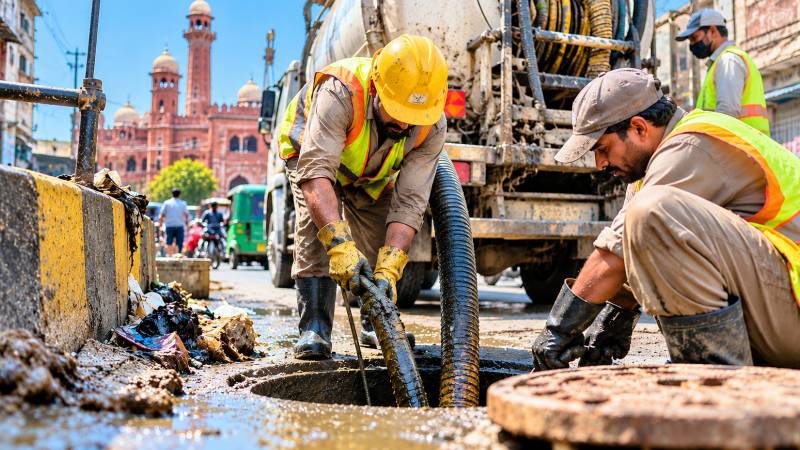
According to Dawn, 26 sanitation workers have lost their lives over the last eight months, descending into dangerous sewers only to be choked by toxic fumes. Most of these victims belonged to vulnerable communities and historically marginalised castes. Far from being an aberration, these cases are symptomatic of a grim pattern of stigmatisation and the pushing of minorities into highly hazardous occupations.
Sanitation work underpins the very architecture of society. Thanks to these workers, we have clean streets, safe water systems, functional drainage, and the seamless functioning of sprawling urban centres. Should this pillar erode, cities will instantly unravel: clogged drains will cripple them as floods sweep through; stagnant water will become fertile ground for pathogens and disease vectors; canals and rivers will become contaminated with sewage; and drinking-water sources will be poisoned. Yet not only do we leave these workers to fend for themselves amid the dangers of their occupation, but we also dehumanise them, degrading the hands that reach out to clear society’s dirt. This demeaning treatment can hardly be captured better than in the harrowing words of a female sanitation worker: “Cut us open and see that we bleed like them, so why do they call us these hateful words?”
An Amnesty International report documented that nearly 300 government advertisements required or preferred non-Muslim or “lower-caste” applicants, while 13 such advertisements still appeared after the apex court condemned the practice in 2023. At Punjab University, only four out of 400 sanitation workers were Muslim. Furthermore, one Christian man in Bahawalpur applied for a job as an electrician but, to his utter dismay, was offered a cleaning position once recruiters learned of his faith. This sheds light on the sheer extent of institutionalised discrimination and tramples upon human dignity. Worse still, it creates a fabricated hierarchy in which economic opportunities for minorities are effectively shut off.
Those who do end up in sanitation work remain at the mercy of lethal fumes, as workers lack access to protective gear, oxygen masks, and even the most basic safeguards. The Amnesty report further revealed that, out of the 66 survey respondents, only six had received any safety training. The cumulative effect, therefore, is dire and tragic: workers’ lives are routinely imperilled. As one worker remarked, “Every time we descend into a manhole, we are uncertain if we will return.” This uncertainty is not accidental; it is the engineered result of the government’s criminal negligence.
The question is ultimately larger than workers’ rights: a society that depends on sanitation workers to keep its cities alive owes them not only safety and security, but recognition of their fundamental human dignity.
Beyond this, the government shirks responsibility by outsourcing sanitation work to third-party contractors, and the underhanded practice at play here merits attention. Pakistan’s Standing Orders Ordinance (1968) provides that a worker becomes permanent once they have performed work of a permanent nature and completed the 90-day probationary period. This, in turn, brings job security, a pension, leave, and other employment benefits. Contractors sidestep this by hiring workers for 89 days, terminating their contracts for a day, and then renewing them for another 90 days. The vicious cycle can continue for years, sometimes decades. The Amnesty report records the case of a man in Umerkot who worked for 18 years in a municipal committee as a daily-wage worker but was never regularised. Rather than receiving the benefits that come with regular employment, sanitation workers are condemned to endure insecurity both while descending into the manhole and while climbing out of it.
Let us hear the sceptics. They argue that the economy is already in shambles, blighted by a suffocating debt burden and galloping inflation. Hence, the government’s capacity to accommodate the regularisation of workers is severely constrained. What escapes their notice, however, is that the existing arrangement comes at a cost: outsourcing requires the payment of margins to third-party contractors, while the government becomes bogged down in years of litigation and compensation disputes. Furthermore, the right to life is woven into the Constitution, and this right is not contingent upon financial constraints. A state that can marshal resources for all its other priorities, but not for the safety of its workers, is one whose emphasis is misplaced.
The glaring question, then, is not one of budgetary constraints but of skewed priorities. Equally, viewing this problem through a rigid, binary lens is misguided. A comprehensive and phased approach is the way forward, whereby the government first prioritises workers’ safety by equipping them with protective gear and then moves towards their regularisation.
If one zooms out a little, the stark question that emerges is not merely one of workers’ rights but of human dignity. Those who routinely confront the spectre of death as they descend into sewage gutters are branded with stigma. This not only implicates the government but also indicts us as a society, imprinting an indelible stain on our conscience.
It is through these “fringe” elements that the machinery of our cities operates. Small acts of kindness can go a long way; even offering a smile to those sweeping the roads before the break of dawn can convey to them that they are not the ostracised ones. But a society that lives off their labour owes these workers, at the very least, safety, security, and respect.