

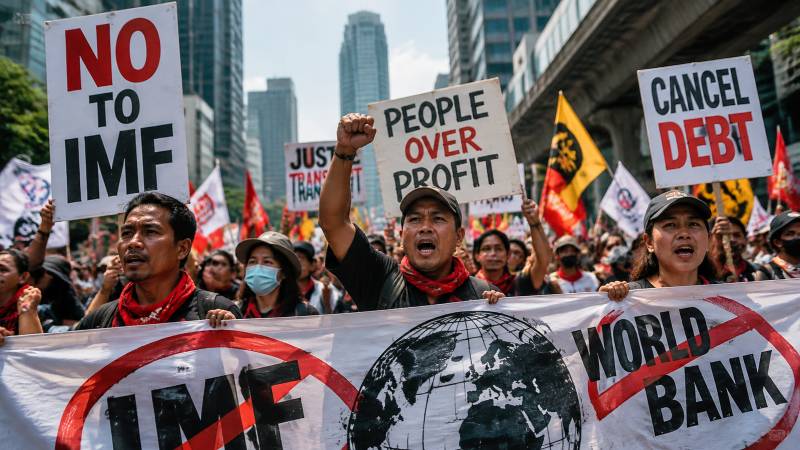
When demonstrators filled the streets of Bangkok on October 16, media coverage focused on clashes with police barricades or echoed official narratives from the International Monetary Fund (IMF) and World Bank (WB) meetings which offered no real solutions to rising debt, geopolitical conflict, or the macroeconomic risks of AI, prescribing instead more spending cuts and deregulation. The narrative overlooked a vital pillar of the protests: organized labour. Over a thousand members of the Thai Labour Solidarity Confederation (TLSC), State Enterprises Workers’ Relations Confederation (SERC), and their global allies marched in Bangkok as part of rallies in over 150 cities across 38 countries in a Global Day of Action vs the IMF and WB.
Multilateral lending frameworks and policy prescriptions strike at the very heart of workers' economic survival. To understand this, one must examine the global debt architecture choking public budgets across the Global South. Developing nations now spend a median of 9.5% of their government revenue strictly on sovereign debt interest payments—a 25-year high that represents more than triple the burden borne by high-income economies. According to UN Trade and Development (UNCTAD) and World Bank data, a record 61 developing countries are forced to allocate at least 10% of their revenues to interest alone, severely constraining budgets.
In 2024, developing nations paid $384 billion in external debt interest. This is part of the total net interest payout across all public debt (domestic and external combined) that reached $921 billion, marking a 10% increase from the prior year. Consequently, roughly 32 low-income countries are currently in debt distress or at high risk of it, trapping between 3.4 and 3.7 billion people in nations that spend far more on foreign interest payouts than on essential public services like healthcare and education. When governments are forced to prioritize interest payouts to foreign creditors over social spending, domestic fiscal space collapses. To avoid default or secure emergency assistance, governments adopt strict fiscal discipline dictated by loan conditionalities—passing the financial burden directly onto working families through reduced public spending, regressive taxation, and structural austerity.
The consequences for public sector workers and essential services are severe - a reality that is well-documented: IMF-mandated public sector wage bill constraints systematically destroy national workforces. By capping government wage bills, these conditionalities force hiring freezes and real-wage cuts. In practice, this starves schools, clinics, and social programs of staff, shifting the unpaid care work onto women and driving essential workers into poverty. When public services are gutted to satisfy foreign interest payments, workers pay twice: first through lower pay and lost jobs, and second through diminished access to the services they rely on to survive.
When public services are gutted to satisfy foreign interest payments, workers pay twice: first through lower pay and lost jobs, and second through diminished access to the services they rely on to survive.
Both the IMF and WB have historically seen labour unions as obstacles to their structural reforms. The World Bank was forced to abandon its annual ‘Doing Business’ report in 2021 following widespread criticism, including for encouraging labour market deregulation and lower labour standards. Yet its replacement, the ‘B Ready’ report continues to promote a race to the bottom in labour standards, rewarding countries that cut workers’ entitlements, pay a minimum wage that is not ‘burdensome’ (read: unlivable) and relieve corporations of obligations to contribute to social protection. Nowhere are these impacts clearer than in the push for privatisation. Both institutions continue to promote privatisation of public services as a way to escape debt. Yet privatisation actively deepens financial crises. Governments sell off public assets for discounted prices and lock in guaranteed payments to the private sector for the delivery of those services creating ‘off book’, long term debts in US dollars.
Energy unions from Indonesia, Pakistan, Bangladesh and Thailand joined protests specifically to expose these risks. In Pakistan, where the IMF demands the total sell-off of remaining public energy systems, privatization has been an unmitigated disaster. Over the past two years, "capacity payments"—fees paid to private companies for unused power generation—accounted for over 60% of payments to energy suppliers. Today, more than half of consumer tariffs are swallowed up paying companies for electricity they never produced. To enforce these IMF directives and make further sales attractive, the Pakistani government has repeatedly cracked down on energy unions, attempting to ban trade union activities, which are protected by the constitution and international law.
Thai unions marched against this same long shadow of IMF-World Bank policy influence. In the wake of the IMF-fueled 1997 Asian Financial Crisis, the government targeted major public sectors including petroleum, postal services, airports,and telecommunications—for structural reform. Energy unions successfully halted the complete privatization of the Electricity Generating Authority of Thailand (EGAT). Yet, decades later, Thai workers still bear the burden of higher Value Added Tax (VAT) rates imposed under those historical loan agreements. Entities like Airports of Thailand and state telecoms were partially privatized. Thai labor unions continue to struggle against ongoing corporatization.
Today, workers recognize that these institutions remain unyielding advocates for big business —a bias expected to continue as International Financial Institutions (IFIs) navigate AI and privilege corporate tech monopolies over workforce displacement. Rather than enforcing austerity, IFIs should be pushed to answer fundamental questions: Why not address inflation by reining in corporate profit margins, or champion global wealth taxes to stop resource hoarding by billionaires? The strong union turnout on October 16 showed the workers’ stance on austerity as an immediate threat to labor rights and collective survival. Until international lenders eliminate predatory debt structures and abandon destructive conditionalities, the voices of organized labor on the streets will only grow louder.