

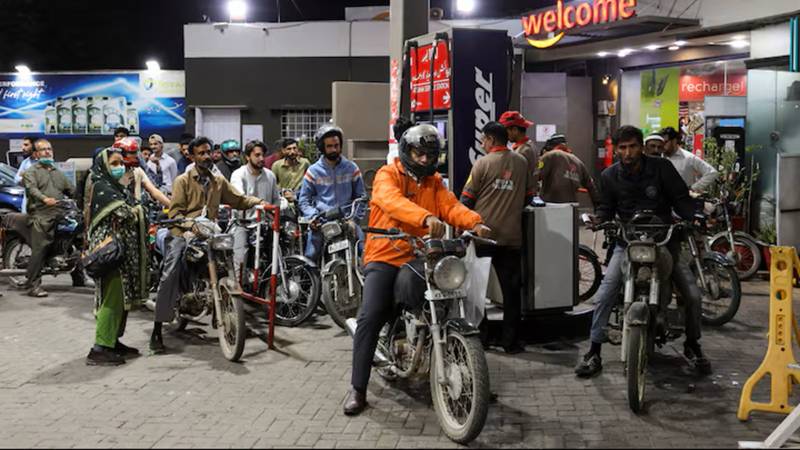
Pakistan's fuel-pricing mechanism now moves almost daily. On 25 September the Oil and Gas Regulatory Authority raised petrol by Rs 2.02 a litre to Rs 391.30, while cutting high-speed diesel by Rs 3.59 to Rs 408.53 — the latest twitch in a month of near-continuous revisions since prices first jumped past Rs 384 a litre in mid-September. The government continues to levy Rs 114 per litre on petrol and Rs 100 on diesel regardless of where the base price lands. Since July, prices have been fixed daily, so movements in global oil markets now reach the pump almost at once.
The government's answer has been austerity plus cash relief, not the deeper shutdown some feared. On 17 September it reintroduced fuel-saving measures: shops, markets and shopping malls must close by 9 pm, wedding halls by 10 pm and restaurants by 11 pm, and fuel for official vehicles is halved for three months. The notification binds Islamabad and federal entities directly; provinces, including Punjab, were asked to consider adopting matching measures. A deeper package, informally called a “petroleum smart lockdown,” was floated the same week — reviving memories of the Covid-19 era, when authorities sealed off targeted areas rather than the whole country. Here the target would be mobility rather than movement itself.
Officials have since downplayed the idea in public, and no four-day work week or blanket market closure has been formally notified; a fabricated notification claiming otherwise, purporting to come from the Cabinet Division, was debunked by the government's own fact-checking unit within a day of circulating online. What has moved instead is the price of relief: on 28 September the petroleum minister said the government was prepared to divert Rs 400–500 billion from its budget to keep the Prime Minister's Fuel Relief Scheme running for up to ten months if prices stay elevated. Punjab, home to more than half of Pakistan's people, will largely decide how far the burden of whatever comes next spreads.
Reports of a meeting chaired by Prime Minister Shehbaz Sharif in mid-September described several proposals: a four-day working week for offices, schools and universities, with Friday to Sunday off; rotating attendance for public employees; grounding roughly half of government vehicles; and three days of market closures. Punjab's education minister has argued that schools should stay out of fuel-saving measures, since most government-school pupils walk to class, and traders' leaders have warned they will resist forced closures. Dawn argued in an editorial that the choice is not between business as usual and a lockdown, and that conservation should be targeted rather than blanket.
Pakistan cannot control the price of oil or the passage of tankers through Hormuz and Bab al-Mandab, but it can control who absorbs the shock
This is a second round. After the US-Iran war began on 28 February and shipping through the Strait of Hormuz was disrupted, Pakistan ordered a four-day week for government employees and a two-week school closure in March. Pump prices peaked on 3 April at Rs 458.41 for petrol and Rs 520.35 for diesel, both well above today's levels. Most of those measures ended on 19 June, though market timings stayed. What is different now is that households have absorbed months of additional inflation on top of that shock, and Houthi attacks on Saudi energy infrastructure and Red Sea shipping have disrupted flows through the Bab al-Mandab Strait — Pakistan's last working alternative to a Hormuz still effectively closed by the Iran-US conflict — pushing global oil prices to their highest since May.
The government's case is that conservation protects supplies and the import bill; a prime ministerial coordinator has said no supply shortage is expected. Because the deeper measures are still only proposals, what follows assesses their likely effects, alongside the rules already in place, rather than counting realised outcomes.
For Punjab's wealthy and senior corporate staff, concentrated in neighbourhoods such as Gulberg and DHA in Lahore, a lockdown would be a logistical inconvenience. Reliable broadband, employers able to offer remote work and financial reserves make working from home easy. Higher incomes absorb costlier fuel, and many such households have rooftop solar, which cushions them against grid electricity costs. Cars shift from daily commutes to leisure use.
Salaried households are hit by friction more than by outright loss. Technology firms and corporates can adopt hybrid models; schools, government offices and retailers cannot as easily. Fitting five days of work or teaching into four lengthens the working day. A 9 pm closing time squeezes evening shopping for families in which both adults work, and cuts trade for the small shopkeepers many of them rely on. Commuters on motorcycles or ride-hailing apps pay more per kilometre. The Prime Minister's Fuel Relief Scheme helps, but only in part: it takes up to Rs 100 off each litre of petrol for owners of eligible motorcycles, rickshaws and vehicles up to 800 cc, and more than 1.75 million people had registered by 19 September. With petrol above Rs 390 per litre, that softens the blow without removing it.
Rickshaw drivers, porters, market labourers, construction workers and shop assistants are paid only when they work, and their work depends on other people moving about and shops staying open. Earlier closing hours cut evening trade. A 10 pm limit and a one-dish rule at weddings could reduce work for caterers, cooks and hall staff. Takeaway and home delivery are exempt from the closing hours, which helps delivery riders, but dearer fuel still cuts their margins. Any extra closure day would mean fewer paid days, with no option to work remotely. Relief on petrol does little for a worker whose income falls because customers stay home. Costlier diesel, which mainly fuels heavy transport, also raises freight costs and, in turn, food prices. Poor households spend a large share of their income on food and have little room to cut back, so the pass-through lands on them directly.
Farmers meet the crisis through inputs rather than office rules. Diesel powers tractors, harvesters and many tubewells, so each price rise adds to irrigation and harvesting costs just as the autumn harvest and the wheat-sowing season approach. As announced, the relief scheme covers petrol only, so diesel users fall outside it. Shorter market hours and slower freight also threaten perishables such as vegetables and milk, which lose value if they miss city wholesale markets (mandis). Producers may be forced to accept lower farm-gate prices even as urban consumers pay more.
Table 1 summarises how the burden would differ. Classes overlap in practice, since many farming and urban households also depend on informal work.
The policy is caught between three goals: cutting oil import costs, protecting daily-wage incomes and sustaining economic growth. Pushing hard on the first strains the other two. A shorter working week lowers fuel use but also lowers commercial activity and, with it, tax receipts. Fuel is itself a major source of revenue, since the government continues to levy Rs 114 per litre on petrol and Rs 100 on diesel, so when consumption falls, part of the state's income falls too. Savings on imports could therefore be partly offset by lost revenue and by the cost of the subsidy scheme itself, and the case for going further would be stronger if the government published how much fuel the March measures actually saved.
If the government goes further, five adjustments would keep demand management from becoming a transfer of hardship to those least able to bear it. It could protect public transport, favouring targeted subsidies for metro bus and rail services in Lahore, Rawalpindi-Islamabad and Multan over broad price relief, so low-income workers can keep commuting. It could keep food and farm logistics moving: the current rules already give fruit and vegetable shops later closing hours, and that treatment could extend to grain markets, mandis and food freight, alongside relief on diesel for smallholders. It could pair curbs with cash, using the Benazir Income Support Programme, the country's main cash-transfer scheme, to compensate daily earners for lost working days. It could stagger rather than shut, rotating shifts for essential retail rather than imposing blanket closures, so energy is saved without ending a day's income. And it could publish the evidence, releasing the fuel savings and income effects from the March measures before repeating or deepening them.
Pakistan cannot control the price of oil or the passage of tankers through Hormuz and Bab al-Mandab. It can control who absorbs the shock. Remote work and shorter weeks offer real relief to the state's energy bill and to insulated urban professionals, but they pass the cost down to commuters, daily earners and farmers. Lasting resilience will come from investment rather than pauses: mass transit, renewable energy and safety nets that reach the poor before the next price spike does. Without them, each oil shock — and there is little sign the current one is the last — will deepen the inequalities it exposes.