


Bukera Sharif in Tando Allahyar district was once the thriving centre of the Suhrawardi silsila. The saints and shrines in Bukera are linked to the Ghausi Jam’at of Shaikh Bahauddin Zakariya (d. 1262) and the Sarwari Jam’at of Makhdoom Nuh Sarwar (d. 1590). The shrines of these Suhrawardi saints remain major sites of veneration for devotees connected to both groups of Sufi saints. Today, most of the shrines in Bukera Sharif belong to the Ghausi Jam’at.
Suhrawardi saints from Bukera Sharif played important roles in spreading the Suhrawardi silsila in Sindh from the 16th to the 20th century. Even today, the descendants of these revered figures continue to wield spiritual and political power in the area. Devotees of the Suhrawardi saints gather at their shrines for annual festivals and other significant occasions.
These Suhrawardi saints can trace their lineage back to Shaikh Bahauddin Zakariya, a renowned Suhrawardi saint of the thirteenth century. The first person to migrate from Multan and settle in Sindh’s Bukera was Pir Syed Fazil Shah Kalan, who came to Bukera in 951 AH/1544 CE. According to Tuhfat ul-Kiram by Mir Ali Sher Qani (1989), Makhdoom Pir Fazil Shah Qureshi was a descendant of Shaikh Bahauddin Zakariya. He was among the earliest members of Shaikh Bahauddin Zakariya's family to preach and settle in Sindh. He had no sons, only daughters. He married one of his daughters to Makhdoom Shaikh Shahrullah Qureshi, a relative.
Syed Ali Kachi's Azkar Qalandari (1914) states that Makhdoom Pir Fazil Shah Qureshi, also known as Makhdoom Fazil Shah Kalan, died on the 12th of January 1569 CE (14th Rajab, 976 AH). He was known for his piety and was buried in an impressive tomb in Bukera Sharif. After his death, his son-in-law, Makhdoom Shahruhllah Shah, became the Gaddi Nahin (custodian) of his dargah (shrine). He was also a learned scholar and saint who significantly spread the Suhrawardiyya silsila in Sindh. Many people became his disciples.
The Arrival of Shaikh Banho
Apart from the Suhrawardi saints belonging to the Qureshi family, a few shrines in Bukera Sharif are associated with non-Qureshi families. One of the earliest Suhrawardi saints to settle in Bukera Sharif was Shaikh Banho, who lived there before the arrival of Makhdoom Pir Fazil Shah Kalan. Not much is known about his life. However, Azkar Qalandari by Syed Ali Kachi (1914) and a few other written sources provide some glimpses into his life. According to these accounts, Shaikh Banho was sent by his spiritual master to settle in what is now Bukera Sharif.
The movement of saints, deputies, and disciples from Multan to places such as Bukera was perhaps not simply a matter of individual spiritual journeys, but part of a wider process to expand the Suhrawardi order
As with many Sufi saints, Shaikh Banho's hagiographical account is interwoven with traditions and miraculous stories. According to Azkar Qalandari, after granting Shaikh Banho khilafat (spiritual authorisation), his spiritual master instructed him to travel to Sindh, where, he was told, their descendants would also settle later. Shaikh Banho asked his master where in Sindh he should go. His master replied that he should continue his journey until he reached a place where he was offered fish (machhi) and barley (jau). Following these instructions, Shaikh Banho set out for Sindh. When he reached Bukera, he was offered fish and barley. Taking this as a sign from his spiritual master, he decided to settle there.
Most hagiographical accounts of mystics are full of stories and miracles of spiritual masters. Before I discuss who Shaikh Banho was, I want to highlight two important points in this story. First, the instruction to Shaikh Banho to go to Sindh, where he would find machhi (fish) and jau (barley), is recorded in Azkar Qalandari by Syed Ali Kachi (1914) and other books, notably Sala Sachai Ja by Hanif Jarwar (2018) and Zikr-e-Ghaus Multani by Muhammad Qasim Rahimoon (2016). The same story is also prevalent among the devotees and local community.
Why did the spiritual master say to settle where one finds machhi and jau? Did this food reflect the simple foods with which faqirs could sustain themselves, or was it something else? One can look at this story from both angles. From the simplicity that Sufis adopted or promoted, but at the same time, one cannot rule out the other angle or perspective of many Sufis enjoying power, wealth, and gifts from landed elites or rulers.
The reference to fish and barley may point to the prosperity and abundance of Bukera and the surrounding region at the time. It is difficult to imagine that, during his long journey from Multan to Bukera, Shaikh Banho did not encounter fish and barley anywhere else along the way. The mention of these two foods, therefore, may have carried a deeper symbolic meaning rather than merely marking a particular place. Fish and barley may have represented abundance, agricultural productivity, and the region's economic prosperity.
The story can also be viewed from a broader historical perspective. Why was Bukera chosen as the place for Shaikh Banho to settle? Was it because of its strategic location on routes connecting Multan, an important centre of the Suhrawardi tradition, with Sindh and other regions? Or was the establishment of a Suhrawardi presence there also intended to extend the influence of the order in an area where other Sufi traditions and religious groups were already active? Such possibilities need to be considered when interpreting these hagiographical stories and local traditions. Beneath their miraculous and symbolic elements, they may preserve fragments of a more complex history of mobility, settlement, competition, and interaction among the religious groups that were active in medieval Sindh. These missing links need to be explored to better understand the region's religious dynamics.
The Movement of the Saints
The second point concerns the descendants of Shaikh Bahauddin Zakariya who later came to Bukera. Following Shaikh Banho's settlement there, sources mention the arrival of Makhdoom Pir Fazil Shah Kalan from Multan, who also made Bukera his home. However, the chronology of these two figures is difficult to establish with certainty. Did Makhdoom Pir Fazil Shah Kalan arrive soon after Shaikh Banho, or was there a considerable gap between their settlements in Bukera? This question is important for understanding the wider movement of Suhrawardi saints and their descendants from Multan to different parts of Sindh and beyond. Establishing a clearer timeline may also help us understand whether their movement occurred gradually over generations or formed part of a broader process through which Suhrawardi networks expanded into new regions.
I read this as part of a broader strategy adopted by spiritual masters to expand their religious and social networks. Disciples and deputies were often sent to settle in prosperous villages and towns, particularly at places located along important routes, where they could preach, attract new followers, establish centres of spiritual authority, and extend the influence of their Sufi order. Their presence in such places may also have enabled them to establish a foothold in areas where mystics belonging to other Sufi traditions were already active.
Bukera may have occupied such an important position in medieval Sindh. Its location and apparent prosperity could have made it a suitable place for Shaikh Banho to settle and establish a Suhrawardi presence. The later arrival of Makhdoom Pir Fazil Shah Kalan in Bukera in 951 AH/1544 CE further suggests the growing importance of the settlement within the Suhrawardi network. Seen from this perspective, the movement of saints, deputies, and disciples from Multan to places such as Bukera was perhaps not simply a matter of individual spiritual journeys. It may also have been part of a wider process through which the Suhrawardi order expanded its network, established new centres of influence, and connected Multan with religious communities in different parts of Sindh.
The Identity of Shaikh Banho
Shaikh Banho was Hindu and was converted by a custodian of the shrine of Shaikh Bahauddin Zakariya. It is believed that he was from the Bhati caste. He hailed from Rajasthan. It is not known which part of Rajasthan he was from. According to Muhammad Qasim Rahimoon (2016), Makhdoom Lutfullah Dars alias Shaikh Banho was one of the prominent deputies of Hazrat Ghaus al-Alamin (Shaikh Bahauddin Zakariya).
No one knows Shaikh Banho's Hindu name. One does not even know what new name was given to him after becoming Muslim. Was Shaikh Banho the new name given by the spiritual master? Muhammad Ashraf Dars writes in Sala Sachai Ja by Hanif Jarwar (2018) that according to unverified sources, his name was Lutfullah. He believes that he travelled with a caravan to Multan. According to one account, on his way to Multan, Shaikh Banho was sold seven times, and it was his spiritual master who eventually gave him the name Banho.
This detail, however, is difficult to verify from independent historical sources. It comes from Azkar Qalandari, a work written largely from the perspective of a devotee rather than that of a critical historian. The story therefore raises an interesting question: was he actually sold as a slave and consequently came to be known as Banho, a name carrying the connotation of a slave or servant, or was Banho a new name bestowed upon him by his spiritual master? In the absence of corroborating evidence, it is difficult to reach a firm conclusion.
The story may perhaps be better understood within the context of the murshid-murid relationship in Sufi traditions. Disciples frequently describe themselves as the slaves or servants of their spiritual masters as an expression of humility, devotion, and complete submission. Such language does not necessarily imply actual enslavement. Seen from this perspective, the story that Shaikh Banho was repeatedly sold as a slave on his journey to Multan and was later given a name carrying a similar connotation may have acquired a more literal form in later hagiographical tradition.
Another possibility is that, after his conversion, Shaikh Banho spent some time serving at the shrine of Shaikh Bahauddin Zakariya in Multan and may also have received religious education in institutions associated with the Suhrawardiyya silsila. His service and devotion to the spiritual master may have contributed to his becoming known as Banho.
Much, however, remains uncertain. It is not known which sajjada nashin of the shrine of Shaikh Bahauddin Zakariya granted him khilafat (spiritual authorisation). If the chronology associated with his arrival in Sindh is considered, one possibility is that he received initiation and spiritual authorisation from Shaikh Bahauddin Thani (d. 951/952 AH; 1545/1546 CE). This identification, however, remains tentative and requires further historical evidence.
The descendants of Shaikh Banho are called Banhepota Dars, who live in Ghulam Dars village near Bukera. Some descendants of Shaikh Banho are also believed to live in Rajasthan.
The Shrine Today
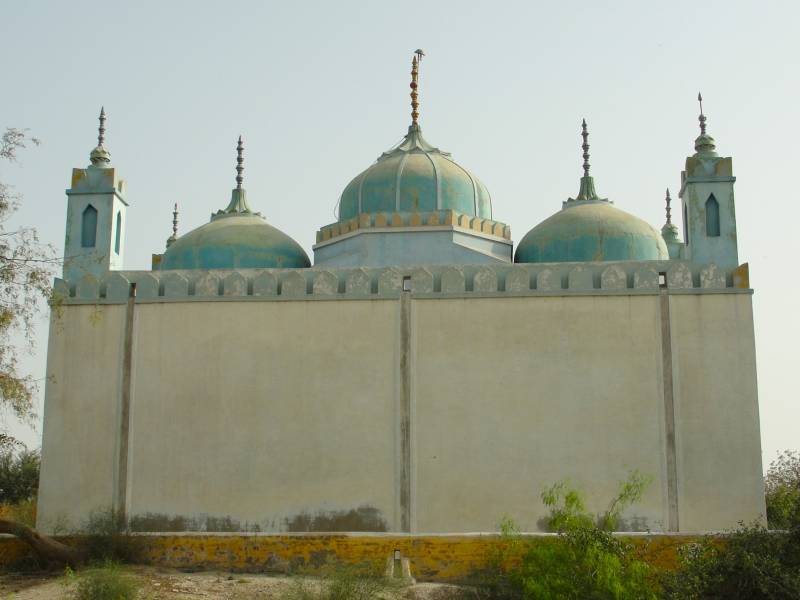
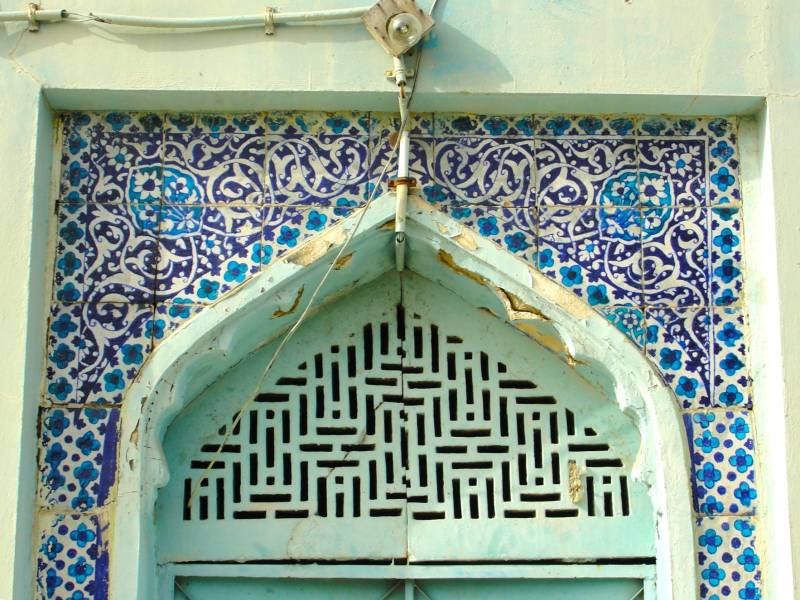
The tomb of Shaikh Banho is located north of Bukera Sharif and is noted for its distinctive architecture. It is a rectangular tomb spanned with three domes. Such a three-domed tomb is rare. These domes were damaged in the 2024 rains and were later restored. The tomb is believed to date to the seventeenth or eighteenth century. It was also renovated several times.
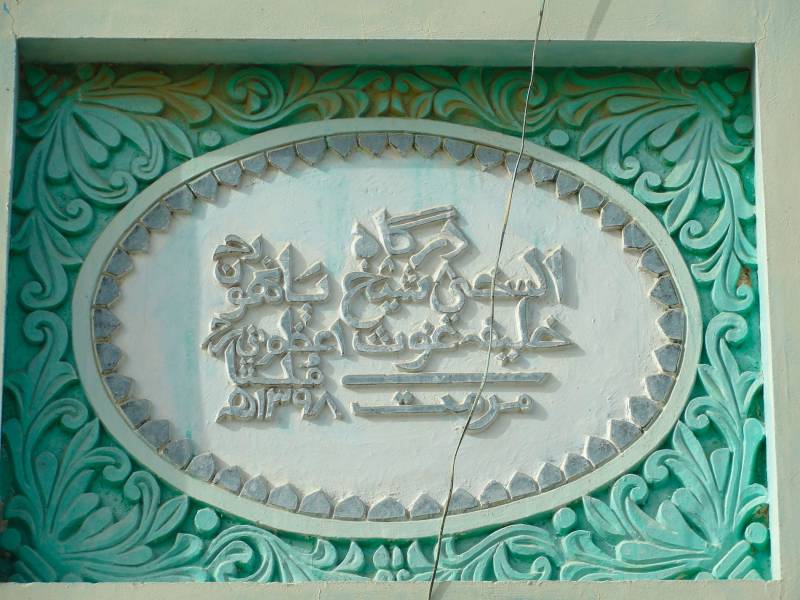
The facade also shows that it was renovated in 1398 AH/1978 CE. This inscription states that Sakhi Shaikh Banho was the deputy (Khalifa) of Ghaus-e-Azam Multani, referring to Shaikh Bahauddin Zakariya, a claim that is disputed. As I stated above, he was more likely a deputy of Shaikh Bahauddin Thani than Shaikh Bahauddin Zakariya.
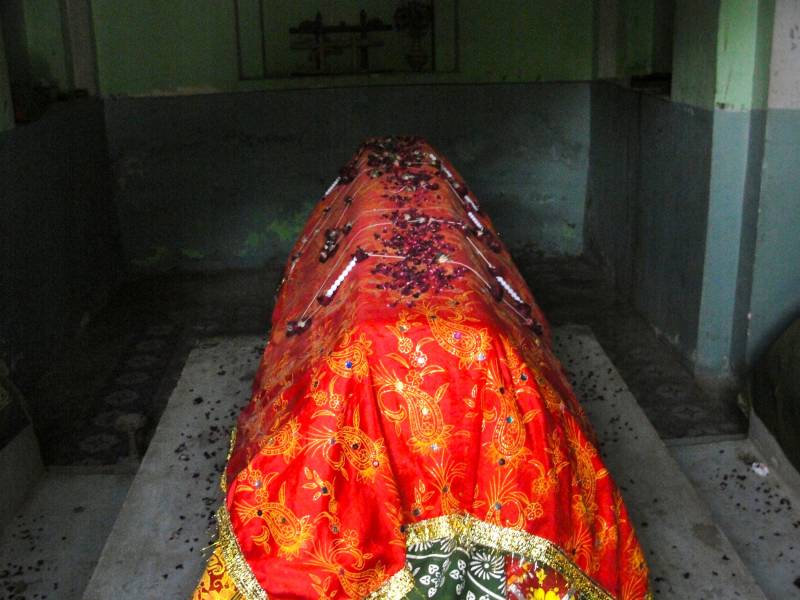
The tomb contains the graves of Shaikh Banho, his family, and custodians. The Kachi Memons venerate him more than any other community.